Support

Cloud Gate

About

Cloud Gate is one of the most iconic and photographed landmarks in Chicago, located in the heart of the city at AT&T Plaza in Millennium Park. Created by British artist Anish Kapoor, this monumental sculpture is one of the world's largest outdoor public art pieces. Its unofficial but highly popular nickname—"The Bean"—comes from its unique shape, which resembles a giant legume or a drop of liquid mercury.
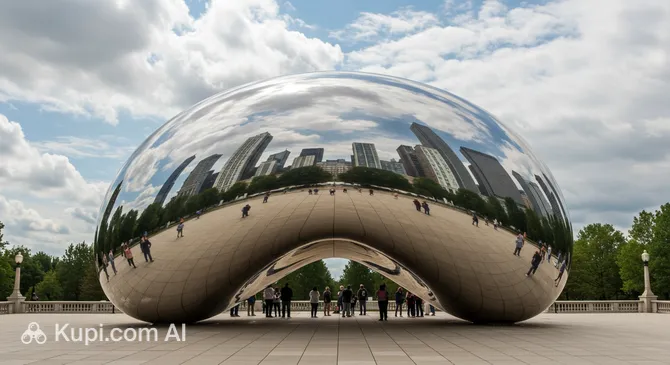
Cloud Gate. Illustration.
Source: Kupi.com AI

Traveler photos:

The sculpture is made of 168 highly polished stainless steel plates, welded together so skillfully that there are no visible seams on the surface. This creates the effect of a single mirror-like object that reflects and whimsically distorts the famous USA skyline and the passing clouds. It was this ability to reflect the sky that inspired the artist's official name—"Cloud Gate." The surface practically begs visitors to touch it and watch their own reflections.

The dimensions of "The Bean" are impressive: it stands 10 meters (33 feet) high, 20 meters (66 feet) long, and 13 meters (42 feet) wide, weighing approximately 100 tons. Visitors are free to walk around the sculpture and even pass under its 3.7-meter (12-foot) central arch. Looking up from under the arch reveals the "omphalos" (Greek for "navel"), a concave chamber that creates a kaleidoscope of multiplied and distorted reflections. Due to its uniqueness and photogenic nature, Cloud Gate has become a true symbol of modern Chicago and a must-see on every tourist's itinerary.

Contacts

Cloud Gate is a public outdoor art installation located in Millennium Park, so the sculpture itself does not have a separate phone number or email address. Access is available during the park's operating hours. For the latest information regarding visiting times, park rules, or upcoming events, it is recommended to check the official websites of the City of Chicago or Millennium Park.

How to contactContact
Address201 E Randolph St, Chicago, IL 60602, USA
Websitewww.chicago.gov

What to Do

The main activity at Cloud Gate is, of course, playing with reflections. Visitors can walk freely around the giant sculpture and step under its impressive 3.7-meter-high arch. Thanks to its perfectly smooth mirror surface, "The Bean" creates unique and often funny distortions of people, the famous Chicago skyscrapers, and the clouds drifting across the sky. This makes it one of the most popular spots in the world for creative photography and selfies.

A special experience awaits those who decide to look under the sculpture's canopy. On its underside is a concave chamber known as the omphalos, which is Greek for "navel." Here, reflections begin to multiply, layer upon each other, and whimsically deform, creating a truly mesmerizing visual effect. It’s like looking into a kaleidoscope where you and the city around you become the main elements of a constantly changing pattern.

Beyond interacting with the art piece itself, Cloud Gate serves as a hub for tourists and locals. The sculpture is located in the lively Millennium Park, which regularly hosts concerts, festivals, and other cultural events. It is a great place to simply sit down, relax, watch urban life unfold, and enjoy the unique atmosphere of one of the most dynamic cities in the USA.

Getting There

The Cloud Gate sculpture is located in the very heart of Chicago, within Millennium Park at AT&T Plaza. Thanks to its prime location, it is very easy to reach. If you are in the downtown area, you can walk to the park in just a few minutes by heading along the famous Michigan Avenue towards Lake Michigan.

For those who prefer public transportation, there are several convenient options near Millennium Park. The nearest "L" stations are Washington/Wabash (served by the Brown, Green, Orange, Pink, and Purple lines) and Randolph/Wabash. From both stations, it is only a couple of minutes' walk to the park entrance. Additionally, numerous city buses stop in the immediate vicinity of the park, making it accessible from almost any part of the city.

If you are traveling by car, there are large parking garages located near Millennium Park; however, keep in mind that parking in downtown Chicago can be expensive. Of course, you can always use a taxi or rideshare service to be dropped off comfortably right at the park entrance. Entry to Millennium Park is free, and the sculpture is clearly visible from various parts of the park, so you definitely won't miss it.

Nearest city: Chicago

History & Facts

The history of Cloud Gate is closely tied to the name of the British artist and sculptor Anish Kapoor. His design was selected in a competition held to decorate the new Millennium Park. The inspiration for its unusual, fluid form was liquid mercury, captured a moment before a drop falls. Work on this ambitious project took place between 2004 and 2006, with the official unveiling on May 15, 2006. Although the sculpture was presented to the public in 2004 during the park's opening, additional time was needed to polish its surface to perfection and hide all the seams.

Despite its official name, "Cloud Gate," which refers to its ability to reflect the sky, locals quickly dubbed it "The Bean." Initially, Anish Kapoor was not thrilled with the nickname, but over time he embraced it, recognizing that it was a sign of the public's love and the popularity of his creation. This playful name has become an integral part of the sculpture's identity and is now used just as often as the official one.

Since its appearance, Cloud Gate has rapidly become one of Chicago's top tourist attractions and a true symbol of the city. This art piece is considered one of the most photographed objects in the world due to its unique ability to distort and multiply the reflections of the surrounding skyscrapers, the sky, and the visitors themselves. The sculpture has become more than just a park ornament; it is a major cultural phenomenon symbolizing the innovation and openness of one of the largest cities in the USA.

Time Needed

When planning a visit to Cloud Gate, consider how much time you want to dedicate to the site. For a quick look at the famous sculpture, 30–60 minutes is generally sufficient. This is enough time to walk all the way around "The Bean," take some creative photos with the distorted reflections of Chicago's skyscrapers, and, of course, step under its impressive arch to see the kaleidoscope of reflections.

If you want to do more than just see the sculpture and fully soak in the atmosphere, it is better to budget about 1.5–2 hours. This allows for a leisurely stroll through Millennium Park, where Cloud Gate is located, time to relax on a bench while enjoying the views, and perhaps catch one of the many events often held nearby. Thus, visiting this attraction can easily fit into a quick dash through the city center or a longer walk through one of the most famous parks in the USA.

Working Hours

The Cloud Gate sculpture is part of the public space of Millennium Park, so access is free and does not require advance booking or tickets. The attraction is open to visitors year-round. Technically, "The Bean" is accessible 24/7 since it is in an open area. However, visiting it depends directly on the operating hours of Millennium Park itself, which is usually open to visitors daily from 6:00 AM to 11:00 PM.

It is important to remember that park management may temporarily close the area at night for maintenance or during special events. Therefore, if you plan to visit late at night, it is highly recommended to check the current operating hours on the official Millennium Park or City of Chicago websites in advance. This will help you avoid any surprises and plan your introduction to one of the greatest icons of the USA.

6:00 – 23:00

Nearby

A visit to Cloud Gate is just the beginning of your introduction to downtown Chicago. The sculpture is situated in the heart of the city's cultural life, and its surroundings are packed with other iconic landmarks just a short walk away. Exploring the neighborhood will allow you to dive deeper into the atmosphere of this amazing metropolis and make your trip even more memorable.

Checking out nearby attractions will not only save you time but also help you form a complete picture of Chicago's character. From world-renowned museums and parks to architectural masterpieces—everything is within walking distance. Below is a list of interesting places you can visit near "The Bean."

NameDistance
The Art Institute of Chicago0.3 km
The Chicago Theatre0.5 km
Medieval Torture Museum0.5 km
Shedd Aquarium1.8 km
Navy Pier1.8 km
360 Chicago1.8 km
Field Museum1.9 km

Have you reached the end of the page?

So the route has been studied inside and out