Support

National Mississippi River Museum & Aquarium

About

Imagine a place where the history of the continent's greatest waterway meets the vibrant world of its inhabitants. The National Mississippi River Museum & Aquarium is a unique cultural and scientific complex located in the city of Dubuque, USA. Combining the functions of a traditional museum, a modern aquarium, and an educational center under one roof, it is rightfully considered one of Iowa's top attractions.
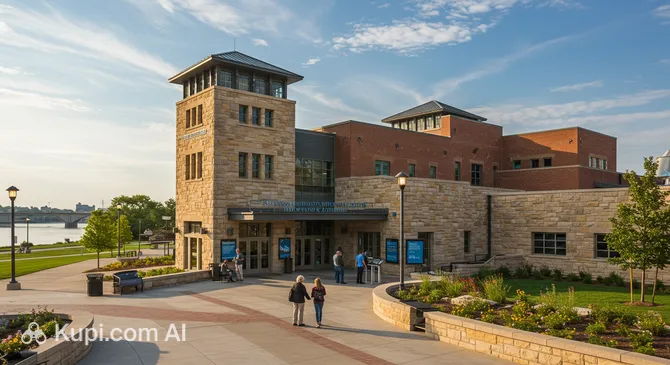
National Mississippi River Museum & Aquarium. Source: Kupi.com AI

The complex is dedicated not only to the natural wealth of the Mississippi River but also to its immense influence on the culture and economy of all of North America. The exhibits cover a wide range of topics: from ancient geology and the lives of Native American tribes to the era of mighty steamboats and modern environmental challenges. It is a dynamic space where dry facts come to life through multimedia technologies and authentic artifacts.

Occupying a significant area on the riverbank, the museum includes several pavilions with live aquariums, reconstructions of historical vessels, and scientific laboratories. Through its affiliation with the Smithsonian Institution, the complex offers guests world-class exhibitions, emphasizing the importance of preserving river ecosystems for future generations.

Contacts

For more information before your visit, you can use the institution's official contact details:

Address: 350 E 3rd St, Dubuque, IA 52001, USA
Phone: +1 563-557-9545
Website: rivermuseum.org
Google Maps: View on map

What to Do

At this museum, it is impossible to remain just a passive observer. Visitors are invited to literally dive into the underwater world by walking through glass aquarium tunnels. Here, you can come face-to-face with sharks, observe graceful otters, funny penguins, and a vast variety of fish that inhabit the Mississippi basin. The alligator and jellyfish zones are particularly interesting, showcasing the amazing diversity of nature.

For those interested in technology and history, the decks of full-sized riverboats and barges are open. You can try your hand at being a captain on a special simulator or explore the inner workings of an old steamboat. Children will love the hands-on activity areas where they can participate in animal feedings, conduct simple science experiments, or play in themed areas.

During the summer months, you can enhance your experience with a boat trip: the museum organizes excursions on the Mississippi itself. Guides talk about the local flora and fauna, allowing you to see the river as the early pioneers once did. Additionally, there is an on-site cinema showing exciting nature documentaries, and seasonal festivals introduce guests to river fishing traditions and folklore.

Getting There

Finding this unique complex is easy, as it is located at 350 E 3rd St, right on the scenic riverbank in the heart of the city. If you are traveling by car, the most convenient way to get here is via US-61 or IA-1. Free parking is available on-site for visitors, making logistics much simpler.

For those arriving via Dubuque Regional Airport (DBQ), it takes about 20–30 minutes to reach the museum by taxi or rental car. The route passes through city neighborhoods, allowing you to immediately appreciate the atmosphere of a river town.

Within the city itself, you can use public transportation—the Jule bus system has stops within walking distance of the complex. If you are staying in the historic center, a pleasant walk to the museum will take no more than 10–15 minutes. During the summer season, you can also arrive by one of the river cruises that dock directly next to the exhibits.

History & Facts

The history of this site began on July 18, 1982, when it opened as the Fred W. Woodward Riverboat Museum. The institution was named after a local benefactor who was passionate about preserving the rich heritage of navigation on the Mississippi. In those years, the primary focus was exclusively on the history of steamboats and their role in the development of American lands.

Over time, the modest museum grew beyond its original scope. In the early 2000s, the complex underwent a large-scale renovation and expansion, transforming into a modern science and education center. High-tech aquariums and interactive zones were added to the historical artifacts, allowing culture and ecology to be merged into a single whole.

The museum's exhibits deeply explore the role of the great river in shaping the modern Midwest. They tell stories not only of the 19th-century golden age of steamboats but also of the lives of indigenous peoples and the first European settlers. The affiliation with the Mississippi River Institute emphasizes the museum's important scientific mission—preserving a unique ecosystem for future generations.

Time Needed

To explore both parts of the complex—the historical museum and the aquarium—without rushing, it is recommended that the average visitor set aside at least 3–4 hours. This is enough time to study the main exhibits, walk the decks of historic vessels, and watch the aquarium inhabitants being fed.

If you are traveling with children, it is better to plan for a 5-hour visit or even a whole day. Numerous interactive zones and the chance to participate in science experiments usually captivate young explorers for a long time, and watching a film at the local cinema is a great way to round off the day.

Working Hours

The National Mississippi River Museum & Aquarium is open to visitors daily, making it easy to include in any travel schedule. The doors of the complex are open from 9:00 AM to 5:00 PM, Monday through Sunday.

Please note that the schedule may change slightly on holidays or during special events, so it is recommended to check the official website for up-to-date information before your visit.

Nearby

The museum's location on the riverbank makes it an excellent starting point for further exploration of the area. Exploring the adjacent streets and parks will help you feel the spirit of the old river port and enjoy the city's architectural diversity.

In the immediate vicinity, you will find both historical buildings and modern entertainment centers, allowing you to create a full itinerary for the entire day.

Name Distance (km)
The Frentress Cabin 0.1
Hotel 0.4
Five Flags Center 0.4
Dubuque Shot Tower 0.7
Andrew-Ryan House 1.2
Gramercy Park 1.4
Langworthy House 1.5
Upper Iowa Street Historic District 1.6
Dubuque Town Clock 1.9
Chaplain Schmitt Island 2.5

Reached the end of the page?

That means the route is fully explored