Support

Tule Springs Fossil Beds National Monument

About

Imagine a place where, beneath layers of desert dust, lie the traces of creatures that ruled the world during the Ice Age. Tule Springs Fossil Beds National Monument is a unique natural and historical site in Las Vegas that transports visitors tens of thousands of years back in time. Unlike the noisy casinos, this area of over 22,000 acres offers silence and the chance to touch the authentic mysteries of paleontology in the northern USA.
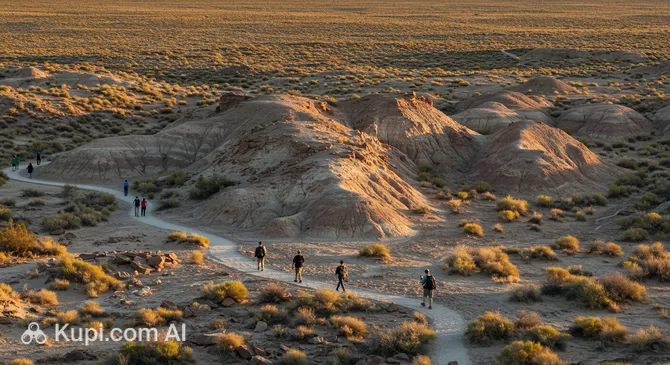
Tule Springs Fossil Beds National Monument. Source: Kupi.com AI

It is the only national monument in the country entirely dedicated to the preservation and study of finds from the Pleistocene epoch. Remains of truly legendary animals have been discovered here: herds of Columbian mammoths with incredibly long tusks, American lions weighing nearly half a ton, and even giant ground sloths the size of a modern car. Once, this dry landscape was a blooming oasis with deep lakes that attracted prehistoric giants.

Today, the parched valley of the Upper Las Vegas Wash holds thousands of fossils within thick layers of sedimentary rock. Visitors can see the sites of famous excavations and feel the scale of the ancient ecosystem. This is not just an open-air museum, but a living scientific laboratory where discoveries continue to this day, helping scientists better understand climate change and the extinction history of the great megafauna.

Contacts

To check for the latest information on events and visiting rules, you can use the official communication channels. Please note that infrastructure within the monument itself is minimal.

Address Las Vegas, NV 89124, USA
Phone +1 702-293-8853
Website www.nps.gov/tusk/
Social Media Official NPS pages on Facebook, Instagram, and Twitter

What to Do

The main activity at Tule Springs is immersing yourself in the prehistoric past through walks along wild trails. You can explore the area on your own, following temporary routes that lead to the site of the legendary "Big Dig". Watch your step: fragments of mammoth bones or tusks washed out of ancient sediments by rain sometimes appear on the ground's surface.

For those who want to learn more about the science, special ranger-led programs are held. This is a great chance to hear fascinating stories about how giant camels and saber-toothed cats lived and why they disappeared. It is crucial to remember the strictest rule: if you spot a fossil, it is strictly forbidden to take it with you—federal law requires you to leave the find in place, take a photo of it, and notify park staff.

Nature lovers will appreciate this site as an excellent location for hiking and landscape photography. There is no typical city bustle or modern infrastructure here, creating a sense of pristine desert. For families with children, a walk across these lands will be a hands-on Earth history lesson, where the imagination easily fills in the images of majestic mammoths against the backdrop of modern Nevada mountains.

Getting There

Getting to this treasure trove of the past is quite easy, as it is located less than 20 miles north of the famous Las Vegas Strip. If you are driving, take I-15 North and then transition to US-95 North until the exit near the Upper Las Vegas Wash. The trip from the city center usually takes about 20–30 minutes.

It is important to note that there is no public transportation to this location. The best option is a private car or a taxi. Parking is limited and consists of small lots near the trailheads. Since the territory is considered wild and has no entrance gates, access is free.

Before your trip, be sure to check the weather forecast and bring plenty of water, as it can be extremely hot in this part of the desert, and there is almost no shade. Look for signs for BLM national lands or the National Park Service.

History & Facts

The history of this site dates back to the Pleistocene epoch, more than half a million years ago. In those days, the territory of the modern monument was not an arid desert at all, but a lush green oasis with vibrant vegetation and abundant springs. This moisture attracted the legendary megafauna: massive mammoths, fierce American lions, and giant ground sloths, which lived and died here over millennia.

Scientific recognition came to Tule Springs in the 1960s with the famous expedition known as the "Big Dig." Scientists from several major universities and museums dug massive trenches up to 13 meters deep to study the soil layers. Thousands of bones were discovered during these works, allowing for a detailed reconstruction of the ancient ecosystem. Interestingly, the first humans—ancestors of the Paiute tribe—appeared in these parts about 1,000 years ago, when the springs had already begun to dry up, but the remains of extinct animals were already safely hidden beneath layers of sedimentary rock by then.

For decades, local residents and enthusiasts fought to preserve this unique territory, fearing urban development. Their efforts were successful in December 2014, when Tule Springs officially received National Monument status by presidential proclamation. Today, this site is protected by the National Park Service and continues to serve as a critical site for paleontological research on a global scale.

Time Needed

For a standard introduction to the monument, 2–4 hours is sufficient for most visitors. This is enough time to leisurely walk the main trails, see the "Big Dig" historical excavation site, and enjoy the desert landscapes while imagining the mammoths that once roamed here.

If you plan to participate in ranger programs, enjoy long hikes, or are a professional photographer, you should set aside half a day for your visit. Keep in mind that the lack of developed infrastructure and shade often causes tourists to move a bit slower, so it is always better to have a time buffer before the peak heat sets in.

Working Hours

The territory of Tule Springs Fossil Beds National Monument is open to the public 24 hours a day, 7 days a week. Since this is an open natural area without gates or ticket booths, you can visit at any time that suits you. However, the safest and most comfortable time for walking the trails is during daylight hours.

Keep in mind that ranger programs and special events are held on a schedule that may change. Occasionally, access to certain areas may be temporarily restricted due to scientific work. Before your visit, it is highly recommended to check the current status of the park on the official website of the National Park Service.

Nearby

A visit to the paleontological monument can be perfectly combined with other entertainment in the surrounding area. Since Tule Springs is located very close to the northern districts of the metropolis, you will easily find places for active family recreation or extreme adventures.

Below are interesting locations situated near the protected area:

Attraction Distance (km)
UPTOWN JUNGLE FUN PARK | Las Vegas, NV 14.9
Spy Ninjas HQ 21.3
SAW Escape Room 23.4
The Adventuredome Indoor Theme Park 24.2
Cowabunga Canyon Waterpark 30.7
Sky Zone Trampoline Park 32.5
Cowabunga Bay Water Park 37
UPTOWN JUNGLE FUN PARK | Henderson, NV 39.8
Dig This - Las Vegas 44
Speed Vegas - Drive Supercars, Go-Karts, and Off-Road 45.5

Reached the end of the page?

That means the route is fully explored