Support

Centennial Land Run Monument

About

Imagine a moment of chaos and hope frozen in bronze — this is the Centennial Land Run Monument. Located in the vibrant district of Oklahoma City, it is one of the largest sculptural installations in the world. It commemorates the legendary Land Run of 1889, when thousands of people rushed at once to settle new territories in the USA.
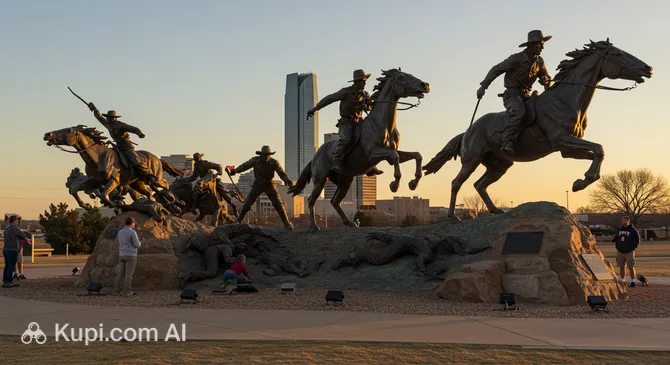
Centennial Land Run Monument. Source: Kupi.com AI

Sculptor Paul Moore's monumental creation stretches over 100 meters long, comparable to the size of a football field. A group of 45 bronze figures, cast at one-and-a-half times life size, depicts riders, heavy wagons, running settlers, and even dogs. Every detail conveys the incredible tension and energy of the pioneers striving to claim their piece of land.

This monument is not just a historical marker, but a true open-air museum in the heart of the Bricktown district. Work on the composition spanned more than two decades, and today it serves as a powerful reminder of the spirit of adventure and determination that shaped the state of Oklahoma.

Contacts

For further details before your visit or to organize group tours of the Bricktown area, you can use the official contact information.

Address 200 Centennial Ave, Oklahoma City, OK 73102, USA
Phone +1 405-297-8912
Website visitokc.com

What to Do

The main reason tourists come here is the opportunity to literally walk through history. You can wander freely among the massive figures, admiring the masterfully crafted details: from the frightened eyes of the horses to the household items in the wagons. This spot in Oklahoma City is considered one of the best locations for dynamic photography, especially during the golden hours of sunset.

Be sure to take the time to read the informational plaques placed along the monument. They contain transcriptions of historical descriptions that help you understand what the "boomers" and cavalry felt at the moment of the start. This turns a simple stroll into an educational open-air history lesson that will be interesting for both adults and children.

A visit to the monument is perfectly complemented by a stroll along the Bricktown canals. In summer, you can watch the city life here, and in the evening, enjoy the artistic lighting of the sculptures. After exploring the monument, it's pleasant to stop by one of the many restaurants or bars within walking distance to discuss what you've seen in a cozy atmosphere.

Getting There

The monument is conveniently located in the lively Bricktown district at 200 Centennial Ave. If you are staying downtown, a walk from the Convention Center or Myriad Gardens will take only 10–15 minutes. The area is very pedestrian and cyclist-friendly, with well-maintained paths along the canal.

For those who prefer public transportation, a great option is the modern MAPS 3 streetcar or OKC city buses, with stops located within a few minutes' walk of the attraction. If you are coming from Will Rogers World Airport, a ride by taxi or Uber/Lyft services will take about 20–30 minutes via the I-44 highway.

For travelers by car, there are several parking zones and covered Bricktown garages in the vicinity. For precise route planning, it is recommended to use navigation apps, targeting the coordinates 35.4611333° N, 97.5051775° W.

History & Facts

The famous Land Run of 1889 began exactly at noon on April 22. By proclamation of President Benjamin Harrison, about 2 million acres of "unassigned lands" in the center of what is now the state of Oklahoma were opened for settlement. More than 50,000 people in the USA rushed out in search of a new life, using horses, wagons, and even trains to stake their claim to a 160-acre plot.

The signal for the start of this grand chaos was the firing of cannons and the sounding of army bugles. Remarkably, by the evening of the same day, entire tent cities had sprung up on the desert territories, marking the beginning of a modern metropolis. This moment is considered the starting point in the history of the region, when the courage and perseverance of pioneers laid the foundation for the future 46th state.

Sculptor Paul Moore worked on creating this monument for over 20 years, turning it into a true family project. Every detail—from the tension in the horses' muscles to the wind-blown clothing of the settlers—is intended to convey the frantic energy of that day. The composition honors the contribution of farmers, cowboys, and former soldiers to the settlement of the American West.

Time Needed

To leisurely walk around the entire exhibit, examine the details of each of the 45 figures, and read the info plaques, most visitors need about 30 to 45 minutes. This is enough time to take high-quality photos and feel the scale of the historical event.

If you plan to combine the monument viewing with a stroll along the Bricktown canals, visiting local cafes, or taking a water taxi ride, you should allow 1–2 hours for this area. An evening visit may also take a bit longer due to the striking lighting, which invites longer contemplation.

Working Hours

One of the main advantages of this attraction is its accessibility. The monument is open to the public 24/7, any day of the week, including weekends and holidays. You can come here early in the morning to avoid the crowds or drop by late at night when the sculptures take on a special look in the glow of city lights.

Nearby

The area surrounding the monument offers many leisure opportunities, especially if you are traveling with family. A walk around the neighborhood will reveal great playgrounds and amusement parks within a few kilometers.

Exploring nearby sites will help make your day in the city more fulfilling and interesting, combining historical excursions with active outdoor recreation.

Attraction Distance (km)
Wiley Post Sprayground 2
Schilling Park Sprayground 2.3
McKinley Park Sprayground 3.6
Lost Lakes Adventure Park 5.6
Memorial Park Sprayground 5.6
Wake Zone Cable Park 5.7
Hurricane Harbor Oklahoma City 7.5
Altitude 1291 8.2
Celebration Station 8.4
Sellers Park Sprayground 9.9

Reached the end of the page?

That means the route is fully explored