Support

Philadelphia International Airport

Airports in the city

About the Airport

Welcome to Philadelphia International Airport (PHL) — the main aerial gateway to one of the most historically significant cities in the USA. As a major hub for American Airlines, this airport handles hundreds of flights daily, connecting Philadelphia with over 130 destinations worldwide. It is not merely a transit hub, but a modern and dynamic complex ready to offer travellers comfort and quality service from their very first minutes in the city.
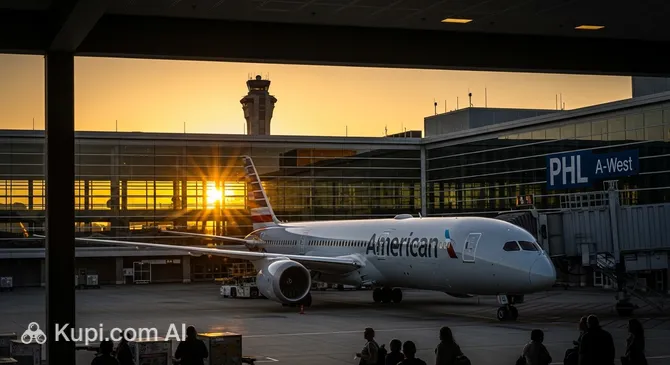
Philadelphia International Airport. Source: Kupi.com Binoculars
IATA Code PHL
ICAO Code KPHL
City Philadelphia
Distance to Centre approx. 11 km
Status International
Annual Passengers approx. 28.1 million (2023)
Popular Airlines American Airlines, Frontier Airlines, Spirit Airlines
Schedule Online Board "Philadelphia International Airport"

Philadelphia International Airport is distinguished by convenient and clear navigation across its seven terminals. It plays a key role not only in the region's transport system but also in its economy. For passenger convenience, there is a wide selection of cafes and restaurants featuring both local cuisine and popular international snacks, as well as numerous shops for browsing while waiting for a flight. The airport offers various options for reaching the city centre: from trains and buses to taxis, making the journey quick and comfortable.

One of the airport's strengths is its status as a major hub for American Airlines and an operational base for Frontier Airlines, ensuring a high frequency of flights and competitive ticket prices. The airport is constantly being modernised to meet high service standards. For travellers who value enhanced comfort, VIP services are available, including expedited formalities and luggage assistance. Thanks to this, Philadelphia International Airport leaves a pleasant impression and serves as a convenient starting point for exploring the city and its surroundings.

Contact Information

Below is the essential contact information for passengers departing from, arriving at, or transiting through Philadelphia International Airport (PHL).

  • Official Website: The most up-to-date information on flights, services, and airport regulations can always be found on the official website: www.phl.org.
  • Information Desk Phone: For general enquiries, you may call +1 215-937-6937.
  • Address: 8000 Essington Avenue, Philadelphia, PA 19153, USA.
  • Email: For general queries, it is recommended to use the contact forms available on the airport's official website.
  • Social Media: Follow airport news and updates on official pages on popular social networks such as X (formerly Twitter) and Facebook.
  • Lost and Found: If your belongings were lost in the terminal or on airport grounds, please contact the Lost and Found service. Contact details for this department can be found on the airport website. If your luggage was lost during a flight, you must immediately contact your airline's representative.
  • Passenger Support Contacts: For questions directly related to your flight, tickets, check-in, or carriage regulations, please contact your airline's support service directly.

How to Get to the Airport

Reaching Philadelphia International Airport (PHL) from the city centre and surrounding areas is possible via several convenient methods. The airport is well-integrated into the city's transport system, allowing travellers to choose the best option based on time, cost, and comfort.

Public Transport

The most popular and economical way to get to the airport is by using the regional rail service, the SEPTA Airport Line. Trains depart every 30 minutes and connect all airport terminals with key stations in central Philadelphia, such as 30th Street Station, Suburban Station, and Jefferson Station. The journey from the city centre takes approximately 25-30 minutes. This is a reliable option to avoid traffic congestion. Additionally, the airport can be reached via SEPTA bus routes 37, 108, and 115, which link it to various districts of the city and suburbs.

Taxi, Transfers, and Ride-sharing

Taxis and ride-sharing services like Uber and Lyft offer a more comfortable way to reach the airport. A trip from the city centre usually takes 20-30 minutes, though this time can increase significantly during peak hours. For trips from central Philadelphia to the airport, a flat taxi rate applies. The cost of trips via apps depends on demand and traffic conditions. A pre-booked transfer can be a convenient solution for large groups or travellers with bulky luggage.

Car Rental and Parking

If you prefer to drive, several major car rental companies operate at the airport. PHL is accessible via major highways I-95 and I-76. The airport grounds offer various parking options: from short-term parking located directly at the terminals to more budget-friendly long-term and economy parking with shuttle buses to the terminals. It is recommended to check availability and rates online, especially during busy periods.

For travellers considering alternative routes, there are several other airports in the region. These include Wilmington Airport (ILG), located approximately 38 km away, McGuire Air Force Base (WRI), Atlantic City International Airport (ACY), and Lehigh Valley International Airport (ABE).

Terminals and Map

Philadelphia International Airport (PHL) is a large and bustling transport hub with a well-designed structure that is relatively simple to navigate. The airport consists of seven terminals, designated by letters: A-West, A-East, B, C, D, E, and F. All are connected into a single complex, allowing passengers to move between them without leaving the secure area (airside) after passing security screening.

Layout and Navigation: Terminals A-E are arranged linearly and connected by spacious corridors. Terminal F, serving primarily regional flights, is located slightly apart but is linked to the other terminals (specifically Terminal C) by a special shuttle bus that runs regularly. Navigation inside the airport is intuitive thanks to numerous signs. Departure zones with check-in counters and security checkpoints are on the upper level, while arrival zones with baggage claim are on the lower level.

Terminal Features:

  • Terminals A-West and A-East: The main international gateways of the airport. These handle flights for airlines such as American Airlines, British Airways, Lufthansa, and Qatar Airways. Terminal A-West houses US Customs and Border Protection services.
  • Terminals B and C: Serve as the hub for American Airlines domestic flights. Between these terminals lies the Marketplace at PHL — a large retail zone with numerous shops, cafes, and restaurants.
  • Terminals D and E: Serve other major American carriers such as Delta, United, Spirit, and Frontier. There is also a good selection of dining outlets and shops here.
  • Terminal F: Specialises in regional flights operated under the American Eagle brand. This terminal has its own compact structure with a central check-in area, security, and a food court, from which three piers extend to the gates.

Time for Procedures: It is recommended to arrive at the airport at least 2 hours before a domestic flight departure and 3 hours before an international one. During peak hours (early morning and evening), queues for check-in and security can be longer. Having TSA PreCheck status significantly speeds up security clearance. Walking between adjacent terminals (e.g., from B to C) takes 5-10 minutes, whereas moving between distant terminals (e.g., from A-West to F) requires at least 25-30 minutes, considering waiting times and the shuttle ride.

Airport History

The history of Philadelphia International Airport (PHL) is a vivid chronicle of aviation development in the USA, reflecting the journey from a modest airfield to one of the country's busiest air hubs. Its roots go back to 1925, when an airfield for training Pennsylvania National Guard pilots was established on Hog Island. This site became the predecessor of the modern giant that serves millions of passengers annually.

The official birth date of the airport in its commercial capacity is considered to be 20 June 1940. On this day, the first passenger terminal was ceremoniously opened, with President Franklin Delano Roosevelt attending the ceremony. From that moment, the airport, then named Philadelphia Municipal Airport, began accepting and dispatching scheduled flights, laying the foundation for future growth.

After World War II, during which the airport served as a vital base for the First Air Force, a new stage of development began. In 1945, it received its current status and name — Philadelphia International Airport, reflecting its growing importance on the global stage. In 1953, a new, more modern terminal complex was opened, capable of handling the increased passenger traffic of the post-war era.

The advent of the jet age in the 1960s and 1970s required another large-scale modernisation. Runways were lengthened, and infrastructure was significantly expanded through the construction of new terminals (B, C, D, and E), which still make up a significant part of the airport today. This allowed PHL to accommodate large jet liners and strengthen its position as a key transport hub on the East Coast.

One of the most significant events in the airport's recent history was the opening of the state-of-the-art international Terminal A-West in 2003. This project, costing 550 million dollars, radically increased capacity for international flights and offered passengers the highest level of comfort. Today, PHL continues to develop, serving as a major hub for American Airlines and an important gateway to North America for travellers from around the world.

Services and Amenities

Philadelphia International Airport (PHL) offers passengers a full range of services and amenities to make their stay as comfortable and productive as possible. Every detail is considered here — from diverse dining options to assistance for travellers with special needs.

In the airport terminals, you will find a vast number of restaurants, cafes, and dining venues to suit every taste: from fast-food chains to establishments offering fine cuisine. For shopping enthusiasts, numerous stores are open, including large Duty Free zones where you can purchase perfumes, souvenirs, and goods from famous brands. This is a wonderful opportunity to pass the time while waiting for a flight and buy gifts.

For those for whom staying connected is important, free Wi-Fi is available throughout the airport. Convenient charging stations for electronic devices are located everywhere, so your smartphone or laptop will not run out of power. Business travellers can utilise business centres and conference rooms for work or meetings.

To relax in a calmer atmosphere, passengers can visit one of the numerous premium lounges. Philadelphia Airport features airline lounges for premium class passengers as well as VIP lounges available to everyone for a fee. These offer snacks, beverages, fresh press, and comfortable places to rest.

Financial matters are easily resolved at the airport: bank branches, ATMs, and currency exchange points are at your service. In case of illness or injury, first aid stations operate within the terminals, ready to provide qualified assistance.

The airport cares for the comfort of all passenger categories. For travellers with children, special nursing suites are equipped where you can feed and change a baby in a quiet environment. The entire infrastructure is fully adapted for passengers with reduced mobility: there are ramps, lifts, specially equipped restrooms, and escort services are provided.

If you have a long layover or an early departure, you can stay at the Philadelphia Airport Marriott hotel, which is directly connected to Terminal B. Additionally, numerous other hotels of various price categories are located in the immediate vicinity of the airport, served by free shuttle buses.

Where to Eat

It is difficult to stay hungry at Philadelphia International Airport (PHL) — there is a huge selection of establishments here for every taste, from budget cafes to fine dining restaurants. Most of them are located airside, after passing security control, allowing travellers to relax and have a bite while waiting for their flight. Whether you are looking for a quick coffee or a full lunch, you will certainly find a suitable option in the PHL terminals.

The main gastronomic souvenir from Philadelphia is, of course, the famous Philly Cheesesteak. To try it, you do not necessarily need to go into the city. Visit one of the iconic local establishments that have opened branches right in the airport: Tony Luke's (in the food court between terminals B and C) or Chickie’s & Pete’s (present in several terminals, including A, C, D, and E). This is a great opportunity to enjoy the authentic taste of a juicy steak with melted cheese in a fresh roll without interrupting your journey through the USA.

For those with little time, numerous spots for a quick snack are ideal. You can grab coffee and pastries at La Colombe or Starbucks, a sandwich at Au Bon Pain, or visit the food courts located in Terminal F and between terminals B and C. If you have time for a leisurely meal, pay attention to full-service restaurants. For example, Bud & Marilyn's (Terminal C) offers American comfort food in a retro atmosphere, while establishments like Vino Volo (Terminals A-East, B, D/E) offer an excellent selection of beverages and light snacks.

Travellers with special dietary needs will also find suitable options. Many establishments feature vegetarian, vegan, and gluten-free items on their menus — look for them at Saladworks (Terminal A-East) or simply ask the staff at other restaurants. Prices at the airport vary: you can find budget options in fast-food chains as well as more expensive dishes in restaurants. Most cafes and restaurants open early in the morning and operate until the last evening flight, though only a few are open 24 hours.

Tips for Travellers

Planning a trip through Philadelphia International Airport (PHL) will be easier if you consider a few useful tips. To avoid rushing, arrive at the airport at least 2 hours before a domestic flight and 3 hours before an international one. During holidays or morning peak hours, it is better to allow extra time for completing all formalities.

To save time, complete online check-in for your flight and save the boarding pass on your phone. At security control, have your ID and boarding pass ready. Remember standard rules: liquids in carry-on luggage must be in containers of no more than 100 ml and packed in a single transparent bag. Be prepared to remove laptops and other large electronics from your bag for separate scanning.

Seat selection on the plane depends on personal preference. A window seat is ideal for those who enjoy beautiful views, while an aisle seat gives more freedom to move around the cabin. If you need extra legroom, consider choosing a seat in the emergency exit row, although airlines often charge an additional fee for this.

It is strictly prohibited to carry sharp objects (knives, scissors with long blades), flammable substances, and weapons in carry-on luggage. Always check your airline's rules regarding the weight and dimensions of carry-on luggage, as they may differ. Solid food items are usually permitted, but be careful with liquids and gels.

If you have a connection in Philadelphia, check the gate number for your next flight on the board immediately upon arrival. PHL is a large airport, and transferring between some terminals may take time. Special shuttles run between terminals, but it is always better to have a time buffer, especially if re-screening is required.

Those arriving in the USA on international flights will need to pass through customs control. Have your passport and completed customs declaration (if required) ready. Be prepared to briefly answer the officer's questions about the purpose of your visit and the items you are bringing into the country.

To save money, use the SEPTA Airport Line train for the trip to the city centre — it is significantly cheaper and often faster than a taxi. Bring an empty reusable water bottle to fill after passing security, along with light snacks. It is also more cost-effective to book airport parking online in advance.

In case of a flight delay, first check the information in your airline's mobile app. Ask the carrier's representative about your rights: for long delays, you may be provided with vouchers for meals or even hotel accommodation. While waiting for departure, you can explore the airport's shops and restaurants or find a comfortable lounge.

Reached the end of the page?

That means the route is fully explored