Support

Utah Field House of Natural History State Park Museum

What else to see

About

Imagine a place where legends of ancient reptiles come to life and stones tell stories spanning billions of years. The Utah Field House of Natural History State Park Museum is a unique scientific and educational complex in the city of Vernal, rightfully considered the gateway to the world of paleontology in the USA. Across a vast 22,000-square-foot area, exhibitions cover four great eras of Earth's history.
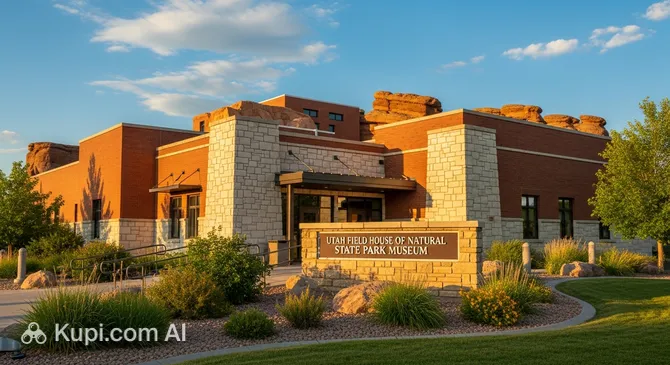
Utah Field House of Natural History State Park Museum. Source: Kupi.com AI

The museum offers visitors a chronological journey from the Precambrian to the Cenozoic. Inside the building, you will find vibrant murals, authentic fossils found in the local area, and interactive galleries. One of the most impressive parts of the complex is the Dinosaur Garden—an outdoor prehistoric garden where 14 full-sized models of ancient creatures, including a fearsome Tyrannosaurus rex and a massive mammoth, stand among desert plants.

Beyond its role as a repository of antiquities, the park serves as an official information center, helping tourists navigate the region's rich natural attractions. Thanks to its location, it serves as the perfect prelude to visiting the famous Dinosaur National Monument.

Contacts

To ensure your trip goes smoothly, we recommend checking the museum's contact information in advance. The museum staff is always ready to answer questions by phone or through the official website to help you plan your visit as efficiently as possible.

Below are the current contact details and the exact address of the site in the city:

Address 496 E Main St, Vernal, UT 84078, USA
Phone +1 435-789-3799; +1 801-533-3592
Official Website stateparks.utah.gov

What to Do

A visit to the museum turns into a true interactive adventure for the whole family. One of the most popular areas is the Morrison Dig—a stylized excavation site where anyone can pick up a brush and carefully clear "fossils" from the sand. In the museum halls, you can see majestic skeletons, such as a nearly complete Haplocanthosaurus, over which an Allosaurus looms menacingly.

Be sure to check out the Eocene Gallery, which features a unique wall of 288 panels showcasing perfectly preserved fossilized plants, and visit the fluorescent mineral room, where rocks begin to glow magically under ultraviolet light. For those interested in human history, the Anthropology Hall on the upper floor displays petroglyphs and the daily life of the ancient Fremont and Ute cultures.

Outside, guests can enjoy a stroll through the Dinosaur Garden, where life-sized models of ancient giants create the feeling of being in a prehistoric forest. For children, there is an engaging scavenger hunt within the dioramas, and the gift shop offers detailed maps and guidebooks for the surrounding natural parks.

Getting There

Finding the Utah Field House of Natural History State Park Museum is easy, as it is conveniently located right in the city center at 496 E Main St. If you are traveling by car, free parking is available directly on the premises. The museum is just 20 miles from the famous Dinosaur National Monument and sits adjacent to the scenic U.S. 191, known as a National Scenic Byway.

Since public transport in this small town is limited, the most comfortable way to reach the site is by personal or rental vehicle, or by using taxi or Uber services. The museum serves as an excellent stop for those heading toward Flaming Gorge or exploring the region's geological wonders.

Please note that there is an admission fee—entry is approximately $8, with discounts available for children, seniors, and veterans. If you have an Annual Utah State Park Pass, you can use it for entry.

History & Facts

The history of this amazing place began in 1945, when the state legislature approved the creation of the museum. The initiative came from the local Lions Club and a group of enthusiasts who sought to preserve the region's rich paleontological heritage. The official opening took place in 1948, and since then, the museum has become a true scientific and tourist magnet.

A major milestone occurred in June 2004, when the building underwent a large-scale renovation. The exhibition space expanded to 22,000 square feet, featuring modern interactive halls and the famous dinosaur garden. Designers aimed to make the space as immersive as possible; for example, the floor tiles in the halls symbolize the connection between geological eras and the actual surrounding landscapes.

The museum's location is unique because, within an 80-mile radius, one can find evidence of nearly the entire geological history of the Earth. This makes the exhibition more than just a collection of bones—it is a comprehensive guide to billions of years of our planet's evolution, accessible to every visitor.

Time Needed

To leisurely explore all the indoor exhibits and walk through the outdoor dinosaur garden, most tourists need between 1.5 to 2 hours. This is plenty of time for children to participate in the interactive digs and for adults to study the details of ancient fossils.

If you are short on time, you can see the highlights in about an hour, focusing on the main halls and taking a few quick photos in the garden. However, if you have a deep interest in paleontology or anthropology, allow a bit more time to examine the mineral collection and the artifacts of the Fremont culture in detail.

Working Hours

The museum typically welcomes guests from 9:00 AM to 5:00 PM, Monday through Saturday. During the summer season (April to September), the park is often open daily; however, during the winter months, Sunday is usually a closing day.

As the schedule may change due to holidays or seasonal events, visitors are strongly encouraged to check the current operating hours on the Utah State Parks official website before planning their trip.

Nearby

After meeting the prehistoric giants, you can continue your stroll through the city. There are many interesting locations around the museum: from historical markers to fun art objects that will complete your impressions of Vernal.

Walking through the surrounding area will allow you to see the city from different perspectives—from its historical heritage to its modern culture of hospitality.

Name Distance (km)
Gateway Saloon 0.5
Dine-A-Ville Pink Dinosaur 0.7
Vernal City Welcome Dinosaur 0.7
Little B's 0.7
Utah Historical Marker #247 0.8
Manfred and Ethel Martin House 0.8
Fort Ashley Center Historical Marker 0.9
Utah Historical Marker #340 0.9
Bar 319 1.4
Kid’s Canal 3.2

Reached the end of the page?

That means the route is fully explored