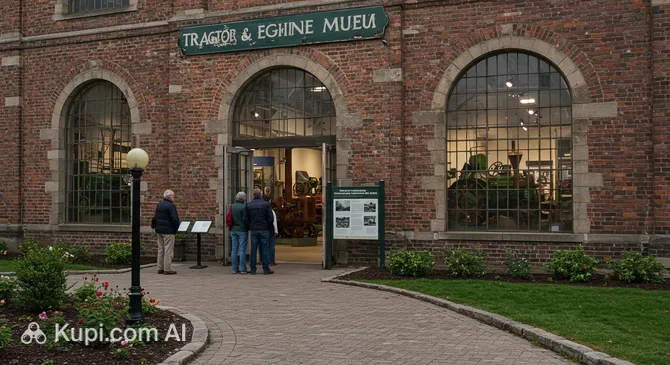
Imagine a place where the history of power and progress comes to life: the John Deere Tractor & Engine Museum invites you on a fascinating journey through the world of engineering ingenuity. Located in the city of Waterloo, this museum stands on historic ground where the very first John Deere factory in the USA once operated.
Tractor & Engine Museum. Illustration.
Source: Kupi.com AI
Traveler photos:
This is not just an exhibition of old machinery, but a true living archive of American agriculture. The collection features the rarest exhibits: from the first tractors that replaced horse-drawn power to futuristic machines controlled by artificial intelligence. The chronological structure of the exhibition allows you to see with your own eyes how farmers' needs changed and technologies improved over the course of a hundred years.
Visitors are impressed by the scale of transformation: from simple iron mechanisms to the most complex units with GPS navigation. The Tractor and Engine Museum in Waterloo is deservedly considered a must-visit for those interested in industrial history and wanting to understand how technology has changed our world.
Contacts
For planning your visit and clarifying details, you can use the museum's official contact information. The staff is always ready to help with information about group tours or special events.
The main reason to visit the museum is the chance to see the legendary Waterloo Boy. This was the first tractor released under the John Deere brand, and it became the symbol of a new era in farming. You can examine its open flywheels and simple yet ingenious control mechanisms, which seem incredible in the digital age.
Of particular interest are the halls dedicated to two-cylinder engines. Here, engineering is presented as an art form: you can study the design of each machine in detail and understand the technical challenges the designers of the last century had to overcome. The collection includes not only tractors but also a variety of tools and stationary engines that worked on farms decades ago.
For young visitors and curious adults, there are interactive exhibits. Here, learning turns into a game: you can touch parts, start some mechanisms, and clearly see the principles of how complex machinery works. It is a unique chance to literally touch the history of industrial design and feel the might of American industry.
Getting There
The museum is located at 500 Westfield Ave, Waterloo, IA 50701, USA. It is most convenient to reach it by car, as the city is well-integrated into the Iowa state highway network. Free parking is provided for visitors on the complex grounds.
For travelers arriving from afar, the nearest air hub is the Regional Airport of Waterloo. The airport is located in close proximity to the city, and the trip from the terminal to the museum gates by taxi or ride-sharing services (such as Uber or Lyft) will take only about 10–15 minutes.
If you are in the city center, you can use local taxi services. Public transport in this area is moderately developed, so for maximum comfort and time-saving, it is recommended to use personal transport or rental cars. Navigator coordinates: 42.4988822, -92.3531036.
Nearest city: Waterloo
History & Facts
The history of this location began in 1918, when the John Deere corporation acquired the Waterloo Gasoline Engine Company. This event was a turning point: the combination of engineering genius from Waterloo and the power of the John Deere brand laid the foundation for the modern agricultural industry. It was here that the famous Waterloo Boy was born — the tractor that proved the advantage of mechanical power over horsepower to farmers.
In the early 20th century, US agriculture faced a serious labor shortage. The museum clearly shows how innovative machines became a salvation for farmers, allowing them to increase production and feed growing cities. Interestingly, the first engine models ran not only on gasoline but also on kerosene, which was cheaper at the time, although this required certain engineering ingenuity.
The exhibition also focuses on the era of two-cylinder engines. This period is often called the "golden age" of tractor design. Visitors can trace how simple mechanisms gradually became more complex, turning into high-tech machines. These historic walls remember times when every new technical solution was a real breakthrough, changing the lives of millions of people.
Time Needed
A standard tour of the main collection and an introduction to the key exhibits usually takes about 2–3 hours. This is enough time to walk through the main halls and get a general idea of the evolution of technology.
However, if you are an engineering enthusiast or are traveling with children who want to study the interactive stands in detail, it is worth setting aside 4–5 hours. A deep dive into the history of each model and participating in demonstrations requires a more measured pace of walking through the museum.
Working Hours
The museum welcomes visitors on a steady schedule throughout the week, with the exception of certain days. Please note that the museum is closed to the public on Monday and Sunday.
Opening hours from Tuesday to Saturday are from 9:00 AM to 5:00 PM. It is recommended to plan your visit for the first half of the day to have enough time to explore all the halls. Before traveling on public holidays, it is advisable to check the current schedule on the official website.
Day
Working hours
Monday
Closed
Tuesday
9:00 – 17:00
Wednesday
9:00 – 17:00
Thursday
9:00 – 17:00
Friday
9:00 – 17:00
Saturday
9:00 – 17:00
Sunday
Closed
Nearby
Waterloo is a city with a rich industrial heritage, and exploring the museum's surroundings will allow you to better feel the atmosphere of this industrial center. A stroll through the adjacent streets will reveal interesting examples of architecture and local establishments that will complement your trip experience.