Support

Clay Tunnel

About

The Clay Tunnel is a unique theme park and open-air museum located in the picturesque surroundings of Dalat, in Vietnam. This unusual attraction is situated about 10-13 km from the city center, in a pine forest on the shores of Tuyen Lam Lake. The park is a long alley ranging from 1.2 to 2 kilometers in length, where all sculptures and installations are handmade from local red basalt clay.

The main idea of the Clay Tunnel is to tell the story of Dalat's formation and development through art. Walking along its winding paths, visitors will see large-scale clay compositions recreating the city's iconic architectural landmarks, mythological scenes, figures of animals, people, and even models of machinery. All this turns the walk into a fascinating journey through time, from ancient times to the present day.
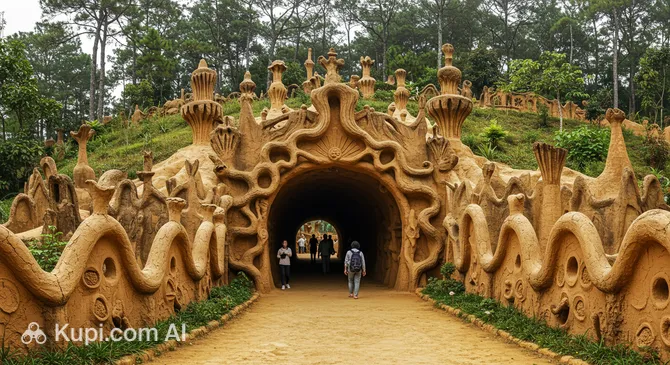
Clay Tunnel. Illustration.
Source: Kupi.com AI

Traveler photos:

This place is also known as the "Clay Village" or the "Sculpture Tunnel." Due to its originality and photogenic nature, it has become one of the most popular tourist sites in the region. Here, you can not only learn about the culture and history of Dalat in an unusual format but also take many bright and memorable photos against the backdrop of whimsical clay masterpieces and beautiful nature.

Contacts

For the most up-to-date information regarding opening hours, ticket prices, and special events at the Clay Tunnel, it is recommended to visit the official website or contact the park administration directly. Below are the key contact details that may be useful when planning your visit.

How to contactContact
AddressPhường 4, Dalat, Lam Dong 66000, Vietnam
Websiteticketdulich.com

What to Do

A visit to the Clay Tunnel is an exciting open-air walk where the main activity is exploring and photography. You can stroll along winding paths among hundreds of clay sculptures that tell the story of Dalat's history and culture. Of particular interest are the detailed replicas of the city's famous architectural monuments, clay cars, as well as scenes from mythology, such as the huge dragon sculpture symbolizing Vietnam's legends about the origin of its people.

This place seems created for vibrant photo sessions. Here, you can take spectacular shots against the backdrop of unusual art objects and installations reflecting the life and development of the city from ancient times to the present day. In addition to walking and photography, you can learn about the culture of local residents through artistic compositions in the park. For visitors' convenience, there are special photo zones, observation decks, and resting areas. The territory also features cafes and souvenir shops, making a visit to the Clay Tunnel comfortable and enjoyable for the whole family.

Getting There

Getting to the Clay Tunnel from the center of Dalat is quite easy, as this attraction is a popular tourist destination. It is located about 10–13 km south of the city, on the scenic shores of Tuyen Lam Lake. The trip usually takes from 20 to 30 minutes and is a small adventure in itself, as the route passes through beautiful mountain and forest landscapes.

The most popular way to reach the tunnel is by rented scooter or motorbike. This option offers freedom of movement and allows you to enjoy the views at your own pace. Another convenient way is to use taxi services or order a car through a mobile app. Such a trip will be fast and comfortable. Additionally, many travel agencies in Dalat include a visit to the Clay Tunnel as part of organized tours, which takes away all the hassle of route planning.

For those looking for more budget-friendly or combined options, there are tourist shuttles and minibuses that run toward Tuyen Lam Lake. From the lake to the tunnel itself, you can walk or travel the short remaining distance by local taxi. You might also consider an interesting route via the cable car leading to the Truc Lam Monastery — from there, the Clay Tunnel is just a stone's throw away, and the ride offers breathtaking views of the surroundings.

Nearest city: Da Lat

History & Facts

The history of the Clay Tunnel is inextricably linked to the dream of one man — a local entrepreneur named Trinh Ba Dung. Having studied maritime affairs and business administration in Germany, he returned to Vietnam with the idea of creating something completely unique for his homeland. Intending to turn ordinary local clay into a durable art material, he spent over four years researching and experimenting to find the perfect formula. His goal was not just to build a park, but to tell the story of Dalat through the language of art.

Construction of the park began in 2010, and the official opening to visitors took place in 2012. The creator's persistence was rewarded: he managed to transform red basalt clay into a new, environmentally friendly material with strength comparable to concrete. This allowed for the creation of large-scale and detailed sculptures capable of withstanding any weather conditions. Since its opening, the exhibition has been constantly expanding, adding new chapters to the city's clay chronicle.

Thanks to its originality and scale, the Clay Tunnel quickly gained popularity and was recognized as one of the man-made wonders of Vietnam. Inspiration for the numerous sculptures comes from both real historical events and architectural masterpieces of Dalat, as well as ancient local legends and myths. For example, one of the first sculptures greeting guests is a dragon's head, referring to the legend of the origin of the Vietnamese people. Thus, each composition in the park is not just a work of art, but part of a grand story that Trinh Ba Dung lovingly shared with the world.

Time Needed

To fully explore the Clay Tunnel in Dalat, it is recommended to set aside approximately 1.5–2 hours. This time is quite sufficient to leisurely stroll through the entire area, take photos, and get a detailed look at the main exhibits telling the city's history. Walking through the park is a journey through eras, and this timeframe will allow you to immerse yourself in this unique clay chronicle without rushing.

Of course, the duration of your visit may vary depending on your personal interests. If you are into photography, you might stay longer, as there are many popular photo zones in the park where you sometimes have to wait your turn. Families with children may also spend more time here, as young travelers usually enjoy exploring the unusual sculptures. In any case, even an hour will be enough for a quick look at the main highlights.

Overall, one and a half to two hours is enough for a comfortable and complete introduction to the Clay Tunnel. During this time, you will have time not only to see the entire open-air exhibition but also to relax in a local cafe or check out the souvenir shops. When planning your visit to this attraction in Vietnam, aim for this time slot to get the most out of your experience without unnecessary haste.

Working Hours

The Clay Tunnel in Dalat is open to visitors year-round and operates daily. Generally, visiting hours are from 7:30 AM to 5:00 PM. This time is sufficient to explore the entire exhibition without rushing. However, it's worth keeping in mind that operating hours may vary slightly depending on the season, weather conditions, or during public holidays.

Advance ticket booking for individual visits is usually not required; they can be purchased directly at the park entrance. Nevertheless, to avoid any inconvenience, it is recommended to check the most up-to-date information on opening hours and prices on the attraction's official website or its social media pages before your trip.

7:00 – 17:00

Nearby

A visit to the Clay Tunnel is just part of a grand adventure that awaits you in the vicinity of Dalat. This region of Vietnam is famous for its picturesque nature and many interesting places located nearby. Exploring the nearest attractions will allow you to dive deeper into the atmosphere of this unique mountain resort and form a more complete impression of its culture and beauty.

To help you plan your route, we have compiled a list of interesting locations near the Clay Tunnel. All of them are worth visiting and can be a great addition to your trip.

NameDistance
Datanla Waterfall4.8 km
The Florest – Flowers in the Forest5.2 km
Bao Dai Palace 35.6 km
Dalat Cable Car5.7 km
Crazy House6.1 km
Cao Nguyen Hoa Ecotourism Area6.5 km
Da Lat Cathedral6.5 km

Have you reached the end of the page?

So the route has been studied inside and out