Support

Noi Bai International Airport

About the Airport

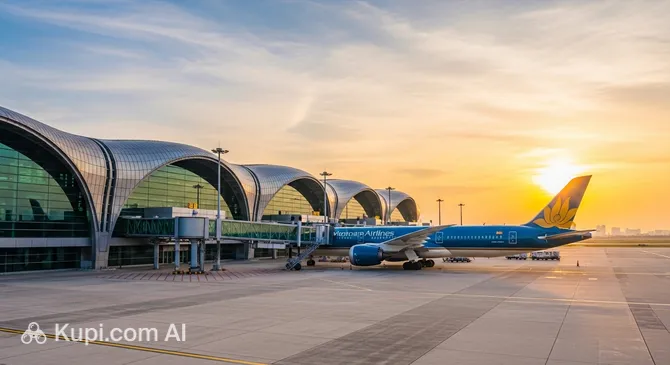
Noi Bai International Airport. Source: Kupi.com Binoculars

Noi Bai International Airport is not merely a transit point, but a true gateway into the heart of Northern Vietnam, where modern comfort meets Asian hospitality. Located amidst the picturesque suburban rice paddies, this aviation hub immerses travellers in the country's unique atmosphere from the very first minute, thanks to its architecture resembling the wings of a giant bird. Here, the bustling energy of Hanoi blends harmoniously with thoughtful infrastructure, offering guests a convenient starting point for exploring ancient pagodas and the region's natural wonders.

IATA Code HAN
ICAO Code VVNB
City Hanoi
Distance to centre ~28 km (about 45 minutes by car)
Status International
Annual passengers ~30 million
Schedule Available on the online board

Features and Advantages of the Airport:

Noi Bai Airport consists of two terminals: T1 serves domestic flights and is known for its geometric architecture with Vietnamese style elements, while the new and spacious T2 handles international destinations. One of the main highlights for weary tourists are the special Sleep Pods, where one can rest in comfort between flights without leaving the transit zone.

Transport accessibility here is also excellent: besides standard taxis, the bright orange Bus No. 86 is very popular. This express route, featuring air conditioning and Wi-Fi, has become a favourite way to travel to Hanoi's Old Quarter comfortably and on a budget. Additionally, the airport offers an excellent selection of cafes where you can taste authentic Vietnamese Pho or purchase souvenirs before departure.

Contact Information

For your convenience, we have compiled the main contact information for Noi Bai International Airport (HAN). We recommend checking the data for accuracy on the official website before your trip.

  • Official Website: www.noibaiairport.vn. Here you will find the latest information on flights, services, and airport regulations.
  • Information Desk Phone: Hotline for calls within Vietnam — 1900 636 535. For calls from abroad, use the number +84 24 3886 5047.
  • Airport Address: Phú Minh, Sóc Sơn, Hà Nội, Việt Nam (Phu Minh Commune, Soc Son District, Hanoi).
  • Email: For general inquiries and feedback, you can use the address cs.han@acv.vn.
  • Social Media: The airport has official pages on social networks (such as Facebook) where important updates and news are published. Search for "Noi Bai International Airport".
  • Lost & Found Information: Contacts depend on the arrival terminal:
    - Terminal T1 (Domestic flights): +84 983 774 374
    - Terminal T2 (International flights): +84 24 3584 4444
  • Passenger Support Contacts: For questions related to service at the airport, you can contact the main hotline number or email.

How to Get to the Airport

Getting to Noi Bai International Airport (HAN) from the centre of Hanoi can be done in several ways, suitable for any budget and comfort level. The airport is located approximately 35 kilometres north of the city centre, and the journey usually takes from 40 to 60 minutes depending on the chosen transport and traffic conditions.

Public Transport is the most economical option. The most popular among tourists is the Express Bus No. 86. It travels from Hanoi Railway Station through the Old Quarter and the Hoan Kiem Lake area directly to the airport terminals. The buses are modern, with air conditioning and luggage space. The fare is low, and the frequency is about every 25-30 minutes. There are also cheaper, but slower city buses (e.g., No. 7 and No. 17), which are suitable for those travelling light and wishing to save money.

Taxi and Transfer are the most convenient and fastest methods. In Vietnam, taxi-hailing apps like Grab are popular, offering rides at a fixed and pre-known price. This helps avoid misunderstandings regarding payment. You can also use the services of official taxi companies such as Mai Linh or Vinasun. It is recommended to ensure the driver turns on the meter or to agree on a price before starting the trip. For maximum convenience, you can book a private transfer in advance through your hotel or an online service.

If you prefer independence, you might consider car rental. However, it is worth remembering that traffic in Hanoi is very chaotic and can be stressful for an unprepared driver. This option is more suitable for experienced motorists planning further travel around the country. For those arriving at the airport in their own or rented vehicle, Noi Bai Airport provides parking, offering both short-term and long-term options.

Recommendations:

  • For solo travellers and couples with light luggage, Express Bus No. 86 is the ideal combination of price and comfort.
  • Families with children and travellers with many suitcases are better off choosing a taxi or booking a transfer.
  • Always allow extra time for the journey, especially if you are travelling during peak hours (morning from 7:00 to 9:00 and evening from 17:00 to 19:00).

Terminals and Map

Noi Bai International Airport (HAN), the main air gateway to Hanoi and Northern Vietnam, has a simple and clear structure consisting of two main passenger terminals. It is important to know in advance which terminal your flight departs from to plan your time correctly.

Terminal 1 (T1) is used to serve domestic flights within the country. It is an older building that has undergone several renovations. Although it may seem less spacious compared to the international terminal, navigation here is quite simple. Arrival and departure zones are clearly marked.

Terminal 2 (T2) is a modern and spacious complex serving all international flights. It opened in 2014 and was designed with modern standards in mind. The terminal structure is intuitive:

  • 1st Floor: Arrival zone, baggage claim, customs control.
  • 2nd Floor: Zone for transit passengers and airline offices.
  • 3rd Floor: Departure zone with Check-in counters.
  • 4th Floor: Passport control zone, Duty Free shops, restaurants, waiting lounges, and boarding gates.

A free shuttle bus runs between terminals T1 and T2. It departs every 10-15 minutes, and the journey takes about 5-7 minutes. Shuttle stops are easy to find by following the signs at the exit of each terminal. This is a convenient way to transfer if you have a connecting flight between domestic and international lines.

For check-in and pre-flight security on international flights (in T2), it is recommended to arrive at the airport 2.5-3 hours before departure. For domestic flights (in T1), 1.5-2 hours is usually sufficient. Queues are possible during peak hours, so it is better to have a time buffer. Navigation in both terminals is simplified thanks to numerous signs in Vietnamese and English.

Airport History

The history of Noi Bai International Airport is a journey from a military airfield to the modern air gateway of the capital of Vietnam. Initially, it was built as the Phuc Yen airbase for the needs of the Vietnam People's Army and played an important strategic role. The decision to convert it into a civilian airport was made after the end of the war to serve the growing needs of Hanoi and the northern regions of the country.

Officially, the airport opened for civil flights on January 2, 1978. In the early years, its infrastructure was modest, but with the start of economic reforms in the country and the growth of tourist flow, there was an urgent need for modernisation. The first major step was the construction and opening of Terminal 1 in 2001. This significantly increased passenger capacity, but the rapid growth of air travel quickly exhausted its resources.

A key moment in the modern history of the airport was the opening of the new international terminal T2 at the end of 2014. This massive project, implemented with the support of Japan, took Noi Bai to a completely new level. Spacious and modern, Terminal 2 took over all international flights, while the old Terminal 1 was refitted to serve domestic lines. At the same time, a new expressway and the Nhat Tan Bridge were opened, reducing travel time to the city centre by almost half.

Today, Noi Bai is the second busiest airport in Vietnam and a major hub for national carriers such as Vietnam Airlines and VietJet Air. One interesting fact about its history is that the airport still retains a dual purpose: part of its territory is still used as a military airbase, which is a direct legacy of its past.

Services and Amenities

Noi Bai International Airport (HAN) offers passengers a wide range of services for a comfortable wait for their flight. In the terminals, you will find numerous restaurants and cafes where you can taste both Vietnamese cuisine and familiar international snacks. Duty-free shops offer perfumes, confectionery, souvenirs, and local delicacies, making the airport an excellent place for last-minute shopping before departure.

For those who value enhanced comfort, business lounges and VIP lounges operate at the airport. They provide a secluded space with comfortable seating, complimentary snacks, beverages, and press. Free Wi-Fi is available throughout the airport, and numerous charging stations for gadgets allow you to stay connected at all times.

Financial matters can be settled at bank branches, ATMs, or currency exchange points located in the arrival and departure halls. In case of illness, a medical centre operates around the clock at the airport to provide first aid, and there are also pharmacies with necessary medications.

Passengers with children will appreciate the presence of children's play areas and mother-and-child rooms equipped with everything necessary for baby care. Special services are provided for passengers with reduced mobility, including ramps, lifts, adapted toilets, and staff assistance during boarding and disembarking from the aircraft.

If you have a long layover, you can stay at one of the hotels located either within the airport grounds or in its immediate vicinity. For business travellers, conference rooms and business centres are available where you can hold a meeting or work in a quiet environment.

Where to Eat

At Noi Bai International Airport (HAN), passengers will find diverse dining options, from authentic Vietnamese cuisine to familiar international chains. Establishments are concentrated in both terminals, offering solutions for both a quick snack and a leisurely lunch before departure.

Terminal T2 (International Flights)

The majority of restaurants and cafes in the international terminal are located airside, after passing passport control and security. On the third floor of the departure zone, there is a food court featuring various cuisines. Here you can find establishments such as Big Bowl, specialising in traditional Pho soup, and other restaurants offering Vietnamese and Asian dishes. For fans of Western food, outlets of famous chains, such as Burger King, are available. In the public area (landside), the selection is more modest and mainly represented by coffee shops and small eateries in the arrival and departure halls.

Terminal T1 (Domestic Flights)

The domestic terminal also has a food court and several cafes. The selection here is more oriented towards the local public, so this is an excellent opportunity to try authentic Vietnamese dishes at more moderate prices than in the international terminal. Establishments are located in both the public area and the departure zone.

What to Try?

While at Hanoi airport, be sure to try iconic Vietnamese dishes. Pho (Phở) — a fragrant beef or chicken broth with rice noodles — is an ideal option for a full meal. For a quick and filling snack, Banh Mi (Bánh mì) — a crispy baguette with various fillings, from pâté and meat to vegetables and herbs — is perfect. Do not forget the famous Vietnamese coffee with condensed milk.

Special Dietary Requirements and Prices

Many Vietnamese dishes are naturally suitable for vegetarians, as they are often prepared based on rice, noodles, and vegetables. However, finding certified Halal or gluten-free dishes may be more difficult, so it is recommended to verify the ingredients directly at the restaurant. Prices at the airport are generally higher than in the city but remain within reasonable limits. A full lunch will cost approximately 10–15 USD, and a quick snack — 5–7 USD.

Opening Hours

Most establishments in international terminal T2, especially airside, operate around the clock or have extended hours to serve passengers of night and morning flights. In terminal T1, cafes and restaurants usually close for the night.

Travel Tips

To ensure your journey through Noi Bai International Airport in Hanoi goes as smoothly as possible, make use of these tips. The airport is the main air hub of Northern Vietnam, so preparation will help avoid unnecessary stress.

Arrival Time at the Airport: For international flights, it is recommended to arrive at the airport at least 3 hours before departure. For domestic flights, 2 hours is sufficient. During peak hours and holidays, queues for check-in and security checks may be longer, so allow extra time.

Check-in and Security Control: To save time, complete online check-in for your flight if your airline offers this option. This will allow you to go straight to the baggage drop-off counter or to security if you are travelling with hand luggage only. When passing through security control, have your passport and boarding pass ready in advance, and remove laptops, tablets, and liquids from your bag.

Seat Selection: If you want to enjoy the views during takeoff and landing, choose a window seat. If comfort and the ability to stand up freely without disturbing neighbours are important to you, your choice is an aisle seat. Seats at emergency exits usually offer more legroom but may cost more.

Hand Luggage: Standard security rules apply here. All liquids (perfumes, gels, creams) must be in containers of no more than 100 ml and packed in a transparent bag. Sharp objects are prohibited. Power banks and lithium batteries are allowed only in hand luggage; their capacity must not exceed the limits set by the airline.

Connecting Passengers: Noi Bai Airport has two main terminals: T2 for international flights and T1 for domestic ones. A free shuttle bus runs between them. If you have a layover, check if you need to collect your luggage and check it in again. Also, check if you require a visa to enter the city if the layover is long.

Customs Control: The customs control procedure usually proceeds quickly. If you are importing or exporting amounts exceeding the established limit (usually around 5000 USD) or goods subject to declaration, fill out a customs declaration in advance. Be prepared to present your luggage for inspection upon the request of a customs officer.

Saving Time and Money: To save on transfer to the city, consider using express buses or book a taxi in advance through trusted apps. Prices for food and drinks in the departure zone are traditionally higher, so you can have a snack before passing security control. Free Wi-Fi is available at the airport.

In Case of Flight Delay: First, contact your airline representative for information on the flight status and your rights. For long delays, airlines are obliged to provide meal vouchers and sometimes hotel accommodation. The airport has many cafes, shops, and high-comfort waiting halls (lounges) where you can pass the time.

Reached the end of the page?

That means the route is fully explored