Support

Vienna International Airport

About the Airport

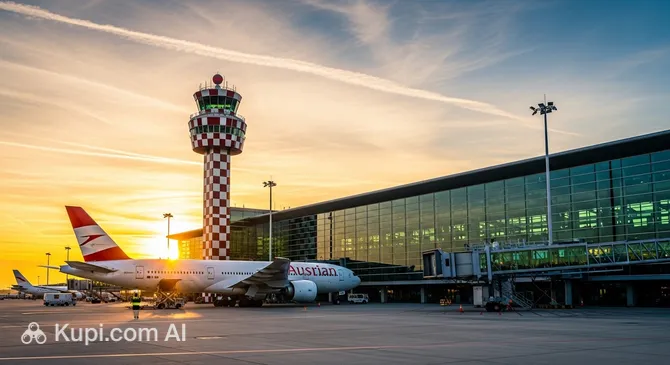
Vienna International Airport. Illustration.
Source: Kupi.com AI

Vienna International Airport is not just a transportation hub, but a true overture to your introduction to the musical capital of Europe. This modern and intuitive hub is located in the town of Schwechat and is renowned for the punctuality and comfort that travelers value so highly. Here, among the elegant terminals, your immersion into the atmosphere of Austria begins with your first cup of Melange coffee and a friendly smile from the staff.

CharacteristicValue
IATA codeVIE
ICAO codeLOWW
CityVienna
CountryAustria
Time zoneEurope/Vienna
Popular airlinesLOT Polish Airlines, Accesrail Inc, Lufthansa, Swiss, Brussels Airlines
ScheduleLive departures board

Vienna Airport is deservedly considered one of the most convenient in Europe due to its compactness and thoughtful logistics. One of the main highlights is the City Airport Train (CAT) — a high-speed train that whisks you directly to the center of Vienna in just 16 minutes without intermediate stops. For those who prefer alternative routes, a well-developed network of S-Bahn suburban trains and buses connects the terminals with various city districts and even neighboring countries.

The interior space is organized to simplify navigation as much as possible: the minimum connection time here is a record-breaking 25–30 minutes for Star Alliance flights. Passengers can enjoy spacious waiting areas in Terminal 3, offering panoramic views of the airfield. Additionally, the airport offers excellent opportunities for shopping and relaxation, allowing you to purchase famous souvenirs or spend time in comfortable lounges before your flight.

Contact Information

  • Official website: www.viennaairport.com. The website provides up-to-date information on flights, services, and airport regulations.
  • Information desk phone: +43-1-7007-0. You can contact this number for general questions regarding airport operations.
  • Address: Wien-Flughafen, 1300 Schwechat, Austria.
  • Email: The airport suggests using specific contact forms on the official website for various inquiries to ensure faster processing of requests.
  • Social media: You can follow news and updates on the airport's official pages on Facebook, X (formerly Twitter), and Instagram.
  • Lost & Found: If your luggage is lost, your first step should be to contact your airline's representative office. There is also a centralized Lost & Found office at the airport, with contact details listed on the official website.
  • Passenger Support Contacts: For assistance and consultations on general matters, it is recommended to use the main airport information desk phone.

How to Get to the Airport

There are several convenient ways to get to Vienna International Airport (VIE) from the center of Vienna that suit any budget and preference. The airport is located about 18 km southeast of the capital of Austria, and the route to it is well-organized.

The City Airport Train (CAT) is the fastest way to reach the airport. The train departs from Wien Mitte (Landstraße) station and travels non-stop to the terminal. The journey takes just 16 minutes. The trains are comfortable, with free Wi-Fi and power outlets. CAT tickets are more expensive than regular public transport, but this is offset by speed and convenience. At Wien Mitte station, you can even check in for your flight and drop off luggage for many airlines.

The S-Bahn suburban train (Line S7) is a more budget-friendly alternative to the CAT. The train also departs from Wien Mitte and other stations in the city but makes all stops. The trip to the airport takes about 25-30 minutes. This is an excellent option for those looking to save money, as the S-Bahn ticket is significantly cheaper. Most importantly, ensure your train is heading specifically to the Flughafen Wien (Airport) station.

Vienna Airport Lines (VAL) buses are another convenient option. Specialized buses run on three main routes, connecting the airport with key points in the city, including the main railway station (Wien Hauptbahnhof) and the Westbahnhof. The journey takes between 20 to 45 minutes depending on the route and traffic situation. This is a good choice if you are staying near one of the VAL bus stops.

Taxis and transfers offer maximum comfort, especially if you have a lot of luggage or are traveling with a family. A taxi ride from the city center to the airport takes approximately 20-30 minutes depending on traffic. Many services offer a fixed price, but it is better to confirm the cost in advance. Pre-booked transfer services are also popular, allowing you to lock in the price and be sure the driver will meet you at the scheduled time.

Car rental and parking. If you are traveling by car, numerous parking options are provided at the airport — from short-term parking right by the terminals to more budget-friendly long-term parking lots. The road to the airport is well-marked with signs. This option is convenient for those planning to travel around the outskirts of Vienna by car.

For travelers exploring Central Europe, it is also worth keeping nearby airports in mind. Depending on your route, convenient alternatives may include Bratislava Airport (only 49 km away), Brno Airport, or Graz Airport, all of which are well-connected to the region by bus and rail services.

Terminals and Layout

Despite its status as a major European hub, Vienna International Airport (VIE) is distinguished by its thoughtful and compact structure. In fact, all passenger areas are located in one building, which significantly simplifies navigation and movement between them. You will not need shuttles or trains to get from one end of the airport to the other — everything can be done on foot.

The main structure of the airport consists of two main registration (check-in) areas and several boarding gate zones:

  • Terminal 1 (Check-in 1): This is the older part of the airport. Many airlines not belonging to major alliances, as well as some low-cost carriers, check in here.
  • Terminal 3 (Check-in 3): The most modern and largest terminal, which serves as the main base for Austrian Airlines and its Star Alliance partners. Spacious check-in counters, self-service baggage drop machines, and main security checkpoints are located here.

After checking in and dropping off baggage in one of the terminals, passengers head to centralized security checkpoints and then to one of the boarding gate zones. These are clearly divided into Schengen and non-Schengen:

  • Gates B, C, F: Serve flights within the Schengen Area. After passing security control, you can move freely between these zones.
  • Gates D, G: Designed for flights to countries outside the Schengen Area. Passport control is required to access these gates.

The Arrivals area is common to all terminals and is located on the ground floor (Level 0). Regardless of which gate your plane arrives at, you will find yourself in a single baggage claim hall and exit to the city. Navigation at Vienna Airport is intuitive thanks to numerous signs in German and English. To find your way, simply follow the signs indicating your gate number.

In terms of timing, Vienna Airport is considered very efficient. 1.5–2 hours is usually sufficient for check-in and security control for Schengen flights. For international (non-Schengen) flights, it is recommended to arrive 2.5–3 hours before departure to complete all formalities, including passport control, without rushing. Always check the information on your ticket — the required check-in terminal and boarding gate zone will be indicated there.

Airport History

The history of Vienna International Airport (VIE), the main air gateway of Austria located near Vienna, began in 1938. Initially, it was built as a military airfield for the Luftwaffe and was named Schwechat Airfield. After World War II, the facility came under the control of British forces and was only converted into the country's main civilian airport in 1954, replacing the outdated Aspern Airport.

From that moment, a period of active growth began. As early as 1960, a new terminal complex was opened, which is known today as Terminal 2. Constantly growing passenger traffic required further expansion: in 1972, a second runway was built. In the following decades, the airport continued to modernize: Pier East was opened in 1988, and in 1992, Terminal 1 was opened, significantly increasing capacity.

The recent history of the airport has been marked by several landmark projects. In 2005, a new air traffic control tower was erected, standing 109 meters high, which was the tallest in Europe at the time of construction. It is not only an architectural landmark but also a symbol of the airport's technological development. The most ambitious project was the construction of the modern Terminal 3 (initially known as Skylink), which was commissioned in 2012. This modernization finally secured Vienna Airport's status as one of the most important transit hubs connecting Western and Eastern Europe.

Among the interesting facts from the airport's history is its special role during the Cold War. Due to the neutral status of Austria, Vienna-Schwechat Airport served as a kind of bridge between East and West, hosting flights from countries on both sides of the Iron Curtain. This unique status contributed to its development as a major international hub, which it remains to this day, serving millions of passengers annually.

Services and Facilities

Vienna International Airport (VIE) offers passengers a wide range of services to make their stay as comfortable and productive as possible. Every detail is considered here, from diverse gastronomic offerings to facilities for business travelers and families with children.

For gourmets and shopping enthusiasts, Vienna Airport is a real treat. Numerous restaurants, cafes, and bars offer both Austrian cuisine and popular international formats. You can enjoy a Viennese schnitzel or a cup of coffee with Sacher torte before your flight. In the spacious Duty Free area, as well as in brand boutiques, you can purchase souvenirs, cosmetics, clothing, and delicacies.

For those who value enhanced comfort, several business lounges and VIP lounges (such as the SKY Lounge and JET Lounge) operate at the airport. Here, you can relax in silence, work, take a shower, and enjoy snacks and drinks. Free Wi-Fi is available throughout the terminals, and numerous stations and outlets allow you to charge electronic devices without difficulty.

Financial matters are easily resolved right at the airport: bank branches, ATMs, and currency exchange points are at the disposal of passengers. In case of need, a medical center operates 24/7 at the airport, ready to provide first aid.

Travelers with children will appreciate the special play areas and mother-and-child rooms equipped with everything necessary for baby care. For passengers with limited mobility, comprehensive support is provided: special parking, ramps, elevators, and assistance upon prior request to the airline.

If you have a long layover or an early flight, you can stay at one of the hotels located in the immediate vicinity of the terminals, such as the Moxy Vienna Airport or the NH Vienna Airport Conference Center. The latter also offers modern conference rooms and business centers, making Vienna Airport a convenient venue for business meetings and events.

Dining

Vienna International Airport (VIE) offers passengers a wide selection of dining establishments to suit every taste and budget. Whether you are looking for a quick snack before departure or a full dinner while waiting for your flight, you will easily find a suitable option here. Most cafes and restaurants are concentrated in Terminal 1 and Terminal 3, both in the landside (public) area and in the airside area after security control.

For those who want to experience Austrian cuisine, the airport offers several excellent opportunities. You can enjoy a cup of aromatic Viennese coffee with a slice of the famous Sacher torte or apple strudel at coffee houses such as Café Wien or Demel. If you have time for a full meal, look for restaurants serving traditional Viennese schnitzel. These establishments are generally located in the main departure area after passport control.

If you are in a hurry, many quick snack options are at your service. The airport features popular international chains such as McDonald's, Burger King, and Starbucks, as well as local bakeries like Anker, where you can buy fresh pastries, sandwiches, and drinks. Most fast-food outlets operate from early morning until late evening, and some are open 24/7.

For passengers who prefer a more relaxed environment, there are table-service restaurants and cozy bars. Here, you can try international cuisine, from Italian pasta to Asian delicacies. For example, Jamie's Italian restaurant is located in Departure Area G. In the wine bars, you can sample excellent Austrian wines before your flight. The price range varies: from budget-friendly options in food courts to higher prices in a la carte restaurants.

Vienna Airport also caters to passengers with special dietary needs. Many establishments mark vegetarian, vegan, and gluten-free dishes on their menus. Cafes like dean&david specialize in fresh salads, smoothies, and healthy food. It is best to inquire about Halal options directly at the restaurant. Generally, finding suitable options is not difficult, especially in the larger restaurants in the departure area.

Travel Tips

When planning a departure from Vienna International Airport (VIE), the main air gateway to Austria, there are a few points to consider for a comfortable journey. It is recommended to arrive at the airport at least 2 hours before departure for Schengen destinations and 3 hours before international flights. Vienna Airport is a large and busy hub, so extra time will help avoid rushing, especially during morning and evening peak hours.

To save time, take advantage of online check-in, which is offered by almost all airlines. This allows you to go directly to the baggage drop-off counter or, if you are traveling light, straight to security. The security procedure here is standard, but be prepared for potential queues. Take laptops and liquids out of your carry-on luggage in advance to speed up the process.

Choosing a seat on the plane depends on your preferences. Window seats offer beautiful views during takeoff and landing, especially in clear weather. Aisle seats are convenient if you need to get up during the flight or want to exit the plane faster upon arrival. Emergency exit row seats usually offer more legroom, but booking them may involve a fee and they are not available for all categories of passengers.

In your carry-on luggage, you are allowed to bring liquids in containers of up to 100 ml each, packed in a transparent bag with a total volume of no more than 1 liter. Sharp objects, weapons, and flammable substances are prohibited. Always check your airline's rules, as they may set their own restrictions on the weight and dimensions of carry-on baggage.

For transit passengers, Vienna Airport is very convenient. It is designed for fast transfers, and the signs are intuitive. If your connection occurs within the Schengen Area, no additional passport control is required. When flying from a non-Schengen country to a Schengen one (or vice versa), be prepared to go through border control, which may take some time. Check the boarding gate information on the monitors, as it may change.

When arriving in Vienna from a non-EU country, you will need to go through customs control. If you have no goods to declare, feel free to choose the "green" corridor. If you are carrying goods whose quantity or value exceeds the established limits (e.g., alcohol, tobacco, expensive purchases), you must go through the "red" corridor and declare them.

To save money, use public transport for the trip to the city. The S-Bahn train (S7) is a cheaper alternative to the CAT (City Airport Train) express. The airport itself has free Wi-Fi, as well as many drinking water fountains where you can refill your bottle after passing through security.

In the event of a flight delay or cancellation, your first step should be to contact your airline representative. They will provide up-to-date information and explain your rights, including potential provision of meals or a hotel in accordance with European legislation (EU Regulation 261/2004). The airport has many shops, cafes, and comfortable waiting areas where you can spend your time.

Reached the bottom of the page?

Looks like you know this route inside out

We use cookies for your convenience.