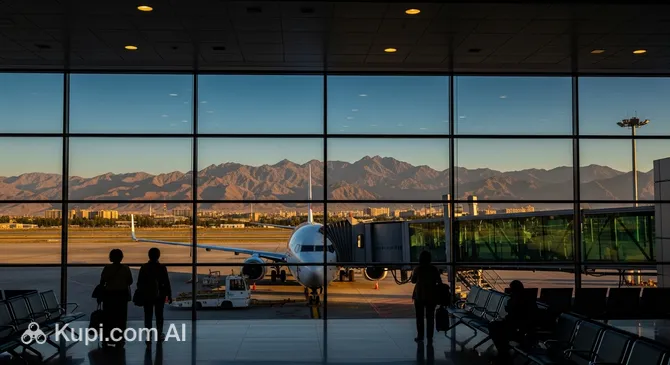
Source: Kupi.com AI
| Characteristic | Value |
|---|---|
| IATA code | KBL |
| ICAO code | OAKB |
| City | Kabul |
| Country | Afghanistan |
| Time zone | Asia/Kabul |
| Popular airlines | Turkish Airlines, Etihad, Kam Air |
| Schedule | Online timetable |
| Characteristic | Value |
|---|---|
| IATA code | KBL |
| ICAO code | OAKB |
| City | Kabul |
| Country | Afghanistan |
| Time zone | Asia/Kabul |
| Popular airlines | Turkish Airlines, Etihad, Kam Air |
| Schedule | Online timetable |
Please note that due to the current situation in the region, obtaining up-to-date and confirmed contact information for Kabul Airport may be difficult. It is recommended to clarify all details directly with your airline before traveling.
You can get to Kabul International Airport, located approximately 5 kilometers from the city center, in several ways. The choice of transport depends on your budget, comfort requirements, and the time you have available. It is worth planning your trip with extra time, as the traffic situation in Kabul can be unpredictable.
Taxi and Private Transfer
The most convenient and recommended method for tourists is a taxi or a pre-booked transfer. Many hotels and guesthouses offer airport transfer services to their guests. This is the safest and most reliable option, although more expensive. If you decide to use a street taxi, be sure to agree on the fare with the driver before starting the journey. A trip from the city center usually takes from 20 to 40 minutes depending on traffic jams. The estimated cost of a taxi ride may vary but usually amounts to several hundred Afghanis (AFN).
Car Rental
Car rental services are available in Kabul, however, foreign tourists are most often recommended to rent a car with a local driver. This eliminates the need to navigate complex traffic and search for parking. A driver who knows the city well will be able to choose the optimal route and drive you to the airport in comfort. Self-driving is not a common practice for tourists.
Public Transport
The public transport system in the city is represented mainly by local buses and shared taxis. There are generally no direct express routes to the airport. Using public transport can be difficult for tourists due to the lack of clear schedules, language barriers, and overcrowding. This option is the cheapest, but the least comfortable and predictable.
Parking at the Airport
There is a car park within the territory of Kabul International Airport. Zones for both short-term and long-term parking are provided. If you arrive in a rented or personal car, you can leave it here for the duration of your absence. It is recommended to arrive early to find a spot without rushing and undergo all pre-flight procedures.
The International Airport of Kabul (KBL), the main air hub of Afghanistan, consists of two main passenger terminals. They are clearly divided by purpose: one serves all international flights, and the second serves domestic flights within the country. Such a simple and logical structure makes navigation in the airport quite intuitive for travelers.
The International Terminal is a modern building that receives and dispatches flights to other countries. Located here are the check-in counters of international airlines, passport control zones, and customs. After completing formalities, passengers enter the departure area with waiting lounges. The infrastructure here is more developed compared to the domestic terminal, although it does not match the scale of major global hubs.
The Domestic Terminal is located in an older building and serves flights to other cities in the country. It is significantly smaller and simpler in its layout. Procedures here generally take less time, but there are also fewer amenities for passengers. Nevertheless, it effectively handles its task of ensuring air connectivity within the country.
The terminals are located in separate buildings but are in close proximity to each other. Transfer between them can easily be made on foot; it takes just a few minutes. The airport is generally compact, so getting lost here is quite difficult. Signs are usually in Dari, Pashto, and English, which facilitates orientation.
A key feature of Kabul Airport is its multi-level security system. Be prepared for multiple document checks and inspections both on the approach to the airport and inside the terminals. In this regard, it is strongly recommended to arrive for international flights at least 3-4 hours before departure, and for domestic flights — 2 hours before. Keep your passport and ticket handy, as you may be asked to present them several times at different stages of control.
The history of Kabul International Airport (KBL) is a reflection of the turbulent history of Afghanistan itself. The airport was built in the early 1960s with the assistance of Soviet engineers and originally bore the name Khwaja Rawash. Its opening was an important step in the modernization of the country and the development of its ties with the outside world, turning it into the state's main air hub.
Starting from the late 1970s, the airport acquired strategic importance and for decades served as a key military transport and logistics center during periods of historical change. These events inevitably affected the condition of the infrastructure, which required serious renovation.
A new stage in the life of the airport began in the 2000s, when large-scale reconstruction was carried out with the support of the international community. A key moment was the opening in 2008 of a new modern international terminal, built with funds provided by Japan. This allowed for a significant improvement in the quality of passenger service and the separation of international and domestic flights, for which the old terminal is now used.
In 2014, the airport was officially named after Hamid Karzai, however, it is still widely known as Kabul International Airport. In August 2021, it became the focus of world attention, becoming a key point for a massive international evacuation of civilians. Among interesting facts, it is worth noting its location at an altitude of about 1800 meters above sea level, which requires special skill from pilots during takeoff and landing.
Kabul International Airport (KBL) offers passengers a set of basic services designed to make waiting for a flight more comfortable. In the terminal, you can find necessary amenities for both business travelers and tourists with families.
For those wishing to have a snack or make purchases, the airport has several cafes and small restaurants offering dishes of local and international cuisine. There are also shops where you can purchase souvenirs, travel goods, and perfumery, including in the Duty Free zone. For a more comfortable wait for departure, passengers can use general halls or the services of VIP lounges, which offer a calmer atmosphere.
To stay connected, stations for charging mobile devices are provided in the terminal. The availability of Wi-Fi connection is recommended to be checked at information desks in the airport. For financial matters, bank branches and currency exchange points are available where you can exchange money or use an ATM.
The airport also cares for the health and well-being of its guests: a medical point is located on its territory to provide first aid. For passengers traveling with small children, mother and child rooms are equipped. Additionally, assistance is provided and conditions are created for the comfortable movement of passengers with reduced mobility.
Although there are no hotels directly on the airport territory, accommodation options for various budgets can be found in Kabul, located a short distance from the air harbor. For business travelers, information about the availability of conference halls or business centers at the airport is provided upon request at information desks.
At Kabul International Airport (KBL), passengers will find several dining options to spend time comfortably while waiting for a flight. The main part of cafes and small restaurants is concentrated in the main departure zone, after passing passport control and security screening (airside). Although specific names of establishments may change, the selection allows for both a quick snack and a full lunch.
For those looking for a light snack, there are cafes with sandwiches, pastries, and drinks. If you have more time, you can visit one of the establishments offering hot dishes. This is a wonderful opportunity to experience the local cuisine of Afghanistan: try traditional kebabs, aromatic pilaf, or fresh flatbreads. Alongside local dishes, more familiar international snacks are generally available.
Regarding dietary needs, practically all food in the airport complies with Halal standards. Finding simple vegetarian dishes, for example, based on rice or vegetables, is usually possible. However, finding specialized vegan or gluten-free options may be difficult. Travelers with strict dietary restrictions are advised to carry their own snacks in case suitable options are missing.
The operating hours of catering establishments are usually tied to the flight schedule, especially international flights. Prices for food and drinks correspond to the average level for airports. It is recommended to have cash in local currency for payment, as not all establishments may accept bank cards.
Planning a trip through Kabul International Airport requires attention to detail. To ensure your journey begins and proceeds smoothly, familiarize yourself with our tips that will help you navigate the airport and avoid unpleasant surprises.
Airport Arrival Time. For international flights, it is recommended to arrive at the airport at least 3-4 hours before departure. This will give you enough time to go through all formalities without rushing, including check-in, baggage drop, and security screening, which may take longer than expected.
Check-in and Security Control. Keep all necessary documents ready: passport, visa (if required), and ticket. Screening procedures at the airport can be very thorough. Be prepared for several stages of checks. To speed up the process, remove all metal objects from your pockets, take off outerwear, and prepare electronic devices for inspection in advance.
Seat Selection on the Plane. If the airline offers the option to select a seat during online check-in, take advantage of it. Window seats will offer you beautiful views during takeoff and landing, while aisle seats provide more legroom and the ability to stand up freely without disturbing neighbors.
Hand Luggage Rules. Standard international rules apply here as well: liquids in containers no larger than 100 ml, packed in a transparent bag; no sharp objects or other prohibited substances. Be sure to check the exact weight and size limits for hand luggage on your airline's website to avoid extra charges at the airport.
Passengers with Connections. If you have a connecting flight, find out in advance if you need to collect and re-check your luggage in Kabul. Also, clarify if a transit visa is required for staying in the country. Allow enough time between flights — at least 2-3 hours.
Customs Control. When entering Afghanistan or leaving the country, it is necessary to declare large amounts of currency and other valuable items in accordance with local legislation. Familiarize yourself with customs regulations in advance to avoid misunderstandings.
Saving Time and Money. If possible, complete check-in online. This will save you time at the airport. To avoid paying for excess weight, weigh your luggage at home. Bring an empty water bottle with you, which can be filled after passing security.
In Case of Flight Delay. In the event of a flight delay or cancellation, first contact your airline representative. They will provide current information and explain your rights, including the possible provision of meals or accommodation. Keep important items, such as a phone charger and necessary medications, in your hand luggage.
Have you reached the end of the page?
So the route has been studied inside and out