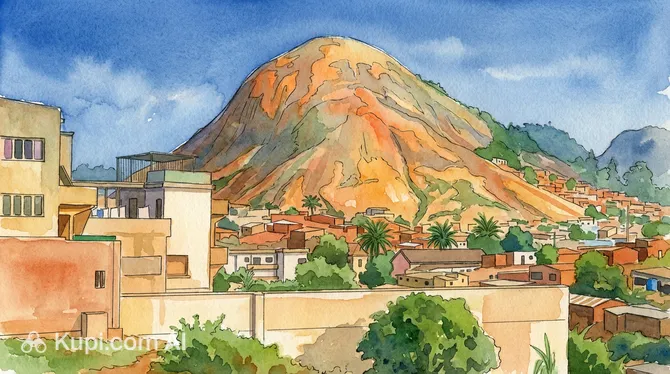
Gabela is a cozy and quiet town located in the Cuanza Sul province, in the heart of Angola. As the administrative center of the Amboim municipality, the town maintains an atmosphere of traditional provincial life, where daily routine is closely intertwined with agricultural activities. It is home to about 270,000 people, and the settlement itself serves as an important hub for the surrounding farming communities.
Gabela. Illustration.
Source: Kupi.com AI
The town was founded in 1907 under the poetic name N’Guebela. If you are interested in how this settlement was formed and evolved over the decades, it is worth exploring the historical heritage of the region. Traces of the colonial past can still be seen in the town's architecture and layout, although today Gabela is primarily a residential center where life flows at a slow and steady pace.
Despite the absence of bustling tourist clusters, Gabela attracts visitors with its authenticity. The town is surrounded by the picturesque plains of Cuanza Sul province, and the local flavor is best felt in the lively markets and central squares. A visit to Gabela is an excellent opportunity to see the real Angola, far from the hustle and bustle of megacities, and to experience the hospitality of the local residents.
Weather Overview
The climate of Gabela is classified as tropical, which defines a clear division of the year into two main periods. From November to April, a hot and humid rainy season lasts. During this time, air humidity rises significantly, and precipitation often falls in the form of short but intense downpours, which is characteristic of the entire Cuanza Sul province.
If you want to know what the temperature and probability of precipitation will be in the near future, check the current city weather. From May to October, the dry season begins, known as "cacimbo." During this period, the temperature becomes more moderate, and the rains practically stop. Average annual figures range between 22–28°C, providing comfortable conditions for a stay if you avoid the peak hours of solar activity.
The characteristics of the local relief and the absence of dense industrial development contribute to the air in Gabela remaining relatively clean. Nevertheless, during the dry season, dust may be present in the air due to soil characteristics. Travelers are recommended to plan their visit for the period from June to September, when the weather is most stable and favorable for trips around the region.
Average monthly temperature
Average monthly precipitation
Interesting Facts
Gabela was officially founded on September 28, 1907, and was originally named N'Guebela, reflecting its deep roots in local toponymy.
The town holds an honorable place in the demographic list of Angola, consistently ranking among the 15 largest cities in the country by population.
Despite the significant number of residents, Gabela maintains its status as an administrative and agricultural hub rather than turning into an industrial giant.
The town observes an interesting gender balance: according to statistical estimates, the population is distributed almost equally, with a slight predominance of women (about 51.5%).
The gap between the area of the town center itself (about 7.2 km²) and the total territory of the commune (over 1000 km²) highlights the spacious, dispersed nature of the region's development.
How to Get There
The transport accessibility of Gabela largely depends on its connection with the capital and regional centers. The town does not have its own airport, so the main way to get here is by ground transport. Traveling by car or bus allows you to fully enjoy the landscapes of Cuanza Sul province, although you should take into account the condition of the road surface and possible delays.
The nearest air gateways are located in Luanda and Sumbe. If you are planning a trip, be sure to study the detailed information on how to get to the city in the most convenient way. Most travelers prefer to fly to Luanda International Airport and then cover the remaining 200–250 km by taxi or intercity buses, which takes about 4–6 hours.
Rail service in this area is currently not developed, so trains are not an option for traveling directly to Gabela. The primary role in transportation is played by the famous Angolan candongueiros (minibuses), which regularly run between Sumbe and Gabela. The travel time from the regional center is about 2 hours.
Station
Passenger traffic
Distance
Catumbela train station
1
197 km
Bungo station
4
258 km
Main Attractions
The town of Gabela is not one of the major tourist centers, so you won't find classic world-class museums or grandiose monuments here. The main charm of this place lies in its everyday architecture and rhythm of life. One of the key points of attraction is the Gabela-Sede central square, where the main social activity is concentrated and local events are held.
For those who want to feel the local flavor, the city markets are a must-visit. These are not just trading floors, but real centers of social life where you can see the works of local artisans and get acquainted with the lifestyle of Amboim residents. Also noteworthy are the municipal administrative buildings, which stand out against the general architecture and represent a certain architectural interest.
Since Gabela is located in a picturesque province, many travelers use the town as a base for exploring the surroundings. The lack of developed tourist infrastructure is compensated for by the sincerity and authenticity of this place, which allows you to see the life of the modern Angolan province without embellishment.
Local Cuisine
The culinary traditions of Gabela are inextricably linked with the national cuisine of Angola, where the diet is based on hearty and aromatic dishes. The main product here is funge — a thick porridge made from corn or cassava flour, which serves as the perfect side dish for meat and fish sauces. Locals are proud of their muamba, which is prepared with chicken or fish in a rich peanut or palm oil sauce with added vegetables.
Due to its proximity to the coastal province, seafood dishes are frequently found in Gabela. Bananas and cassava in various forms — from fried to baked — are particularly popular. The city's gastronomic scene is represented mainly by market stalls and small establishments where you can try real home-cooked food prepared according to ancient recipes.
Among the drinks, the local Cuca beer stands out as a true symbol of the country, along with the exotic palm wine known as madeira. For those who prefer non-alcoholic options, juices from fresh tropical fruits such as papaya and passion fruit are always available. Visiting the local markets is the best way not only to try local delicacies but also to feel the vibrant energy of the town.
Travel Tips
A trip to Gabela will be a real adventure for you if you prepare for it in advance. These practical tips will help you feel confident and enjoy every moment of your journey.
Clothing and Gear: Choose lightweight clothing made from natural fabrics, as the region has a tropical climate. Be sure to bring comfortable closed shoes for walking, as well as sunglasses and a hat. It can be dusty during the dry season, so a light scarf will also come in handy.
Transport: The best way to travel between cities is to rent a car with a driver or use intercity buses. Within the city, use taxis, agreeing on the cost in advance as there are often no fixed rates.
Finance: The main currency is the Angolan kwanza. Carry a sufficient supply of cash, as there are few ATMs in Gabela and international cards are rarely accepted. It is better to exchange currency in large cities before arrival.
Health: It is recommended to consult a doctor regarding malaria prevention before your trip. Use repellents and drink only bottled water. Pharmacies are available in the center, but it's better to bring specific medications with you.
Communication: The official language is Portuguese. English is not widely spoken, so learn a few basic phrases or use an offline translator. A local SIM card can be purchased in the center for mobile internet access.
Local Etiquette: Angolans are very friendly. Greetings are an important part of communication; a polite "Bom dia" (Good morning/day) will always help establish contact. Ask for permission before taking photos of local residents.
What to Avoid: Do not openly display expensive jewelry or electronics, especially after dark. Avoid discussing political topics and walking in remote, unlit areas unaccompanied.
Additional Tip: Try the local coffee if you get the chance — the region was historically famous for its plantations, and it is a great gastronomic experience.
Gabela will open its soul to you if you travel with an open heart and respect for local traditions. Have a pleasant journey!
Entertainment & Nightlife
The entertainment infrastructure in Gabela is primarily oriented toward the needs of local residents, so it is difficult to find noisy nightclubs or modern concert halls here. However, the town does not go quiet in the evenings: the central square becomes a magnet where people gather to socialize. This is the best time to experience the unhurried rhythm of provincial Angola.
The main places for daytime relaxation are local cafes and open areas near the markets. If you are looking for more active entertainment, such as cinemas or professional theaters, it is worth planning a trip to the nearest major center — Sumbe, which is a couple of hours away. There, the choice of venues is significantly wider, including beach bars and cultural event spaces.
Regarding safety, Gabela is considered a fairly calm town, especially in the central part. However, as in any provincial settlement, tourists are recommended to avoid night walks on unlit outskirts. For traveling after dark, it is better to arrange in advance with local taxi drivers or use the services of trusted carriers.
Parks & Museums
Due to its administrative and economic status, Gabela does not have an extensive network of parks or museum complexes. It is a town of functional development, where public spaces are most often represented by open areas and squares near administrative buildings. However, the lack of formal parks is compensated for by the abundance of natural greenery in the town's surroundings.
Local residents often spend their free time in the open spaces of the central commune, which replace traditional city parks. For nature lovers, walks along the periphery of the town are of interest, where agricultural lands begin and views of the flat landscapes of Cuanza Sul province open up. These are ideal places for those seeking solitude and wanting to see untouched Angolan nature.
If your goal is a deep immersion into history through museum exhibits, it is worth planning a visit to Luanda, where the country's main cultural institutions are located. Gabela, on the other hand, offers a different kind of leisure — live observation of the traditional way of life, which itself is a kind of "open-air museum" preserving the authentic features of the region for many decades.
Getting Around
The public transport system in Gabela is mainly represented by informal carriers, which is typical for many cities in Angola. The main means of transportation for most residents are the blue and white minibuses known as candongueiros. They do not have a strict schedule or fixed stops in the traditional sense — drivers stop on request, and routes pass through the main residential and commercial zones.
For faster trips over short distances, tourists often choose mototaxis. This is a convenient way to bypass traffic congestion, especially during peak hours when the town's central streets can be crowded. You should always agree on the price of the trip in advance, as meters are not provided in these types of transport. Payment is made in cash in the local currency.
Despite the presence of minibuses, Gabela is a fairly compact town, and its central part can be explored on foot. However, for trips to the outskirts or neighboring settlements, it is better to rent a car with a local driver or use taxi services. This will provide greater comfort and allow you to avoid crowded public transport, which is primarily oriented toward the needs of the local population.
Accommodation
Accommodation options in Gabela are quite limited, as the town is primarily oriented toward business trips and internal administrative needs. There are virtually no large international hotel chains here, but travelers can find cozy guesthouses and small local-style hotels offering a basic level of comfort and traditional hospitality.
Most available accommodation options are concentrated in the central part of the Gabela-Sede commune. This is convenient for those who want to be within walking distance of markets and administrative institutions. Long-term apartment rentals are also common, often used by specialists coming to the region for work.
When planning a trip, it is better to book accommodation in advance by contacting the owners directly or through local intermediaries, as not all properties are listed in global booking systems. Prices in Gabela are usually lower than in the capital or coastal tourist cities, making a stay here quite budget-friendly. Pay attention to the availability of air conditioning and a generator, which is important for a comfortable stay in this region.
Nearby Cities
The town of Gabela is an excellent starting point for exploring the inland areas of Cuanza Sul province. The town's surroundings offer travelers the chance to see diverse landscapes — from agricultural lands to untouched natural corners characteristic of this part of Angola.
Just 29 kilometers away is the town of Conda, known for its picturesque surroundings. Also of interest for a day trip is Quilenda, which is about 33 kilometers away. For those ready to drive a bit further, we recommend visiting Ebo, where you can dive deeper into the atmosphere of regional life.
City
Population
Distance
Conda
89 479
29 km
Quilenda
97 648
33 km
Ebo
165 129
47 km
Uku Seles
187 127
62 km
Quibala
163 991
67 km
Exploring nearby settlements will allow you to form a more complete picture of life in the province. Regardless of the chosen direction, such trips promise to be filled with new impressions and encounters with the authentic culture of the region.
Shopping & Souvenirs
Shopping in Gabela is primarily about visiting the bright and colorful local markets, which are the heart of the town's trade. There are no huge shopping malls with global brands here, but there is an abundance of basic necessities, fresh produce, and items made by local artisans. The main trade activity is concentrated in the center of the Gabela-Sede commune, where market rows stretch for considerable distances.
Tourists should pay attention to traditional textiles. Angolan fabrics are famous for their bright patterns and high quality, and in Gabela, they can be purchased at very attractive prices. Also, woven baskets and wooden crafts are frequently found in the markets, which will make excellent souvenirs to remember your trip to Cuanza Sul province.
Shops and stalls in the town usually work from early morning until sunset. When planning your purchases, keep in mind that payment is made mainly in cash in the local currency — kwanzas. The use of bank cards is limited, so a cash reserve will be necessary. Walking through the market rows of Gabela is not only a search for necessary items but also a great way to interact with local residents and practice your Portuguese.