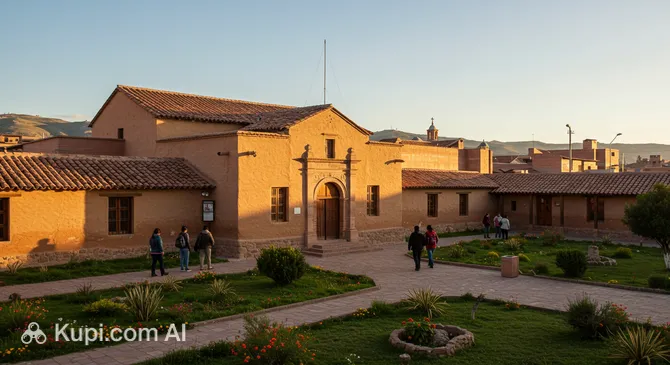
Have you ever wondered what our planet looked like millions of years ago? The National Paleontological and Archaeological Museum in the city of Tarija is a unique place where time seems to have stood still. The museum is the primary scientific pride of Bolivia and invites guests to discover the amazing world of giant creatures from the past.
National Paleontological and Archaeological Museum. Illustration.
Source: Kupi.com AI
Traveler photos:
The museum's exhibition is impressive in its scale: it features about 700 unique exhibits, including skeletons of giant mammals from the Quaternary period and fossils of ancient invertebrates. The building itself, constructed from traditional adobe according to the design of architect José Strocko, is an important cultural monument of the city and is managed by the Juan Misael Saracho University.
In addition to paleontological finds, the museum possesses a colossal archaeological collection of more than 5,000 items. Among them, you can find arrowheads, ancient vessels, and tools that tell the story of the life of the region's first inhabitants. MUNAPARQ (as locals call it for short) serves not only as a museum but also as an important research center, bringing together the history of the earth and humanity under one roof.
Contacts
For more information about visiting the museum or planning group tours, you can use the contact details provided below. The building is conveniently located within walking distance for anyone staying in the historical city center.
In the museum's halls, visitors can take a real journey back to the age of giants. The main magnet for tourists is the reconstructed skeletons of mastodons and other large mammals that once roamed the Tarija Valley. Examining 505 fossils from local caves allows you to study the structural features of these amazing creatures in detail.
The archaeological department offers an equally exciting experience: here you can see arrowheads, stone tools, and ancient ceramic pots belonging to pre-Columbian cultures. Special attention should be paid to the hall with Paleozoic invertebrates and dinosaur tracks from the Mesozoic era, which clearly demonstrate the long journey of life's evolution on the planet.
For those who appreciate a scientific approach, the museum offers educational tours detailing expeditions from the early 20th century and modern research conducted jointly with scientists from Japan and Italy. It is an ideal place for a family visit, where children and adults can feel like real explorers of antiquity.
Getting There
The National Paleontological and Archaeological Museum is located in the heart of the historical district, just one block from the main square, Plaza Luis de Fuentes y Vargas. If you are staying in the central part of the city, the walk to the museum will take no more than 5–10 minutes, allowing you to enjoy the colonial architecture of Tarija along the way.
For those coming from remote areas, it is most convenient to take a taxi — an inexpensive and fast way to get around the city. A trip from Tarija Airport (TJA) will take about 15–20 minutes and cost approximately 10–15 bolivianos. You can also use city buses or minibuses (colectivos) that pass through the city center.
If you arrive at the bus terminal, the museum can be reached on foot in 20–30 minutes, but it is better to take a short taxi ride with luggage. Please note that parking in the museum area is limited, so public transport or walking will be more comfortable options.
Nearest city: Tarija
History & Facts
The history of the museum's creation began in 1939, when Professor Arthur Poznansky proposed to local authorities to establish an institution to protect the region's unique finds. Thanks to the support of Mayor Isaac S. Attie and funding from the central government, construction of the main building was completed by 1947. The project was designed by the famous architect and artist José Strocko.
The official opening took place on April 15, 1959. Initially, the museum had municipal status, but by 1964, it was transferred to the Autonomous Juan Misael Saracho University to develop research activities. The museum gained particular scientific significance in 1994, when it was officially granted national status by a law of the Republic.
The Tarija region has long attracted the attention of world scientists. As early as the beginning of the 20th century, expeditions led by Baron Erland Nordenskiöld and Florentino Ameghino worked here. Today, the museum not only preserves their legacy but also continues international cooperation with universities in Japan and Italy, remaining a leading center for paleontological research in South America.
Time Needed
To carefully explore all the halls and get acquainted with the paleontology and archaeology collections, the average visitor will need between 2 to 3 hours. This is enough time to leisurely examine the skeletons of ancient animals and study the rich pottery exhibition.
If you plan to use a guide's services or are a passionate science enthusiast, it is worth setting aside about 4 hours for the visit. The museum features a large number of small details and information boards that require thoughtful study for complete immersion in the region's prehistory.
Working Hours
The museum is open to visitors throughout the week; however, the schedule is divided into morning and afternoon sessions. From Monday to Friday, you can enter from 08:30 to 12:30 and from 15:00 to 18:30. On Saturdays and Sundays, the museum is open only in the morning — from 08:30 to 12:30.
Since changes to the schedule may occur due to holidays or university events, it is recommended to check the official website of the institution or verify information at the tourist info center on the city's main square before visiting.
Day
Working hours
Monday
08:30–12:30, 15:00–18:30
Tuesday
08:30–12:30, 15:00–18:30
Wednesday
08:30–12:30, 15:00–18:30
Thursday
08:30–12:30, 15:00–18:30
Friday
08:30–12:30, 15:00–18:30
Saturday
08:30–12:30
Sunday
08:30–12:30
Nearby
The museum's central location allows tourists to easily combine a visit to the exhibitions with a tour of other iconic city sites. A walk around the neighborhood will help you dive deeper into the atmosphere of this cozy Bolivian region and see its architectural treasures.