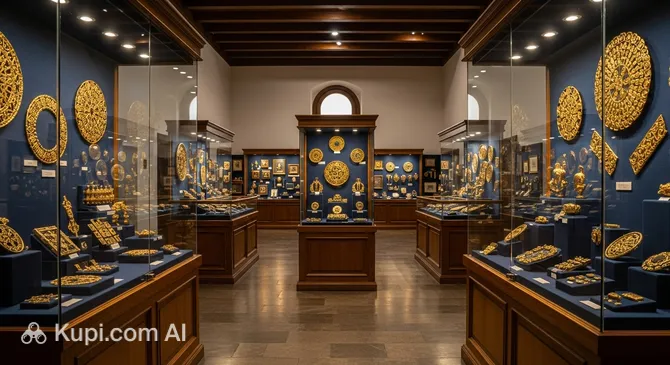
In the heart of the historic center of Sucre lies a unique private treasury — the Museum of Treasures (Museo del Tesoro). This cultural institution is entirely dedicated to the rich mining heritage for which Bolivia is famous. The museum occupies an old mansion right on the city's main square and offers guests a chance to discover the art of processing metals and precious stones.
Museo del Tesoro. Illustration.
Source: Kupi.com AI
Traveler photos:
The museum's exposition masterfully reveals the geological diversity of the region. Here, you can see not only traditional gold and silver but also the rare bicolor stone ametrine (or Bolivianite), which occurs in nature exclusively on Bolivian lands. Through 31 display cases and detailed mine models, visitors are immersed in a world where natural riches are transformed into exquisite works of art.
The Museum of Treasures is not just an exhibition of stones, but a true tribute to the labor of miners and the skill of jewelers. As a private museum that receives no state funding, every visit helps support this unique collection, which tells the story of how the country's underground riches have shaped its history and culture for centuries.
Contacts
If you have any questions or would like to clarify details before your visit, you can contact the museum administration directly. The Museum of Treasures is open to communication and ready to provide up-to-date information about special events.
The main reason to visit the Museum of Treasures is the fascinating guided tour with a professional. For an hour, you will be told about the intricacies of mining precious metals and shown how raw minerals are transformed into jewelry masterpieces in the hands of skilled craftsmen. Guides are often multilingual, speaking English and Spanish, making the visit accessible to international tourists.
The museum halls feature more than 100 unique exhibits. Special attention should be paid to the ametrine collection — an amazing stone that combines the colors of amethyst and citrine. You will also see detailed models of mines that clearly demonstrate the harsh daily lives of miners and the complex silver metallurgy processes that made this region world-famous.
In addition to viewing the stones, visitors can trace the evolution of jewelry techniques: from ancient pre-Hispanic methods to modern exquisite forms. After the official part of the tour is over, you will have the opportunity to walk through the halls on your own to take another close look at the most impressive nuggets and antique jewelry that have become part of the history of Sucre.
Getting There
Finding the Museum of Treasures is easy, as it is located in the very heart of the historic center. It is situated on the main square, Plaza 25 de Mayo, at the corner with Aniceto Arce street. Thanks to this convenient location, the museum can easily be reached on foot from almost any hotel in the central part of the city.
If you are staying in more distant areas, you can use the services of a local taxi. A trip from the airport or the main bus station to the center will take approximately 10–15 minutes. Public transport is usually not necessary within the city center, as the area is very comfortable for walking.
Once you are at the square, look for house number 59. Note that to enter the museum and start the tour, you sometimes need to ring the doorbell. This little adventure only adds to the charm of visiting the old mansion.
Nearest city: Sucre
History & Facts
The story of this remarkable place began not with a state decree, but with a personal passion. The idea for creating the Museum of Treasures was born back in 1990 to the Morales Torricos couple. Over many years, they gathered unique exhibits piece by piece, striving to preserve the mining heritage of their region.
An important milestone was the acquisition of the building in 2006. This historic mansion required colossal efforts to restore. For four years, the building was carefully renovated, trying to preserve its original appearance while simultaneously adapting it for modern museum needs. The installation of the exhibitions themselves began in 2012 and took another three years of hard work.
The museum opened its doors to the public in September 2015. Today, it is a completely private initiative that introduces guests to the thousand-year history of gold and silver mining in the Andes. The exposition covers a vast period — from pre-Hispanic times and the colonial era to the present day, clearly demonstrating how jewelry techniques have changed and how the earth's riches have shaped the country's culture and economy.
Time Needed
To fully appreciate the collection, visitors usually need between 1 and 1.5 hours. This is plenty of time to take the main tour and then return to your favorite displays for a more detailed look.
The informative walk with a guide itself takes about 60 minutes. If you are a passionate fan of mineralogy or jewelry making, you may want to stay longer to study the finest details of stone processing or examine the geological models of the mines.
Working Hours
The museum's doors are open to visitors throughout the week; however, it is worth considering the short break in the middle of the day, which is typical for this region. From Monday to Saturday, the museum is open from 09:00 to 12:30 and from 15:00 to 18:30. On Sunday, the schedule is slightly reduced in the evening — until 18:00.
The entrance fee is 30 bolivianos, and admission is free for children under 10. It is recommended to check the museum's official website before your visit to ensure there are no changes to the schedule, especially on public holidays.
Day
Working hours
Monday
09:00–12:30, 15:00–18:30
Tuesday
09:00–12:30, 15:00–18:30
Wednesday
09:00–12:30, 15:00–18:30
Thursday
09:00–12:30, 15:00–18:30
Friday
09:00–12:30, 15:00–18:30
Saturday
09:00–12:30, 15:00–18:30
Sunday
09:00–12:30, 15:00–18:00
Nearby
A visit to the museum can be perfectly combined with a walk to other iconic city spots. Since the site is located in the historical core, interesting architectural monuments and park areas are hidden around literally every corner, complementing your understanding of the local character.
Exploring the surroundings will allow you to feel the rhythm of life in Sucre and enjoy its famous "white" architecture. Below are some interesting sites located within walking distance.