Support

Train Cemetery

About

Imagine the vast expanses of a high-altitude plateau, where giants of a bygone era stand frozen under a piercingly blue sky. The Train Cemetery is one of the most surreal and iconic landmarks for which Bolivia is famous. Located on the outskirts of Uyuni, this site is an expansive open-air museum where dozens of abandoned steam locomotives and train cars are slowly turning to dust.
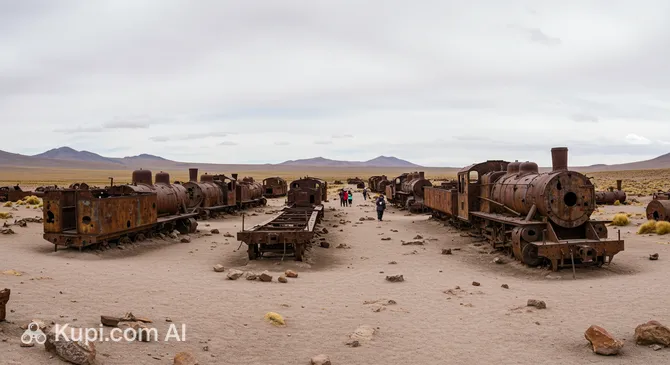
Train Cemetery
Train Cemetery. Иллюстрация. Источник: Kupi.com AI

This abandoned industrial landscape creates a striking post-apocalyptic atmosphere. The locomotives, once the pride of the country's transport system, are now covered in a thick layer of rust, actively "eaten away" by the salty wind. For tourists, this is not just a scrap heap, but a unique historical monument to industrialization that has become a must-see for every visitor to the region.

Today, the Train Cemetery serves as the starting point for most expeditions to the famous Salar de Uyuni salt flats. The rusted shells of the machines against the desert landscapes look incredibly photogenic, attracting artists, photographers, and lovers of unusual locations from all over the world.

Contacts

For your convenience, we have gathered the essential contact information to help you plan your independent trip to this unusual site.

How to contactContact
AddressG596+9R2, Uyuni, Bolivia

What to Do

The main activities here are exploration and photography. Unlike traditional museums, there are no "no entry" signs, so you are free to climb onto the locomotives, peer inside empty boilers, and wander among carriages built as far back as the early 20th century. Be sure to wear comfortable shoes, as pieces of old metal and sand are common underfoot.

For those seeking perfect shots, this place is a real gift. During the "golden hour" at sunrise or sunset, the rusted structures are illuminated by soft light, creating almost cosmic landscapes. Many locomotives are decorated with modern graffiti, turning the cemetery into a kind of open-air street art gallery. Night visits allow you to capture the silhouettes of the trains against the backdrop of the bright Milky Way.

Don't miss the chance to touch history: it is said that some of these trains date back to the days of the legendary outlaws Butch Cassidy and the Sundance Kid. Every dent and rivet here is part of a grand chronicle from the time when the railway was the main engine of progress in the Andes.

Getting There

Reaching this attraction is easy, as it is located just 2–3 kilometers southwest of the Uyuni city center. If you prefer walking and have the time, you can reach the site on foot in about 30 minutes while enjoying the rugged high-altitude landscapes.

The simplest and most popular way to visit is as part of an organized tour of the Salar de Uyuni salt flats. Practically every excursion starting from the city makes its first stop here. You can also take a taxi from the main square or the nearest station — the ride will take no more than 5–10 minutes.

For more adventurous travelers, there is the option of starting a multi-day route from San Pedro de Atacama in Chile, but ultimately the path will still lead you to Uyuni, on the outskirts of which the famous locomotives rest at an altitude of 3,670 meters above sea level.

Ближайший город: Uyuni

History & Facts

In the late 19th century, Bolivia had high hopes for the development of its railway network. The town of Uyuni was envisioned as a major transport hub for an ambitious project aimed at connecting the country's mineral-rich mountain regions with ports on the Pacific coast. For years, these powerful machines transported silver, tin, and salt, driving the region's economic growth.

However, prosperity did not last forever. In the 1950s, due to the depletion of deposits, political instability, and falling metal prices on world markets, the railway industry fell into decline. The infrastructure became obsolete, and maintaining the expensive equipment became impossible. As a result, dozens of trains were simply abandoned on the tracks.

Today, these steel skeletons, most of which were brought from Great Britain, have become a symbol of the resilience of time. The high salt content in the air and the harsh climate have transformed ordinary scrap metal into an artistic canvas of rust and corrosion, making the former junction station a silent witness to the country's rich industrial past.

Time Needed

To leisurely explore the entire area and capture atmospheric photos, most travelers need between 1 and 2 hours. This is plenty of time to stroll along the long rows of rusted trains and peer into the cabs of the largest locomotives.

If you are planning a visit as part of an organized group, keep in mind that guides usually allocate about 45–60 minutes for this stop. If you want to catch specific lighting or have a creative photo session, it is better to come on your own and set aside a bit more time for your walk.

Working Hours

The site is located on open ground and has no official gates or security, so the Train Cemetery is open to visitors 24 hours a day, 7 days a week. You can visit at any time convenient for you; access is completely free.

Nonetheless, experienced travelers suggest choosing the early morning hours (before 9:00 AM) for your visit to avoid large tour groups, or just before sunset for the most expressive photographs. A night visit is also possible, but requires caution due to the uneven terrain and sharp metal parts.

Круглосуточно

Nearby

Exploring the surroundings of Uyuni can significantly enrich your travel experience. After visiting the Train Cemetery, it is worth spending some time in the town itself, where life moves at a leisurely pace and the local cuisine offers dishes that will help you warm up in the cool Andean climate.

In the immediate vicinity of the site and in the city center, you will find themed restaurants dedicated to railway history, as well as rest spots popular with travelers from all over the world. Below are the nearest points of interest that are convenient to visit during your stay in the region.

NameDistance
Memos Coffee Bistro2.6 km
Llama Cafe2.7 km
Jardines de Uyuni Hotel3.1 km

Reached the end of the page?

That means the route is fully explored