Support

Castro Airport

About the Airport

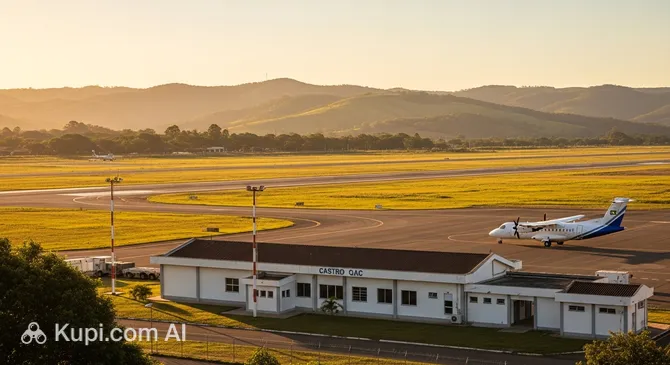
Castro Airport. Source: Kupi.com Binoculars

Castro Airport (Aeroporto de Castro) is a compact municipal aerodrome located in the Brazilian state of Paraná. Unlike bustling international hubs, this air harbour serves as a quiet gateway to the Campos Gerais region, renowned for its picturesque canyons and advanced agriculture. The airport focuses primarily on general aviation, welcoming private jets, air taxis, and small business-class aircraft. It is the ideal arrival point for travellers who value privacy and wish to be as close as possible to the city's historic centre.

IATA CodeQAC
ICAO Code SSQT
City Castro
Distance to Centre 6 km
Status Domestic (Regional)
Annual Passengers No official data (serves private aviation)
ScheduleOnline board

Features and Advantages of Castro Airport:

The main asset of this air facility is its intimacy and convenient location. The airport is situated just a few minutes' drive from the city, allowing travellers to save time on transfers. The absence of regular commercial flights eliminates security queues and luggage waits, making the arrival and departure process as fast and comfortable as possible.

The aerodrome plays a significant role in the region's business tourism, providing direct links to Brazil's major economic centres via private flights. For aviation enthusiasts, it offers the opportunity to observe light aircraft operations in a tranquil setting, against the backdrop of Paraná's beautiful landscapes.

Contact Information

As Castro Airport (Major Neodo S. Pereira) is a small municipal aerodrome serving primarily private aviation, it does not have a separate commercial website or a 24-hour passenger support service typical of large hubs. Management is carried out by the municipal authorities of the city of Castro.

To contact the administration and obtain information, please use the following details:

  • Official Airport Website: Prefeitura Municipal de Castro (Managed by the city administration)
  • Information Desk Phone: +55 (42) 3234-1438 (Aerodrome Administration) or +55 (42) 3278-1266 (Secretariat of Tourism for general enquiries)
  • Airport Address: Rodovia PR-340, Km 198, Colônia Castrolândia, Castro - PR, Brasil
  • Email: There is no direct email for the airport. For official enquiries, it is recommended to use the feedback form on the city hall website or contact@castro.pr.gov.br
  • Social Media: Current news about the region and municipal services is published on Instagram @prefeituracastro
  • Lost Luggage Information: Due to the absence of commercial flights, a centralised lost and found service is not provided. Issues are resolved directly with the pilot or operator of your private flight.
  • Passenger Support Contacts: For questions regarding tourist information and access to the aerodrome, you may contact the Municipal Secretariat of Sport and Culture (Secretaria Municipal de Esporte e Cultura) at +55 (42) 3278-1266.

Getting to the Airport

Since Castro Airport is located just 6 kilometres from the city centre and the district of the famous Dutch colony of Castrolanda, getting there is straightforward. However, given the status of the aerodrome (serving private aviation), there is no express train or shuttle infrastructure typical of major hubs. The journey usually takes about 10–15 minutes by car.

Below are the main methods of transport for pilots, business jet passengers, and tourists visiting the aerodrome.

Taxi and Transfer

This is the most convenient and reliable way to reach the airport. Local taxi services operate in Castro and can be called by phone or found at designated stands in the centre (Ponto de Táxi).

  • Apps: Ride-hailing aggregators popular in Brazil (such as Uber or 99) may operate in the region, but waiting times in a small town can vary.
  • Cost: A trip from the city centre to the airport typically costs between 20–40 Brazilian Reals (BRL), depending on the time of day and tariff.
  • Tip: If you have a scheduled departure, it is recommended to arrange a taxi driver in advance or book a transfer through your hotel, as finding a car spontaneously early in the morning may take time.

Car Rental

Renting a car is an excellent option for those planning to explore the Guartelá Canyon or the Castrolanda colony. Please note that there are no international rental counters directly within the airport terminal.

  • A vehicle must be booked in advance with an option for delivery to the aircraft steps (by prior arrangement with local agencies).
  • Alternatively, you can rent a car in the centre of Castro.
  • The route to the airport follows the PR-340 highway. The road is paved and in good condition.

Public Transport

There is no specialised public transport (airport express or direct buses) to the aerodrome.

  • Buses: Suburban and intercity buses pass the airport along highway PR-340. You can ask the driver to stop at the turn-off for "Aeroporto" or "Castrolanda", but you will have to walk from the highway to the hangars. This option is not recommended for passengers with luggage.
  • Train and Metro: There is no metro system or passenger rail service to the airport in Castro.

Parking

An open-air parking area for cars is provided on the aerodrome grounds. As the airport is small and does not have heavy passenger traffic, finding a space is usually not an issue. Parking is generally free, but it is not guarded 24/7 in the same manner as at large international airports.

How Tourists Can Get There (Nearest Major Airports)

Since Castro Airport does not accept regular commercial flights, most tourists fly into neighbouring large cities and reach Castro by ground transport (bus or rental car).

The nearest major hub is Afonso Pena International Airport in Curitiba. The distance is approximately 112 km, and the drive takes about 2 hours. This is the main hub for travellers heading to the Campos Gerais region.

Other alternative airports in the region:

Terminals and Map

The terminal infrastructure of Castro Airport (QAC) differs strikingly from the layout of large international hubs. There are no confusing labyrinths of corridors, multiple levels, or gate systems here. The terminal complex consists of one compact building, which combines administrative offices and the service area for general aviation passengers.

Terminal Structure and Zones

Given the airport's status servicing private and charter flights, the division into zones is quite nominal here. All procedures take place in a single space, creating an atmosphere of club-like privacy.

  • Check-in and Waiting Area: A small hall where passengers meet pilots and wait for the aircraft to be prepared. There are no check-in counters in the traditional sense; documentation is processed quickly and on an individual basis.
  • Departure and Arrival Zones: There are no boarding gates. Passengers proceed from the terminal building directly onto the apron to the aircraft steps, accompanied by aerodrome staff. The walk from the building entrance to your seat on the plane takes less than 2 minutes.
  • Administrative Block: The same building houses the services responsible for flight planning and meteorological support.

Features and Navigation

The airport layout is intuitively clear, and getting lost is impossible. You will not require terminal maps or signs. The main entrance leads directly into the main hall, which overlooks the runway. Since the airport is not equipped with jet bridges, boarding is always conducted from the ground.

For passengers with luggage, the process is simplified to the maximum: you hand your items to the pilot or technical staff right at the aircraft, bypassing conveyor belts and lengthy baggage drop procedures.

Procedure Times

The main advantage of Castro Airport is significant time savings. The absence of queues and regular commercial traffic allows pre-flight formalities to be kept to a minimum.

  • Check-in and Security: It is recommended to arrive at the airport 15–20 minutes before the scheduled departure time. This is quite sufficient for document checks and confirming flight details with the crew.
  • Security: Standard screening via metal detector frames and scanners, typical of commercial aviation, is usually not applied here or is conducted in a simplified visual control mode, depending on the regulations of the specific private flight.

Navigation Recommendations

If you are flying out of Castro Airport for the first time, look for the main administrative building with the "Aeroporto" sign. The car park is in immediate proximity to the entrance, so the transition from car to terminal does not require transfers or long walks. Free access to the general waiting area is available for those seeing passengers off.

Airport History

The history of Castro Airport (Aeroporto Major Neodo S. Pereira) is inextricably linked to the development of the region's agro-industrial sector, which holds the title of "National Capital of Milk", and the famous Dutch colony of Castrolanda. Unlike many passenger hubs, this airfield was formed as a utilitarian site for agricultural aviation and connecting remote fazendas (farms) with the outside world.

The Dirt Strip Era and Modernisation

For decades, the airfield was a simple dirt strip with a grass surface. A turning point in the facility's modern history was 2013, when a large-scale reconstruction and the long-awaited paving of the runway took place. This infrastructure improvement opened the city's air gates to faster and heavier business aviation aircraft, which was a critical step for investors and partners of the local cooperative.

Despite having a high-quality asphalt surface, the airport has retained strict operational limitations established historically. It is important to note that the aerodrome operates exclusively under VFR Diurno (Visual Flight Rules in daytime). Unlike large regional hubs, there is no night lighting system (balizamento noturno) installed here, so take-offs and landings after sunset are technically impossible and prohibited.

Parachuting Sports Centre

If in the middle of the last century aviation development in the region was associated with early enthusiasts, in modern history the airfield has become famous thanks to Skydive Castro. This school and parachuting centre breathed new life into the facility. The airport became a well-known point on the map for thrill-seekers, transforming from a purely business transport hub into a popular venue for sports and entertainment events on weekends.

Name and Modern Status

Officially, the airport bears the name of Major Neodo S. Pereira. This name cemented its status as an important municipal asset. Today, the airport's history is written by every private flight arriving in the city, remaining a symbol of support for the region's powerful agribusiness.

Interesting Facts:

  • The Agroleite Factor: The peak of airport activity occurs annually during the days of the major Agroleite exhibition. Historically, it is during this week that the quiet apron fills with business jets of agricultural holding executives and international delegations.
  • Strictly by the Sun: The specific "daytime operations only" rule makes the airport dependent on daylight hours, which is an important factor for flight planning during the winter period.
  • Role in the Community: The development of airport infrastructure, including the paving in 2013, was largely dictated by the needs of the Castrolanda colony, for whom rapid air connectivity with Brazil's economic centres was a matter of strategic development.

Services and Facilities

The infrastructure of Castro Airport (QAC) fully corresponds to its status as a small regional aerodrome focused on private aviation and parachuting sports. You will not find crowded terminals, Duty Free shops, or food courts here typical of international hubs. Services and amenities are kept to the necessary minimum, ensuring rapid and comfortable transit for pilots and business jet passengers.

Restaurants, Cafés and Shops

There are no full-service restaurants, cafés, or retail shops inside the terminal. Travellers are advised to consider this when planning their trip.

  • Dining: A small snack bar or buffet may operate on the airfield grounds in the parachute club zone (on weekends), where one can buy water, coffee, and light snacks. However, for a full lunch or dinner, it is better to head into the city.
  • Recommendation: Just a 10–15 minute drive away are the famous restaurants of the Dutch colony Castrolanda, offering excellent European and Brazilian cuisine, as well as traditional confectionery.
  • Shopping: Souvenir stalls and shops are also located in the colony's tourist zone and in the centre of Castro.

Lounges and VIP Services

Since the airport serves primarily private flights, the concept of dividing into "general" and "business" lounges does not apply here. The entire terminal effectively functions as a single VIP lounge. Passengers are guaranteed privacy, no queues, and personal attention from the aerodrome staff. Waiting for a flight takes place in a calm environment overlooking the airfield.

Connectivity and Electronics

Wireless internet access (Wi-Fi) is usually available in the airport's administrative building. Sockets for charging mobile devices and laptops can be found in the waiting area. The mobile signal quality of major Brazilian operators (Vivo, TIM, Claro) on the aerodrome territory is good.

Financial and Medical Services

  • Banks and Currency Exchange: There are no ATMs or currency exchange points at the airport. It is recommended to carry the necessary amount of cash in Brazilian Reals or visit bank branches in Castro city centre beforehand.
  • Medical: There is no specialised medical post for passengers in the terminal. The aerodrome possesses standard first aid kits. The nearest hospitals and 24-hour pharmacies are located within the city limits (about 6 km away).

Passengers with Reduced Mobility

The compactness of the airport makes it reasonably convenient for passengers with reduced mobility. The terminal building is single-storey, eliminating the need for lifts or escalators. The absence of jet bridges means that boarding the aircraft is done from the apron; in the case of private flights, the crew and ground staff always provide assistance with boarding and disembarking.

Hotels Near the Airport

There are no hotels on the aerodrome territory itself, as the facility does not cater to long layovers. However, thanks to the proximity to the city, comfortable accommodation can be reached in 10–15 minutes.

  • In Castro Centre: Here you will find the main city hotels, such as Central Palace Hotel or Hotel Buganville, offering a decent level of service for business travellers.
  • In the Castrolanda District: If you wish to immerse yourself in the atmosphere of Dutch culture, you can choose guest houses or hotels closer to the historic windmill and colony museums.

Conference Rooms and Business Centres

There are no specialised rooms for holding negotiations within the airport building. For business meetings, especially during agro-industrial exhibitions, it is recommended to use the conference halls of hotels in Castro or the infrastructure of the Parque de Exposições Dario Macedo exhibition complex, which is the centre of the region's business life.
Dining

When planning meals during travel through Castro Airport (QAC), it is important to consider its specific nature. As this is a small municipal aerodrome serving private aviation and a parachute club, there is no classic food court zone, fine dining restaurants, or chain coffee shops typical of large international hubs. The catering infrastructure here is minimalistic and oriented towards the basic needs of pilots and athletes.

Cafés and Food Points on Site (Landside/Airside)

Due to the compactness of the terminal, there is no strict division into a "sterile" zone and a general zone regarding access to food. All service is concentrated in one place.

  • Aero Club Snack Bar (Lanchonete): A small buffet or cafeteria usually operates on the aerodrome grounds, often in the hangar zone or at the Skydive Castro centre. It is an informal place with a friendly atmosphere.
  • Opening Hours: The food point's schedule is irregular. On weekdays, it may be closed or operate only upon request. The most activity is observed on weekends and public holidays when parachute jumps take place. At these times, the café may be open from morning until sunset (approximately 09:00 to 18:00).
  • Assortment: The menu is based on beverages (water, soda, coffee, energy drinks) and packaged snacks (crisps, chocolate, biscuits).

For a Quick Snack and Local Specialities

If you manage to catch the buffet open, you can expect simple but filling Brazilian snacks (salgados), which are ideal for a quick bite before departure.

  • What to Try: Traditional Brazilian Pão de queijo (cheese bread) — hot buns made from cassava flour and cheese. Coxinhas (chicken croquettes) or grilled sandwiches (misto quente) may also be offered.
  • Average Cost: Prices are very affordable. Coffee and a snack will cost on average between 15–25 Brazilian Reals (BRL).

Dietary Requirements (Vegetarian, Vegan, Halal)

Travellers with strict dietary restrictions should be prudent.

  • Limited Selection: Finding specialised dishes (vegan, gluten-free, or Halal) directly at the aerodrome is practically impossible. The assortment is limited to factory-made snacks.
  • Recommendation: If you require special food, it is strongly recommended to bring food with you. There is no ban on bringing your own food and drinks into the waiting area or onto a private aircraft at the aerodrome.

Recommendations for a Full Lunch (Gastronomic Tourism Nearby)

Since the aerodrome is just a 10–15 minute drive from the historic centre and the colony, the best solution is to have lunch before arriving at the airport or immediately after landing.

The proximity to the Castrolanda colony opens access to unique cuisine:

  • Dutch Heritage: Restaurants in the colony (such as Estação Castrolanda) serve European cuisine. Be sure to try traditional Dutch pies, meat croquettes, or Indonesian dishes (a legacy of the Netherlands' colonial history), which are popular in the local community.
  • Dairy Products: The region is famous for its milk, so desserts, ice cream, and pastries in local establishments are of the highest quality.

Catering for Private Flights

For business jet passengers, the issue of meals is resolved differently. Ordering in-flight catering is done in advance through your flight operator. Local restaurants and hotels in Castro can provide high-standard meal delivery directly to the aircraft steps by prior arrangement.

Travel Tips

Castro Airport (QAC) is not a typical passenger terminal, but a general aviation aerodrome. The specifics of private and charter flights dictate completely different rules of conduct and time planning compared to major international hubs. Here are some useful tips to help make your journey through this airport as comfortable as possible.

Arrival Time Recommendations

Forget the rule of "arriving 2–3 hours early". In the context of private aviation, such time buffers are unnecessary.

  • Optimal Time: It is sufficient to arrive at the aerodrome 20–30 minutes before the agreed departure time. This is enough to meet the pilot, load luggage, and complete necessary formalities.
  • Punctuality: Despite the flexibility of private flights, try not to be late. Pilots have a strict Flight Plan, and a passenger's delay can lead to the loss of a time slot or the need to recalculate fuel.

Registration and Security

Procedures here take place in a relaxed and personalised atmosphere. You will not have to stand in long queues or remove shoes for screening.

  • Documents: Keep your identification (passport or ID) to hand. Verification is carried out directly by the aircraft commander or an operator representative before boarding.
  • Screening: There is usually no rigid control with X-ray scanners, but the captain has the right to inspect luggage if required by flight safety protocols.

Choosing a Seat on the Plane

In light aircraft and business jets, the concept of the "best seat" differs from regular airlines.

  • View: Since planes fly at lower altitudes, the view from the window will be breathtaking from any seat.
  • Balancing: In light aviation, weight distribution (centring) is critical. The pilot may ask you to take a specific seat to ensure flight safety. Always follow the crew's instructions in this matter.

Hand Luggage and Baggage

This is one of the most important points when flying via Castro Airport. Light aircraft have strict limits on take-off weight and luggage compartment volume.

  • Type of Bags: It is recommended to use soft travel bags instead of rigid plastic suitcases. They are easier to fit into the limited space of a small aircraft's luggage hold.
  • Prohibited Items: Safety rules are standard for aviation: no explosives, flammable substances, or weapons (unless there is a special permit). Liquids can usually be carried, but verify this with the flight operator.

For Passengers with Connections

Castro Airport is a final destination, not a transit hub. There is no possibility of transferring to another flight inside the terminal ("sterile transit").

  • Connection with Scheduled Flights: If Castro is only part of your route and you are flying onwards with regular airlines, allow at least 3–4 hours for the transfer to Afonso Pena Airport in Curitiba. The drive takes about 2 hours, plus time for check-in at the large airport.

Customs Control

The airport works primarily with domestic flights. There is no permanent customs service here.

  • If you are planning an international flight on a private jet arriving in Castro, the aircraft must first land at an international airport of entry (Aeroporto Internacional) to clear customs and immigration procedures, and only then fly to Castro.

Tips for Saving Time and Money

  • Transfer: Taxi services (Uber/99) in Castro may operate with delays due to the small number of cars. Book a transfer in advance through your hotel or arrange with local taxi drivers to avoid waiting for a car upon arrival.
  • Dining: There are no full restaurants at the aerodrome, and catering prices (food delivery on board) can be high. It is more economical and tastier to have a snack in the city or bring fresh pastries from the bakeries of Castrolanda.

What to Do in Case of Flight Delay

The main enemy of the schedule at Castro Airport is the weather, as the aerodrome operates only under visual flight rules (VFR).

  • The Sunset Rule: The airport does not operate at night. If your departure is delayed and sunset is approaching, the flight will likely be rescheduled for the next morning. Consider this when planning important meetings.
  • Fog: Morning fog is a frequent phenomenon in the region. If a departure is scheduled for early morning, check the weather forecast the day before.
  • Waiting: If the flight is postponed, it is better to return to the city or visit the museum complex in Castrolanda than to wait in the aerodrome's small hall.

Reached the end of the page?

That means the route is fully explored