Support

Guaira

About the Airport

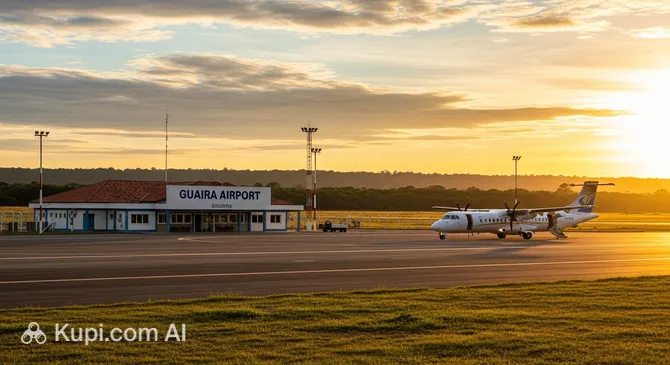
Guaira. Source: Kupi.com Binoculars

Guaíra Airport, officially named after Walter Martins de Oliveira, is a strategically important, albeit small, air gateway in the west of the state of Paraná. Located practically on the border with Paraguay and the state of Mato Grosso do Sul, this cosy terminal offers travellers an excellent alternative to long car journeys. Thanks to its intimate atmosphere, the stress usually associated with metropolises is absent here, and departure often feels like the beginning of an exciting excursion over the picturesque landscapes of Brazil and the waters of the Paraná River.

IATA CodeGGJ
ICAO Code SSGY
City Guaíra
Distance to Centre ~4-5 km
Status Domestic (Regional)
Passengers per Year Approx. 320 (2022 data)
ScheduleOnline board

Airport Features and Advantages

Convenient Location. The airport is located just 4-5 kilometres from the city centre, allowing you to reach it by taxi or transfer in literally 10 minutes. This is particularly convenient for tourists planning to visit the famous river port or go shopping in the neighbouring Paraguayan city of Salto del Guairá immediately upon arrival.

Connection to the State Capital. Guaíra is part of the "Voe Paraná" regional aviation development programme. Regular flights connect the city with Curitiba, reducing a tiring 8-hour car journey to a comfortable flight, opening up new opportunities for business trips and tourism.

Scenic Views. Flights are often operated on small turboprop aircraft, such as the Cessna Grand Caravan. Flying at a comparatively low altitude gives passengers a unique opportunity to view the endless agricultural lands and the majestic Paraná River through the windows, enjoying the panorama of the region.

Swift Service. Due to the low passenger volume, all pre-flight procedures, including check-in and security screening, are completed very quickly. Travellers can afford to arrive at the airport shortly before departure without fearing missing their flight due to queues.

Contact Information

Since Guaíra Airport (GGJ) is a small regional hub, it is managed directly by the city municipality. There is no separate 24-hour terminal hotline, so it is recommended to use the contacts of the city administration or the air carrier for communication.

  • Official Website: www.guaira.pr.gov.br (infrastructure/airport section on the municipality portal).
  • Airport Address: Rodovia BR-272 (exit towards Umuarama), Zona Rural, Guaíra — PR, Brazil.
  • Inquiry Phone: +55 (44) 3642-9900 (Guaíra Administration Secretariat — Secretaria Municipal de Administração). Please note: communication is generally conducted in Portuguese.
  • Email: There is no direct email for the terminal. For official inquiries, you can use the contact form on the city hall website.
  • Passenger Support and Lost Luggage: All issues regarding flights, tickets, or lost items must be resolved directly through the airline operating the flights (currently Azul Conecta).
    • Airline Website: www.voeazul.com.br
    • Azul Support Centre Phone: 0800 887 1118 (within Brazil) or +55 11 4003-1118.
  • Social Media: Current news about airport operations is often published on the official City Hall pages (Prefeitura de Guaíra) on Instagram and Facebook.

How to Get to the Airport

The transport accessibility of Guaíra Airport is one of its main advantages. Thanks to the compactness of the city and the terminal's location just 4–5 kilometres from the centre, the journey takes minimal time. Since the airport serves a small number of regional flights, there are no complex interchanges or traffic jams here, although the choice of transport methods is limited mainly to road vehicles.

Taxi and Transfer

This is the most reliable and common way to get to the airport. The trip from central hotels or the Guaíra bus station usually takes 10–15 minutes.

  • City Taxi: Cars can be found at ranks in the city centre or called by phone. In small Brazilian cities, drivers often work on fixed fares for trips to the airport, but it is always better to clarify in advance whether the meter (taxímetro) will be used or if the price is negotiable. The estimated cost of the trip is between 20 and 40 Brazilian Reais.
  • Ride-hailing Apps: Popular aggregators (such as Uber or 99) may operate in the region, but due to the small size of the city, the number of active drivers can be limited. It is recommended to check vehicle availability in advance, especially for early morning flights.
  • Transfer: Some hotels in Guaíra offer a transfer service for their guests. Given that flights are infrequent, arranging a pick-up or drop-off with your hotel is an excellent idea for peace of mind.

Public Transport

There are no specialised public transport routes (airport express or direct city buses) entering the terminal grounds in Guaíra. The airport is located next to the BR-272 highway. Although intercity or suburban buses may pass by, stopping on the highway with luggage can be inconvenient and unsafe. Tourists are strongly advised to choose a taxi or a rental car.

Car Rental and Parking

Travelling by car is a popular choice for those planning to visit not only Guaíra but also neighbouring Paraguay or the Sete Quedas falls (now submerged, but with a museum nearby).

  • Car Rental: Inside the small airport building, counters of international rental companies may operate on a limited schedule — only for flight arrivals. It is recommended to book a car online in advance so that a representative meets you with the keys upon arrival.
  • Parking: A parking area is equipped in front of the terminal. Typically, in such small regional airports in Brazil, parking is open-air and may be free or cost a nominal fee, however, it is better to check for security presence and exact rates on site.

Alternative Airports Nearby

Since Guaíra Airport receives a limited number of small aviation flights, many tourists prefer to fly into larger neighbouring hubs and reach the city by bus or rental car. Here is a list of the nearest alternatives:

  • Cascavel Airport (CAC) — located approximately 124 km away. It is a major regional hub with a large number of regular flights.
  • Alejo García Airport (AGT) — located in Paraguay, 166 km from Guaíra. Convenient for those planning a trip across the border.
  • Cataratas Airport (IGU) — the main tourist airport of the region, located in Foz do Iguaçu (170 km). Most tourists (over 2 million per year) wishing to see the famous waterfalls fly here.
  • Cataratas del Iguazú International Airport (IGR) — the Argentine alternative, located 185 km away.
  • Dourados Airport (DOU) — located in the neighbouring state of Mato Grosso do Sul, at a distance of about 221 km.

Terminals and Map

The structure of Guaíra Airport (GGJ) is distinguished by extreme simplicity and compactness, which is typical for regional air harbours in Brazil with low passenger traffic. You will not find confusing corridors or multi-level interchanges here — everything is arranged so that the traveller spends minimum time on formalities.

Number of Terminals and Their Purpose

The airport has one passenger terminal. It is a small single-storey building that serves both departing and arriving flights. There is no separation into domestic and international sectors, as the airport exclusively receives regional flights within the country (predominantly from the state capital — Curitiba).

Airport Layout and Navigation

Navigation in the terminal is intuitive, and getting lost here is practically impossible. All key zones are within direct line of sight from the entrance:

  • Central Hall: Upon entering the building, passengers find themselves in the general waiting area where airline check-in counters are located.
  • Departure Zone: After check-in and baggage drop, passengers pass through security into the sterile zone ("Sala de Embarque"). It consists of a small room with seats and an exit directly onto the apron to the aircraft.
  • Arrival Zone: The arrival sector ("Desembarque") is in the same building. Since flights are operated by small aircraft, baggage claim often occurs in a simplified mode — staff deliver it from a cart directly to the claim area, which may not be equipped with complex conveyor belts.

Transfers and Service Features

Since the terminal complex consists of a single building, there are no transfers between terminals. Passengers do not require shuttles, travelators, or lifts to move around.

Terminal Features:

  • Walking Boarding: Jet bridges are not used in Guaíra. Passengers walk out of the terminal building and proceed across the airfield to the aircraft (a distance of only a few dozen metres). This allows for beautiful photos with the aircraft in the background (with staff permission).
  • Compactness: The distance from the airport entrance to your seat on the plane can be covered in literally a couple of minutes (excluding procedure time).
  • Minimalist Services: The terminal has basic amenities (restrooms, waiting area), but do not count on an extensive Duty Free zone, business lounges, or large restaurants. It is recommended to arrange a snack in advance if you are used to a substantial meal before flying.

Processing Times

Thanks to low congestion, all processes in Guaíra are much faster than in major hubs:

  • Check-in: Queues at counters are either non-existent or minimal. However, considering the schedule of regional flights, the counter may close strictly according to regulations (usually 30–40 minutes before departure).
  • Security Screening: Security checks take 5–10 minutes.
  • Time Recommendation: Despite the lack of queues, it is recommended to arrive at the airport approximately 1 hour before departure. This time is sufficient to calmly check in luggage and pass security without risking being late due to unforeseen circumstances.

Airport History

Airport History: From Tourist Mecca to Regional Revival

The history of Guaíra Airport (GGJ) is inextricably linked to the dramatic and eventful fate of the city itself. Unlike many other regional airfields built solely for agricultural or postal needs, Guaíra's air gateway was once the portal to one of nature's greatest wonders.

The Era of the "Seven Falls" (until 1982)
In the mid-20th century, Guaíra was one of the most popular tourist destinations in South America. Travellers from all over the world flocked here to see the famous Sete Quedas waterfalls — the largest by volume in the world at that time. During those years, the airport played a key role, receiving flights with tourists and high-ranking guests. It was a golden age when infrastructure operated at its limit to serve the flow of those wishing to see the "thundering water".

Turning Point and Quiet Years
In 1982, with the formation of the reservoir for the Itaipu hydroelectric plant, the waterfalls were submerged. With the disappearance of the main attraction, the tourist flow dried up sharply. Decades of quiet ensued for the airport. For a long time, it functioned mainly as a site for private aviation, flying clubs, and agricultural aircraft, losing its status as an important passenger hub.

Revival: The Voe Paraná Programme
A new chapter in the airport's history began quite recently, in the late 2010s. The government of the state of Paraná launched the ambitious "Voe Paraná" programme, aimed at restoring air connections with small cities. Under this programme, Guaíra Airport underwent a series of modernisations to meet the strict requirements of the National Civil Aviation Agency (ANAC). Between 2019 and 2021, significant works were carried out:

  • Renewal of perimeter fencing to prevent wild animals from entering the runway.
  • Modernisation of the terminal and waiting area for passenger comfort.
  • Improvement of the fire safety system and navigational signs.

Thanks to these efforts, after almost three decades of no regular commercial flights, major aviation returned to Guaíra in the form of Azul Conecta, connecting the city with the state capital, Curitiba.

Interesting Facts

  • Name on the Map: The airport bears the name of Walter Martins de Oliveira. This is a tribute to a local figure who contributed to the development of the region, highlighting the close connection of the air harbour with municipal history.
  • Strategic Geography: The airport is located at a unique geographical point. During take-off and landing, pilots must consider the proximity of the national border, as the Paraná River separates Brazilian Guaíra from the Paraguayan city of Salto del Guairá.
  • Runway Length: The airport runway is asphalt-paved and approximately 1300 metres long. This is sufficient to accommodate small turboprop aircraft and business jets but restricts the arrival of large mainline airliners.

Services and Facilities

Given its status as a regional airport with low passenger traffic, Guaíra Airport (GGJ) offers a very limited range of services. The terminal is designed for the fastest possible departure and arrival procedures, so passengers should not expect the infrastructure typical of major international hubs. Nevertheless, the necessary minimum for a comfortable short wait is available here.

Dining and Shopping

Gastronomic options in the terminal are kept to a minimum. There are no full-service restaurants, chain cafes, or Duty Free zones here.

  • Cafe and Snacks: A small sales point (kiosk) or vending machines with soft drinks, coffee, and light snacks may operate in the waiting hall. However, the assortment is limited.
  • Recommendation: Travellers are strongly advised to eat in the city before heading to the airport. Guaíra's centre, with excellent steakhouses (churrascarias) and restaurants, is just a 10-minute drive away.
  • Shops: There are no souvenir shops or clothing stores in the airport. If you wish to buy something to remember the region by or famous Paraguayan products, it is better to do so in the city's shopping centres or in neighbouring Salto del Guairá.

Connectivity, Finance, and Business Services

Guaíra Airport is a place where you spend minimal time before boarding, so business infrastructure is poorly developed here.

  • Wi-Fi and Charging: Free wireless internet provided by the municipality or airport operator is generally available in the terminal building. The connection speed is sufficient for checking email and messaging apps. Power outlets for charging gadgets can be found in the general waiting hall, but their number is limited — it is recommended to carry a charged power bank.
  • ATMs and Currency Exchange: Currency exchange points and bank branches are absent in the terminal. ATMs (Caixa 24h) may also not be available directly in the building. It is best to withdraw cash (Brazilian Reais) in advance at bank branches in the city centre.
  • Business Lounges: There are no VIP lounges or conference rooms at the airport. The waiting hall is shared by all categories of passengers.

Medical and Family Services

Despite its compactness, the administration strives to ensure basic comfort and safety.

  • Medical Assistance: There is no full-fledged medical centre with a doctor at the airport, but security and administration staff are trained in first aid and have first aid kits. In emergencies, an ambulance from the city arrives very quickly due to the short distance.
  • For Passengers with Children: Specialised mother and child rooms are not provided. However, clean restrooms are available. Considering that check-in and boarding take little time, waiting with children here is rarely tiring.

Passengers with Reduced Mobility

The single-storey architecture of the terminal makes it quite convenient for citizens with limited mobility.

  • Accessibility: There are no stairs, escalators, or lifts in the airport, which simplifies movement in a wheelchair from the entrance to the airfield. Entrances are equipped with ramps.
  • Boarding the Aircraft: Since there are no jet bridges and flights are operated on small aircraft (e.g., Cessna Grand Caravan), boarding takes place from the apron. Airport and airline staff are always ready to assist with boarding. It is recommended to notify the airline of the need for special assistance no later than 48 hours before departure.

Hotels Near the Airport

There are no hotels directly on the airport grounds or within walking distance. However, due to the proximity to the city, a transfer to any hotel takes no more than 15 minutes. Tourists can choose accommodation both in Guaíra itself and consider options on the border.

Popular accommodation options in the city:

  • Deville Express Guaíra: One of the most well-known hotels in the region with a pool and green grounds, offering comfortable conditions for relaxation.
  • Hotel Gaucha: A budget-friendly and convenient option in the city centre, suitable for transit passengers.

If you have an early flight, there is no need to look for accommodation near the terminal — a taxi from anywhere in the city will get you to the check-in counter in mere minutes.

Where to Eat

Dining Options at the Airport

Passengers flying from Guaíra need to consider the specifics of this small regional airport: there is no full food court zone, fine dining restaurants, or chain coffee shops here. The gastronomic infrastructure of the terminal is focused exclusively on a quick snack before a short flight.

Main Establishments and Location:

  • Snack Bar (Lanchonete) / Cafeteria: In the general waiting hall (Landside), accessible before security screening, a small food point or kiosk usually operates. This is the only place in the airport where you can buy food and beverages.
  • Departure Zone (Airside): In the sterile zone after security, opportunities to buy food may be non-existent or limited to a vending machine. It is recommended to purchase water or a snack before passing through security control.

Menu and Local Flavour

Despite the modest selection, even in such a small cafe, you can taste the flavour of Brazil. The assortment usually includes:

  • Pão de queijo (Cheese Bread): Famous Brazilian cheese buns made from cassava flour. This is an ideal hot and filling snack worth trying with a cup of strong local coffee ("cafezinho").
  • Salgados: Traditional savoury pastries filled with chicken (coxinha) or meat.
  • Beverages: Soft carbonated drinks (including the popular Brazilian Guaraná Antarctica), water, juices, and coffee.

Dietary Requirements

The choice of specialised food in the terminal itself is extremely limited:

  • For Vegetarians: Cheese buns (Pão de queijo) are suitable for ovo-lacto vegetarians, but vegan options are hard to find (most pastries contain cheese or eggs).
  • Gluten-Free: Traditional Pão de queijo is made from cassava starch and is naturally gluten-free, however, due to possible cross-contamination in the kitchen, people with coeliac disease should be cautious and check ingredients.
  • Halal and Kosher: There are no specialised certified products available at the airport.

Prices and Opening Hours

  • Opening Hours: The food point does not operate 24 hours. The schedule is strictly tied to flight times: the kiosk opens approximately an hour and a half before departure and closes shortly after the aircraft leaves. On days without flights, the cafe may be closed.
  • Price Range: Prices are affordable. Coffee and a bun will cost on average 15–25 Brazilian Reais.

Recommendations for Passengers

For a Quick Snack: If you just need to curb your hunger, the snack bar at the airport is quite suitable. Fresh coffee and a cheese bun will brighten up the short wait for boarding.

For a Full Meal: It is strongly recommended to eat in the city before leaving for the airport. Guaíra is famous for its river cuisine. Since the terminal is only a 10-minute drive from the centre, you will have enough time to visit one of the local Churrascarias (steakhouses) or try "Pintado na Telha" (fish on a tile) in restaurants on the banks of the Paraná River, and then calmly head to your flight full and satisfied.

Traveller Tips

Travelling through a small regional airport like Guaíra has its own specifics. The rules of huge international hubs do not apply here, and a cosy, almost homely atmosphere coexists with the strict requirements of small aviation. To ensure your flight goes smoothly, we have compiled the most important practical tips.

Optimal Arrival Time

Forget the rule of "arriving 3 hours early". Guaíra Airport is so compact that arriving too early will doom you to a long, boring wait in a small hall.

  • The Golden Standard: Arrive at the airport 1 hour before departure. This time is quite sufficient to check in and pass security without rushing.
  • Critical Threshold: Check-in counters close strictly according to schedule (usually 30–40 minutes before departure). Being even 5 minutes late can be fatal, as staff move on to preparing the aircraft on the apron.

Check-in, Luggage, and Seat Selection

Flights from Guaíra are often operated on light aircraft such as the Cessna Grand Caravan (capacity up to 9 passengers). This imposes special restrictions:

  • Weighing: Be prepared for staff to possibly ask to weigh not only your luggage but you as well (or simply ask for your weight). This is a standard procedure for balancing a small aircraft and ensuring flight safety.
  • Seat Selection: In such aircraft, the seating layout is usually 1-1. This means that every seat is both a window and an aisle seat. Choosing a side is not critical: the plane flies at a low altitude (about 3000 metres), and stunning views of the Paraná River and fields are open to all passengers.
  • Check-in: It is recommended to check in online via the airline app (Azul) to save time at the terminal.

Hand Luggage: What is Allowed and What is Not

This is the most important point for passengers of small aviation. A standard "cabin size" suitcase that you are used to taking into the cabin of an Airbus or Boeing will not fit in the cabin of a Cessna.

  • Size Matters: Only small backpacks, ladies' handbags, or laptops that can be placed under the seat or on your lap are allowed in the cabin.
  • Valet Check: If you have a standard hand luggage bag (wheeled suitcase), it will be collected free of charge at the aircraft steps and placed in the luggage compartment, and returned immediately upon exiting the aircraft on arrival. Remove fragile items, documents, and electronics from such bags in advance.
  • Liquids: Since flights are domestic, rules for carrying liquids are more lenient than on international flights, but do not overdo the volumes due to limited space.

Connections and Transit

Most flights from Guaíra head to Curitiba, from where passengers fly to all parts of Brazil.

Tip: When planning a transfer in Curitiba, allow at least 2–3 hours between flights. Small aviation is more sensitive to weather conditions than large airliners. Fog or strong wind can delay departure from Guaíra, so a time buffer will save you from stress.

Customs and Shopping

The airport serves only domestic flights, so there is no customs or passport control here. However, there is an important nuance:

Goods from Paraguay: Guaíra borders Paraguay, a popular place for shopping. If you are carrying electronics or expensive goods bought abroad, keep the receipts. Although customs officers are rarely seen at the airport, checks by the Federal Revenue Service (Receita Federal) may be conducted on roads to the airport regarding compliance with duty-free import quotas (usually 500 USD for the land border).

Saving Time and Money

  • Don't Waste Money on Taxis: If you have little luggage and the weather is good, check with your hotel about transfer possibilities. In a small city, you can often agree on a fixed (lower) price with local drivers than by the meter.
  • Dining: Eat in the city. Prices at the airport (if the kiosk is open) may be inflated with a meagre selection. Bring an empty water bottle — there is often a cooler or drinking fountain in the waiting hall.

What to Do in Case of Flight Delay

In a small airport, a flight delay is felt more acutely due to the lack of entertainment.

  • Monitor the App: There are few information screens in the terminal. You will get the most up-to-date information on flight status through the airline app.
  • Alternative Transport: If a flight is cancelled (for example, due to bad weather) and you need to fly urgently, immediately consider a ground transfer to Cascavel (CAC) or Foz do Iguaçu (IGU) airports. Large aircraft land there, which are less dependent on meteorological conditions. The drive to Cascavel by car takes about 2 hours.
Reached the end of the page?

That means the route is fully explored