| IATA Code | IRZ |
| ICAO Code | SWTP |
| City | Santa Isabel do Rio Negro |
| Distance to centre | 5 km |
| Status | Domestic (Regional) |
| Annual Passengers | No official data |
| Schedule | Online board |
Tapuruquara
About the Airport
Contact Information
Given the remote location of Tapuruquara Airport (IRZ) in the very heart of the Amazon, it is important to know that services familiar to major hubs operate differently here. There is very little direct contact data for the terminal available in the public domain, as management is often carried out jointly with local authorities or airline representatives.
- Official Airport Website: The airport does not have its own website. It is recommended to check the current flight schedule and flight status directly on the website of the airline operating the flights (mainly Azul Conecta).
- Airport Address: Aeroporto de Santa Isabel do Rio Negro, Santa Isabel do Rio Negro - AM, 69740-000, Brazil. (Located approximately 5 km from the city centre).
- Information Desk Phone: There is no direct public phone for the terminal. For urgent queries, it is best to contact the local airline office or the City Hall (Prefeitura) of Santa Isabel do Rio Negro.
- Email: There is no public e-mail provided for passengers.
- Social Media: There are no official airport accounts. Sometimes news is published in city public pages or tourism groups for the Amazonas region.
- Lost Luggage Information: Tracing items is carried out exclusively through airline representatives (Azul) immediately upon arrival. There is no separate Lost & Found counter at the airport.
- Passenger Support Contacts: Support is provided through airline call centres. For Azul (Brazil): 0800 887 1118.
How to Get to the Airport
Tapuruquara Airport is located just 5 kilometres from the centre of the city of Santa Isabel do Rio Negro. Considering this is a small settlement in the heart of the Amazon, transport logistics here are quite simple and have their own unique local flavour. You will not find familiar airport express trains or complex metro systems here, but getting to the departure point will not be difficult.
Travel time from the city centre to the terminal is usually 10–15 minutes, depending on the chosen transport and the condition of the dirt road, especially during the rainy season.
Transfers and Taxis
These are the most reliable and common ways to get to the airport. Most tourists arriving here for sport fishing or climbing Pico da Neblina use pre-arranged transfers.
- Organised Transfer: If you are flying as part of a tour group or have booked a lodge, you will likely be met or seen off in a private minibus or off-road vehicle. This is the most comfortable option, the cost of which is usually included in the tour price.
- Official Taxi: There are several private drivers in the city acting as taxis. Cars are not always equipped with meters, so it is better to agree on the trip price (usually a fixed amount, around 20–30 Brazilian Reals) in advance before boarding.
- Moto-taxi (Mototáxi): The most popular and budget-friendly mode of transport in the region. Drivers in vests will quickly deliver you with a small backpack to the aircraft steps. It is cheap (about 5–10 Reals) and allows you to feel the rhythm of local life, but it is completely unsuitable for travellers with bulky luggage or fishing rod tubes.
Public Transport
Santa Isabel do Rio Negro lacks a public transport system in the conventional sense. There are no scheduled buses, trolleybuses, trains, or metro lines running between the city and the airport. Travellers must rely exclusively on taxis or transfers.
Car Rental and Parking
Car rental services (Rent-a-Car) are not represented at Tapuruquara Airport. The road network in the region is extremely limited and practically isolated from the rest of Brazil, so renting a car here makes no practical sense.
As for parking, there is an open area in front of the small terminal building. This is an unguarded zone where those seeing people off can leave their vehicles for free for a short time. There are no specialised paid long-term car parks here.
Recommendations for Passengers
When planning your trip to the airport, keep in mind that in the event of heavy tropical downpours, the road may become washed out, and travel time will increase. Since the terminal infrastructure is minimal, it is recommended to arrive well-fed and with a supply of drinking water, as the café in the departure zone may not be working.
Nearest Airports and Transport Hubs
Since Tapuruquara is a local airport, most travellers arrive here via major transfer hubs or use neighbouring regional airfields to build complex routes across the Amazon.
- Eduardo Gomes International Airport (MAO) — the main hub of the region, located 624 km away. Most flights to Santa Isabel depart from here.
- Boa Vista Airport (BVB) — another important node in northern Brazil (597 km).
- Coari (CIZ) — a regional airport 464 km to the south.
Also, within a radius of 600–700 km, there are airports in neighbouring Colombia, such as Puerto Inírida and Mitú, however, there are no direct flight connections with them, and they can only be reached via complex river routes.
Terminals and Map
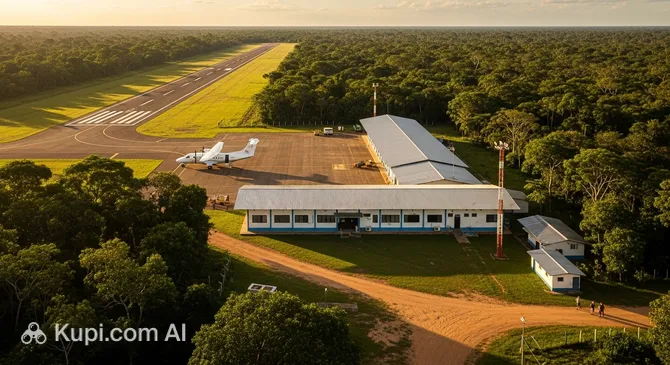
Tapuruquara Airport (IRZ) in Santa Isabel do Rio Negro is a compact regional airfield, the layout of which differs radically from bustling international hubs. A calm atmosphere reigns here, and infrastructure is reduced to the necessary minimum for servicing small aviation flights.
Number of Terminals and Airport Layout
The airport has only one small passenger terminal. It is a single-storey building that serves both departing and arriving passengers. Thanks to its modest size, Tapuruquara Airport is one of the easiest to navigate: it is impossible to get lost here, as all functional zones are within direct line of sight from the entrance.
Terminal maps or navigation apps are not required here. All logistics are intuitive: the entrance to the building leads directly to the check-in counters, and the boarding gate is located a few steps from the waiting area.
Departure and Arrival Zones
The terminal space is zoned very nominally, but effectively for the existing passenger flow:
- Check-in Zone: Located immediately at the entrance. The airline counters (usually Azul Conecta) are located here. The check-in process often proceeds in a more relaxed mode than in major cities, but with compliance with all safety rules.
- Waiting Hall: A small area with seats where passengers await the boarding call. The comfort level is basic; there may not be powerful air conditioning systems here, so one should be prepared for the humid tropical climate even indoors.
- Arrival Zone: There is no separate hall for greeters with electronic boards here. Passengers exit the aircraft, walk down the steps themselves, and walk across the airfield to the terminal building (the distance is minimal).
- Baggage Claim: There are no automatic baggage belts. Luggage is unloaded from the aircraft by staff manually and handed to passengers either at a special delivery window or at a designated area inside the terminal.
Terminal Features and Services
The Tapuruquara Airport terminal is maximally ascetic. Passengers should consider the following features:
- Transfers between terminals: Since there is only one terminal, no transfers or shuttles are required.
- Infrastructure: The airport has restrooms. Food outlets (cafés or buffets) operate inconsistently and may be closed during your flight, so it is recommended to bring food and water with you.
- Shops and Services: There are no Duty Free zones, ATMs, or currency exchange points in the terminal.
- Accessibility: The single-storey design is convenient for passengers with reduced mobility, however, the lack of airbridges (boarding is via the aircraft's stair-ladder) may require staff assistance, which is willingly provided.
Procedure Times
The absence of long queues is the main advantage of IRZ airport. Procedures here are very quick:
- Check-in and Baggage Drop: Usually takes from 5 to 15 minutes.
- Pre-flight Security: Conducted quickly but thoroughly. There are practically no queues.
- Recommended Arrival Time: Despite the speed of service, airlines recommend arriving at the airport 1 hour before departure. This is because check-in may close strictly according to schedule, and staff need time to prepare documentation and load the aircraft.
Navigation Recommendations
The main advice for tourists in Tapuruquara is to relax and follow the instructions of airline staff. There are no complex corridors or multiple gates here. The entire flow of passengers is directed through a single exit to the airfield. Keep your boarding pass to hand and listen carefully to voice announcements, which are typically made by staff in person, without the use of a PA system.
History of the Airport
The history of Tapuruquara Airport (IRZ) is inextricably linked with the exploration of the Brazilian Amazon and attempts to establish connections with the most remote corners of the region. Unlike capital hubs, which were built immediately as major civil facilities, the air harbour of Santa Isabel do Rio Negro developed as a vital outpost for the city's survival in conditions of geographical isolation.
Foundation and Preservation of the Historical Name
The exact date of the opening of the first runway in this location dates back to the mid-20th century, when aviation began to replace long river journeys along the Rio Negro. Notably, the airport officially retained the name Tapuruquara, which the city itself bore until 1956. This name is a tribute to the historical roots of the settlement, which originated as a mission. For a long time, the airfield was a simple dirt strip, serviced mainly by military aviation (Força Aérea Brasileira) and rare mail flights.
Stages of Development and Modernisation
A key factor in the airport's development has always been its strategic importance for border control and support of local communities. The evolution of the air harbour went through several important stages:
- The Dirt Strip Era: For decades, landing here required high pilot skill. Infrastructure was minimal, and the strip, washed out by tropical downpours, often became unusable, cutting the city off from the outside world.
- Asphalting and Terminal Construction: A crucial step was the laying of an asphalt surface 1,200 metres long. This allowed for the reception of not only light private aircraft but also more capacious turboprop vessels, such as the Embraer Bandeirante, and with certain restrictions, ATRs.
- Inclusion in Federal Programmes: In the 2010s, the airport became part of the Regional Aviation Development Programme (PDAR), which drew the attention of authorities to the need for repairing fences and upgrading navigation equipment.
Recent History and Return of Regular Flights
A landmark event in the modern history of the airport was the end of 2022. After a period when the city relied mainly on irregular charters, air taxis, and military flights, stable air communication was restored. In December 2022, the airline Azul Conecta (a regional subsidiary of the giant Azul) officially launched regular flights from Manaus. Flights are operated on reliable Cessna Grand Caravan aircraft, ideally suited for Amazonian conditions. This event was a real breakthrough, returning Santa Isabel do Rio Negro to the national route network.
In parallel, in the early 2020s, the airport was included in a list of facilities subject to reconstruction within the framework of public-private partnerships and federal investments aimed at improving flight safety in hard-to-reach regions.
Interesting Facts and Significance
Tapuruquara Airport holds a unique status in the Brazilian tourism world due to its location and logistical features:
- Gateway to the Peak of Brazil: This is the nearest civil airfield to the country's highest point — Pico da Neblina (2,995 m). The history of many scientific and sports expeditions to this summit began right on the IRZ runway.
- Capital of Sport Fishing: The growth in passenger traffic in recent years is largely dictated by fishing tourism. In the season (from September to March), traffic here increases significantly due to enthusiasts fishing for the giant peacock bass (tucunaré-açu).
- Logistical Feat: All materials for runway repairs and terminal construction were previously delivered here by river on barges. This journey from Manaus could take up to several weeks, making any modernisation a true engineering challenge.
Services and Amenities
Passengers arriving at or departing from Tapuruquara Airport (IRZ) should remember: this is a remote regional airfield in the very heart of the Amazon. The level of service and infrastructure here corresponds to basic needs and differs radically from what travellers are accustomed to in major metropolises. Comfort here is minimalist but functional.
Restaurants, Cafés, and Shops
Gastronomic opportunities in the terminal are extremely limited. There are no chain restaurants, coffee shops, or a full food court zone here.
- Dining: A small kiosk or buffet (lanchonete) may operate in the airport building, offering soft drinks, coffee, crisps, and local pastries. However, its opening hours often depend on the flight schedule, and it may be closed. It is strongly recommended to carry a supply of drinking water and a light snack, especially if you are travelling with children.
- Shops: Duty Free zones are absent. There are typically no souvenir stalls in the terminal itself. It is best to purchase items from local artisans or travel necessities in advance in the city of Santa Isabel do Rio Negro.
Financial Services and Connectivity
When heading to this region, it is important to be prepared for limited access to modern technologies and banking services directly at the airport.
- ATMs and Currency Exchange: There are no ATMs or currency exchange points in the terminal. Card payments at the buffet (if open) may be unavailable due to connection interruptions. Travellers need to carry a sufficient supply of cash (Brazilian Reals), withdrawn in advance in Manaus or at a bank branch in the city.
- Wi-Fi and Connectivity: Public free Wi-Fi at the airport is typically absent or works extremely unstably. Mobile signal in the airport area may be patchy.
- Charging Stations: There are no specialised stands for charging gadgets. You may find a free power socket in the waiting hall, but their number is limited. It is recommended to carry a fully charged power bank.
Comfort and Waiting Lounges
The airport has one general waiting hall. The zoning of the space is simple and without frills.
- Business Lounges: There are no VIP lounges or halls of increased comfort at Tapuruquara Airport. All passengers await departure in the general hall.
- Air Conditioning: The hall is equipped with fans or a basic air conditioning system, but due to the humid climate, it may feel stuffy inside.
Medical Services and Safety
There is no full medical centre or pharmacy in the terminal. Only a basic first aid kit is available with airport staff. The nearest hospital is in the city of Santa Isabel do Rio Negro (about 10–15 minutes' drive). For passengers with chronic conditions, it is critical to carry all necessary medication in hand luggage.
Services for Passengers with Children
There is no specialised infrastructure for families with children (mother and child rooms, changing tables, play zones) in the terminal. Given the potential waiting time, parents should take care of entertainment, food, and hygiene supplies for little ones themselves.
For Passengers with Disabilities
Despite the simplicity of the terminal, its single-storey layout is convenient for citizens with reduced mobility — there are no thresholds, lifts, or escalators, which facilitates movement in a wheelchair.
Important Nuance: Boarding the aircraft (usually small Cessna Caravans) is carried out via built-in stair-ladders. There are no ambulifts. Airport and airline staff are always ready to provide physical assistance with boarding and disembarking, but the airline should be notified of the need for such assistance when booking the ticket.
Hotels and Accommodation
There are no hotels on the airport territory or within walking distance. Since the airport is just 5 km from the city, passengers stay in hotels in Santa Isabel do Rio Negro.
Accommodation options in the city are mainly represented by small guest houses (pousadas), oriented towards anglers and eco-tourists. Transfer to the hotel usually takes no more than 15 minutes by taxi.
Business Services
There are no conference rooms, business centres, or printing/fax services at the airport. If you need to resolve work issues, it is better to do so before leaving your hotel in the city, where there is internet access.
Where to Eat
The gastronomic scene at Tapuruquara Airport (IRZ) fully reflects its status as a remote regional airfield in the Amazon jungle. Do not expect fine dining restaurants, food courts with international chains, or exquisite coffee houses here. Dining infrastructure is reduced to the necessary minimum, oriented towards a quick snack before a short flight.
Cafés and Food Outlets
In the airport's single terminal, typically only one outlet functions. This is a small snack bar or buffet (known in Brazil as a lanchonete). It does not have a brand name and is managed by local entrepreneurs.
- Location: The food point is located in the general zone (landside), accessible both to departing passengers before security screening and to greeters. In the "sterile" departure zone (airside) after screening, there are no food or drink sales points.
- Opening Hours: The buffet's schedule is not fixed. The establishment opens exclusively according to the flight schedule, usually 1–1.5 hours before the arrival or departure of an aircraft (mainly Azul Conecta flights). At other times, or if there are no flights on that day, the kiosk will be closed.
Menu and Local Specialities
The snack bar's assortment is extremely simple and consists of long-life products and basic Brazilian pastries.
- For a Quick Snack: The menu is based on salgados — traditional savoury Brazilian pastries and snacks (coxinha with chicken, pastries with cheese or meat), which are heated on-site. You can also find crisps, biscuits, and chocolate bars.
- Drinks: Bottled water, carbonated drinks (including guarana soda, popular in the region), carton juices, and basic black coffee are usually available. Alcohol is typically not sold at the buffet.
- Price Range: Prices here are slightly higher than in the city but remain affordable (low/medium segment). Coffee and a bun will cost around 15–25 Brazilian Reals.
Special and Dietary Food
Given the airport's limited capabilities, travellers with specific dietary needs should take care of themselves in advance.
- Vegetarians and Vegans: Finding a substantial meal will be extremely difficult. At best, you will be offered a cheese pastry (for vegetarians) or a packet of crisps/nuts (for vegans). Fresh salads or fruits are not sold here.
- Gluten-Free Food: Guaranteeing the absence of gluten or traces of cross-contamination in local pastries is impossible. Traditional Brazilian pão de queijo (cheese bread) theoretically does not contain gluten, but in a small kiosk setting, risks are high.
- Halal and Kosher: Specialized options are not provided. Travellers requiring strictly Halal or Kosher meals are advised to rely on vegetarian snacks or bring their own food.
Recommendations for Passengers
The best dining strategy when departing from Tapuruquara is to have lunch in the city before leaving for the airport.
- For a Full Meal: It is recommended to visit restaurants or cafés in Santa Isabel do Rio Negro itself. The road to the airport takes only 10–15 minutes, so you can eat calmly in the city and arrive at check-in well-fed.
- Water Supply: Due to the hot climate and the possible closure of the kiosk, it is strongly recommended to carry a bottle of water (before passing security) or an empty container that can be filled if there is access to a water cooler.
- Insurance Against Hunger: If you are travelling with children or have a strict diet, be sure to take food with you in your hand luggage (fruits, sandwiches, snacks), as in the event of a flight delay, there may be nowhere to buy food in the terminal.
Tips for Travellers
Travelling through Tapuruquara Airport is a unique experience that differs greatly from flying through major international hubs. Here, in the heart of the Amazon, specific rules apply, dictated by the peculiarities of small aviation and the changeable tropical climate. To ensure your flight is as comfortable as possible, we have prepared a list of practical tips.
Time Planning and Arrival
Despite the airport being tiny and there being practically no queues, punctuality is critically important.
- Arrive 60 Minutes Early: It is recommended to be at the airport an hour before departure. Check-in for small aviation flights (usually Cessna Grand Caravan) closes strictly according to schedule. Pilots need time to calculate the aircraft's weight balance before take-off.
- Allow Time for the Road: In the rainy season, the dirt road to the airport can be washed out, and the journey will take longer than usual.
Check-in and Documents
Procedures in Santa Isabel do Rio Negro are conducted "the old-fashioned way," often manually.
- Offline Tickets: Be sure to save your e-ticket to your phone memory or print it out. Internet in the airport area works unstably, and opening the airline app at the right moment may not be possible.
- Weighing Passengers: Do not be surprised or embarrassed if you are asked to stand on the scales together with your hand luggage at check-in. For small aircraft, the exact weight of each passenger is important for flight safety and aircraft centring.
Luggage and Hand Luggage: Attention Anglers
Since most guests of the region are sport fishing enthusiasts, it is important to remember strict safety rules.
- Fishing Tackle: Any hooks, lures, knives, and multi-tools must be checked in as registered baggage. Attempting to bring even a small lure with a hook in hand luggage will lead to its confiscation at security.
- Spinning Rod Tubes: Check the rules for transporting oversized baggage (tubes) with Azul Conecta in advance. There is little space in the luggage compartment, and it is better to warn the carrier about non-standard cargo when purchasing a ticket.
- Soft Bags: For hand luggage, it is better to use soft backpacks rather than rigid "cabin size" suitcases. Shelves in the Cessna Caravan cabin are very small or non-existent (items are placed under the seat or in a special compartment), so a soft bag is easier to stow.
Seat Selection and Flight
Flying over the Amazon jungle is a breathtaking excursion, so seat selection matters.
- Where to Sit: In Cessna-type aircraft, the cabin configuration is usually 1+1 or 1+2. Any window seat will provide stunning views of the winding course of the Rio Negro and the endless green ocean of forests.
- Seat Allocation: Be prepared for the aircraft commander to ask you to move to a specific seat for proper aircraft weight distribution. It is not worth arguing in this case — it is a matter of safety.
Connections and Transit
Practically all flights from Tapuruquara head to Manaus. If you have a further flight planned, consider the following nuances:
- Time Margin: Leave a large gap (minimum 3–4 hours) between arrival in Manaus and your next flight. Weather in the Amazon is unpredictable: a heavy downpour can delay departure from Santa Isabel by several hours.
- Baggage Collection: Through-checking of baggage to the final destination (for example, to São Paulo or Rio) is often impossible if you are flying with different airlines or on different bookings. You will have to collect your luggage in Manaus and check it in again.
Money and Saving
The region's infrastructural limitations dictate their own rules for economy.
- Cash: This is the most important piece of advice. There are no ATMs at the airport, and payment terminals may not work due to connection problems. Always have a supply of cash Reals with you to pay for taxis or water.
- Food and Water with You: Prices at the single kiosk may be inflated, and the choice is meagre. Buy water and a snack (sandwiches, fruit) in a city supermarket in advance — this will save your budget and guarantee that you won't go hungry.
- Shared Transfer: If you are travelling alone, try to cooperate with other tourists for a taxi ride to the city. This is a common practice that allows you to split the cost of the trip.
What to Do in Case of Flight Delay
Delays due to weather conditions are common here. There are no information boards in the terminal, so:
- Stay Close to the Airline Representative: All information is conveyed verbally.
- Charging Gadgets: There are few sockets in the hall. Be sure to take a fully charged power bank with you to stay connected if the wait drags on.
- Offline Entertainment: Download films, books, or music to your phone in advance. Wi-Fi at the airport may not work, and mobile internet may be too slow for streaming.
Reached the end of the page?
That means the route is fully explored