Support

Cabo Frio International Airport

About the Airport

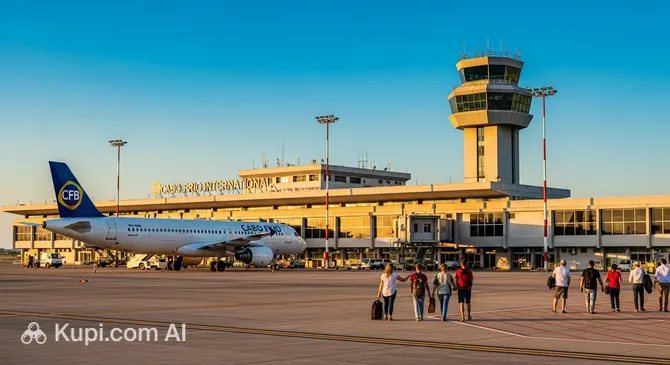
Cabo Frio International Airport. Source: Kupi.com Binoculars

Cabo Frio International Airport (CFB) is not just an air gateway, but your personal ticket to the famous Brazilian "Lakes Region" (Região dos Lagos), the heart of the sunny Costa do Sol. Located on the site of a former military airfield, today it is a modern transport hub that harmoniously combines tourism services with a vital role in logistics. Journeys to white sandy beaches, turquoise lagoons, and lively resort towns begin here, making the airport the ideal starting point for exploring this paradise corner of Brazil.

IATA Code CFB
ICAO Code SBCB
City Cabo Frio
Distance to centre 8 km
Status International
Passengers per year approx. 138,000 (2023)
Popular Airlines Azul Brazilian Airlines, Aerolineas Argentinas, LATAM Airlines
Schedule online schedule "Cabo Frio International Airport"

A key advantage of Cabo Frio Airport is its strategic location. It serves as a convenient starting point for tourists heading to world-renowned resorts such as Búzios and Arraial do Cabo. Thanks to this, travellers do not need to spend time on long and tiring transfers from the major airports of Rio de Janeiro.

The airport is also unique for its dual functionality. Alongside serving passenger flights, including seasonal international and charter routes, it functions as an important logistics centre. It houses a large cargo terminal as well as a dedicated terminal for helicopter flights to offshore oil platforms. This multitasking capability makes it a key element of the economic infrastructure for the entire region.

Contact Information

Below you will find contact information for Cabo Frio International Airport (CFB). We recommend checking the details on the official website before your trip.

  • Official airport website: www.cabofrioairport.com.br
  • Information desk phone: +55 (22) 2647-9500
  • Airport address: Estrada Velha de Arraial do Cabo, s/nº - Fazenda Odeon, Cabo Frio / RJ, CEP: 28.913-000, Brazil
  • Email: contato@cabofrioairport.com.br
  • Social media: You can follow airport news on Instagram: @cabofrioairport
  • Lost luggage information: For lost and found items (Achados e Perdidos), please contact the airport administration or call +55 (22) 2647-9500.
  • Passenger support contacts: For assistance and enquiries, please use the main airport phone number.

How to Get to the Airport

Getting to Cabo Frio International Airport (CFB) from the city centre or nearby resort areas is quite simple, as it is located just 8 kilometres from the centre of Cabo Frio. Depending on your budget, time, and preferences, you can choose from several convenient methods.

Public transport is the most economical option. Municipal buses run between the airport and the central bus station (Rodoviária de Cabo Frio), as well as other key points in the city. While this is the cheapest method, be prepared for the journey to take longer due to stops, approximately 30-40 minutes. The schedule may be irregular, so it is worth checking departure times in advance.

Taxis and transfers are the most comfortable and fastest way. A trip by taxi or via ride-hailing apps (such as Uber) from the city centre to the airport will take just 15-20 minutes without traffic. This is an excellent choice for travellers with large luggage or those who value their time. You can also book a private transfer in advance, which guarantees a fixed price and a meeting at a designated location.

Car rental is the ideal option for those planning to actively explore not only Cabo Frio but also other gems of the "Lakes Region" of Brazil, such as Arraial do Cabo and Búzios. Several rental company offices are present at the airport. Having your own car gives you maximum freedom of movement. There is a car park next to the terminal where you can leave your car for both short and long periods.

In general, for solo travellers and those wishing to save money, the bus is suitable. For families, groups, and those who value comfort, the best choice would be a taxi or transfer. Car rental pays off if you plan to move around the picturesque surroundings extensively.

Terminals and Map

Cabo Frio International Airport (CFB) is a modern and compact aviation hub distinguished by a structure that is simple and easy for travellers to understand. The airport operates one passenger terminal, serving both domestic and international flights, including seasonal and charter destinations.

The terminal layout is extremely logical. All key zones — check-in counters, security screening, the departure hall, and the arrival area with baggage claim — are located in one building a short distance from each other. Since there is only one terminal, transitions between different zones take minimal time, and there is no need for shuttles or long walks. Navigation is intuitively clear, and signs in Portuguese and English will help you orient yourself easily.

Departure and arrival zones are clearly separated for passenger convenience. After checking in for your flight and dropping off luggage, you proceed to the pre-flight security screening area, and then to a comfortable waiting hall with several boarding gates. The arrival zone is positioned so that arriving passengers can quickly proceed to the baggage claim belts and exit the airport.

Thanks to the airport's small size, check-in and security procedures usually do not take much time. On standard days, all procedures take about 30-45 minutes. However, during the peak tourist season (December-February) or on public holidays, it is recommended to allow more time. To avoid rushing, arrive at the airport 1.5–2 hours before departure for domestic routes and 2.5–3 hours before an international flight.

Airport History

The International Airport of Cabo Frio (CFB), officially known as Cabo Frio International Airport, is a relatively young but strategically important transport hub on the famous Costa do Sol in Brazil. Its history is an example of successfully combining industrial needs with tourism potential.

The airport was founded and opened in 1998, and by 2001 it received international status. Initially, its main task was handling cargo transport, primarily to support oil and gas platforms in the Campos Basin (Bacia de Campos), one of the largest oil production areas in the country. For these purposes, one of the longest runways in Brazil was built, capable of accommodating heavy cargo aircraft.

With the growing popularity of the region's resorts, such as Cabo Frio itself, Búzios, and Arraial do Cabo, the airport began actively developing its passenger sector as well. An important stage was attracting charter and seasonal flights, especially from Argentina and Chile, which significantly simplified access to the region's beaches for foreign tourists. This transformed it from a purely industrial facility into an important gateway for international tourism.

One of the key moments in the airport's history was its privatization. It became the first municipal airport in Brazil to be transferred to private company management. This allowed for significant investment in terminal modernization, infrastructure improvement, and service quality enhancement for both passengers and cargo operators. Today, Cabo Frio Airport continues to fulfil its dual mission, serving as a vital logistics centre for the oil industry while simultaneously being a welcoming entrance to one of the most beautiful corners of the Brazilian coast.

Services and Amenities

Cabo Frio International Airport (CFB), despite its compact size, offers passengers all the necessary services for a comfortable wait before their flight. In the terminal, you will find several cafes and snack bars where you can have a bite to eat or drink coffee. Small shops are also available, selling souvenirs, travel goods, and local products.

For the convenience of travellers, free Wi-Fi is available throughout the airport, and waiting halls have power outlets for charging electronic devices. Financial matters can be handled via ATMs and a currency exchange point located in the public area of the terminal.

The airport is equipped to receive passengers with special needs: there are ramps and specially adapted toilets. For travellers with small children, a mother and child room is provided. In case of necessity, you can contact the medical post for first aid.

Although there are no hotels or specialised business centres within the airport building itself, many accommodation options are located in close proximity, in the city of Cabo Frio. Standard waiting halls ensure basic comfort; however, there are generally no separate VIP zones or lounges for business class passengers here.

Where to Eat

Cabo Frio International Airport (CFB) is a compact regional airport, so the choice of dining establishments here is focused on basic passenger needs. While you won't find the wide variety of restaurants seen in major hubs, getting a snack before departure is certainly possible.

The main food outlets are located in the main terminal hall, in the public area before security control (landside). Typically, these are small cafes and kiosks offering a standard set for travellers: coffee, soft drinks, sandwiches, pastries, and light snacks. Here you can also try popular Brazilian snacks, for example, cheese buns known as pão de queijo or savoury pies called salgados.

For a quick snack, coffee and fresh pastries are perfect. If you are looking for a full meal, your options will be quite limited. It is recommended to eat a substantial meal in the city before travelling to the airport, as establishments here are designed more for short waits. After passing security control (airside), the choice is usually even more modest and may be limited to vending machines with drinks and snacks.

Travellers with specific dietary needs (vegans, gluten-free, or halal diets) will find it difficult to find suitable dishes. The selection of vegetarian options usually comes down to cheese pastries or simple salads, if they are on the menu. It is recommended to bring food with you if you have strict dietary restrictions. Prices at the airport, as expected, are higher than average city prices. Opening hours of establishments depend directly on the flight schedule and may be limited to morning and daytime hours.

Travel Tips

Planning a trip through Cabo Frio International Airport (CFB) will be easier if you know a few useful tips. This airport, serving a popular resort region of Brazil, though not as large as capital city hubs, requires standard preparation from passengers.

Arrival time and check-in. To avoid rushing, we recommend arriving at the airport at least 2 hours before domestic flights and 3 hours before international ones. This time is sufficient for check-in, baggage drop, and security control. Many airlines offer online check-in, which saves time and allows you to proceed immediately to the baggage drop counter or, if you are travelling light, to the security screening zone.

Security screening and seat selection. Security control at Cabo Frio Airport follows standard rules. Keep your boarding pass and documents ready. When choosing a seat on the plane, consider your preferences: a window seat will offer you unforgettable views of the Costa do Sol coast during takeoff and landing, whilst an aisle seat provides more legroom and freedom of movement.

Hand luggage. Liquids in containers up to 100 ml, packed in a transparent bag, are allowed in hand luggage. Sharp objects, flammable substances, and weapons are prohibited. Always check your airline's rules, as weight and size requirements for hand luggage may vary.

Connecting passengers and customs. If you have a connecting flight, clarify at check-in whether your luggage will be transferred automatically or if you need to collect it and check it in again. Upon arrival on an international flight, you will have to pass customs control. If you have no goods to declare, feel free to go through the "Green Channel". Customs control is not required for domestic flights.

Saving time and money. To save money, book tickets and transfers from the airport in advance. Bring an empty reusable water bottle with you — it can be filled after passing security. Light luggage will help avoid excess weight fees. Additionally, consider using ride-hailing apps, comparing their prices with official airport taxi tariffs.

In case of flight delay. If your flight is delayed, first contact an airline representative for information. Depending on the length of the delay, you may be provided with drinks, meals, or even hotel accommodation. Keep receipts for unforeseen expenses and check the terms of your travel insurance — it may cover some costs.

Reached the end of the page?

That means the route is fully explored