Support

Galeão Antonio Carlos Jobim International Airport

About the Airport

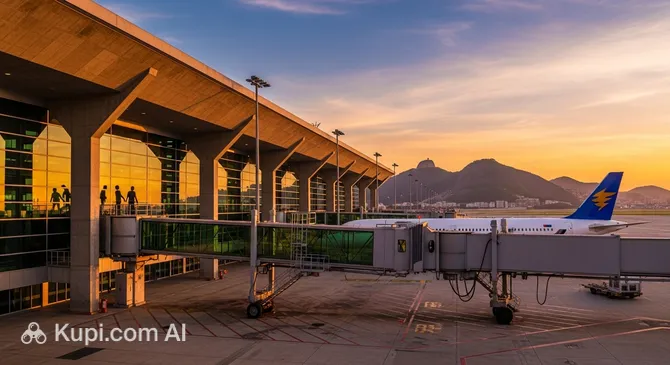
Galeão Antonio Carlos Jobim International Airport. Source: Kupi.com Binoculars

Galeão International Airport, proudly bearing the name of the legendary composer Antonio Carlos Jobim, is not merely a transport hub, but a true prelude to the rhythms of bossa nova and samba. Located on the picturesque Governor's Island, it gifts travellers with breathtaking views of Guanabara Bay and the city's famous skyline even before landing. It is the main aerial gateway opening the path to the golden beaches and iconic landmarks of one of the world's most colourful metropolises.

IATA Code GIG
ICAO Code SBGL
City Rio de Janeiro
Distance to centre ~20 km
Status International
Passengers per year ~14.5 million (2024)

Galeão Airport is renowned for its scale and convenience, offering travellers a range of significant advantages:

Impressive infrastructure. The airport boasts the longest runway in Brazil (4,000 metres), allowing it to accommodate the largest passenger liners from around the globe. Following extensive renovation, the terminals have become even more spacious and modern.

Comfortable waiting. Passengers have access to a wide selection of duty-free shops, restaurants serving local and international cuisine, as well as comfortable VIP lounges. There is an on-site hotel, which is particularly convenient for long layovers.

Transport accessibility. Connection to the city is provided not only by taxis and ride-hailing services but also by BRT (Bus Rapid Transit) express buses. They travel along dedicated lanes, allowing for a faster journey to key points in Rio de Janeiro, bypassing city traffic.

Contact Information

  • Official Website: www.riogaleao.com
  • Help Desk Phone: +55 (21) 3004-6050
  • Address: Av. Vinte de Janeiro, s/nº, Ilha do Governador, Rio de Janeiro, RJ, 21941-900, Brazil
  • Email: For general inquiries and requests, it is recommended to use the contact form on the official website.
  • Social Media: You can follow airport news and updates on the official pages on Instagram and Facebook.
  • Lost & Found Information: If you have lost items within the airport premises, contact the service via email at perdidos.achados@riogaleao.com or by phone at +55 (21) 3004-6050 (extension 4). Current information is available on the dedicated page.
  • Passenger Support Contacts: For assistance or consultation, you may use the general help desk phone number or the contact form on the website.

Getting to the Airport

There are several ways to get to Galeão International Airport (GIG), the main aviation hub of Rio de Janeiro. The choice depends on your budget, time, and comfort preferences. The airport is located approximately 20 kilometres north of central tourist areas such as Copacabana and Ipanema, and travel time depends heavily on traffic conditions.

Public Transport is the most budget-friendly way to reach the city. The primary option is the BRT (Bus Rapid Transit) system. The TransCarioca line directly connects the airport with the Barra da Tijuca district, as well as the Vicente de Carvalho metro station (Line 2), allowing for a convenient and inexpensive route from various parts of the city. Additionally, special shuttle buses (known as "Frescão") operate from the airport to the South Zone (Copacabana, Ipanema, Leblon) and the centre. They are more comfortable, equipped with air conditioning and luggage space, but cost more than the BRT.

Taxi and Transfer are the most convenient and fastest methods (in the absence of traffic jams). Right in the arrivals terminal, you will find counters for official radio taxis, where you can pay for the trip in advance at a fixed rate. This is a reliable option that protects against overcharging. Ride-hailing apps such as Uber and 99 are also popular in Brazil. Generally, their services are cheaper than regular taxis, though prices may vary depending on demand and time of day. Pick-up points for such services are usually located at the exit of the arrivals hall.

Car Rental and Parking. If you plan to travel extensively around Rio's surroundings, renting a car might be a good solution. Offices of all major international and local rental companies are present at Galeão Airport. For those arriving at the airport in their own or rented vehicle, multi-level parking facilities are provided. Both short-term and long-term parking are available, though the cost can be quite high.

Estimated travel time and cost:

  • BRT and Metro: The trip will take 1 to 1.5 hours from the South Zone; this is the most affordable option.
  • Shuttle Bus ("Frescão"): About 1–1.5 hours, average cost.
  • Taxi/Uber: With favourable traffic conditions, you can arrive in 40–60 minutes. This is the most expensive method, especially fixed-rate taxis.

When planning a trip to the airport, always allow extra time. During peak hours (mornings and evenings on weekdays), travel time can increase significantly due to Rio's famous traffic jams. It is also worth remembering that the city has a second airport — Santos Dumont (SDU), which mainly serves domestic flights and is located much closer to the centre.

Terminals and Map

Galeão International Airport in Rio de Janeiro (GIG) consists of two passenger terminals: Terminal 1 and Terminal 2. Although both terminals serve domestic and international flights, the main load, especially for international destinations, falls on the more modern Terminal 2. Before travelling to the airport, be sure to check your ticket or the airline's website to see exactly which terminal your flight departs from.

Terminal 2 is the airport's main hub, which has been significantly modernised and expanded. It serves the majority of international airlines and major Brazilian carriers. Departure and arrival zones are clearly separated by floors: typically, the arrivals area is on the lower level, while check-in and boarding gates are on the upper levels. Terminal 2 features spacious waiting halls, a large number of shops, restaurants, and cafes, making the wait for a flight more comfortable.

Terminal 1 is an older building possessing a certain vintage charm. It serves fewer flights, mainly some domestic and regional routes. Despite its age, it is fully functional. There is a convenient connection between the terminals — a long corridor equipped with travelators (moving walkways), allowing you to walk from one terminal to the other in approximately 10-15 minutes. Follow the "Terminal 1 / Terminal 2" signs for quick navigation.

It is recommended to allow sufficient time for check-in and security screening. For international flights, arrive at the airport at least 3 hours before departure, and for domestic flights — 1.5-2 hours. During peak seasons, such as Carnival or major holidays, queues can be longer, so it is worth arriving even earlier. Passport control and security screening zones in Terminal 2 can be quite busy.

To navigate Galeão Airport, use the numerous signs — they are in Portuguese and English. Information boards with flight schedules are located throughout the building to help you find the correct check-in counter or boarding gate. If you have any questions, do not hesitate to approach the information desks; staff are always ready to help you find your way.

Airport History

The history of Galeão Airport is rooted in the distant past, and not originally in aviation. The area received its name, "Galeão", back in the 17th century when the massive galleon "Padre Eterno" was built here on the beach. Officially, the history of the aviation facility began on May 10, 1923, when the School of Naval Aviation was founded. For a long time, it was exclusively a military airfield, playing an important role for the Air Force of Brazil.

The transition to civil aviation was dictated by the times. After World War II, it became obvious that the existing Santos Dumont Airport could not cope with the growing flow of international flights and the size of new aircraft. As a result, the first passenger terminal was built on the basis of the Galeão military airfield and opened in 1952. This event marked the beginning of a new era for air travel in Rio de Janeiro.

The airport's true heyday came in the 1970s. Due to the jet aviation boom and the growth of tourism, a decision was made to build a new, modern complex. In 1977, a new passenger terminal (known today as Terminal 1) was inaugurated, which at that time was one of the most advanced in the world. One of the brightest and most prestigious achievements in Galeão's history was the regular flights of the supersonic Concorde liner by Air France on the Paris — Rio de Janeiro route, highlighting the airport's status as a key hub in South America.

Further development did not stop. In 1992, Terminal 2 was completed and opened, significantly increasing capacity. In 1999, the airport received its full modern name — Rio de Janeiro/Galeão – Antonio Carlos Jobim International Airport, in honour of the great Brazilian composer and one of the founders of the bossa nova style. Large-scale renovations and modernisations were carried out before the 2014 FIFA World Cup and the 2016 Summer Olympics to meet the highest international standards and welcome millions of guests from all over the world.

Services and Amenities

Galeão International Airport offers passengers a full range of services for a comfortable wait. If you are hungry, there are numerous restaurants, cafes, and eateries at your disposal, where you can find both Brazilian cuisine and familiar international fast-food chains. Before departure, you can enjoy some shopping: the terminals feature Duty Free shops, souvenir stalls, as well as boutiques with clothing, accessories, and local products.

For those who value enhanced comfort, several VIP lounges and business lounges operate at the airport. In these, you can relax in silence, use shower facilities, and enjoy snacks and beverages. Free Wi-Fi is available throughout the terminals, and numerous gadget charging stations will allow you to stay connected. If you need to attend to work matters, you can use the business centre services or rent a conference room.

Financial matters are easily resolved at the airport: there are bank branches, ATMs, and currency exchange points. In case of unforeseen situations or feeling unwell, a medical post operates 24/7 to provide first aid. Luggage wrapping services are also available in the check-in areas.

Special attention is paid to passengers with specific needs. For travellers with children, there are mother and child rooms with changing tables, and some zones have play areas. Passengers with reduced mobility can request special assistance for moving around the airport, and all infrastructure, including toilets and elevators, is fully adapted for their convenience.

If you have a long layover or an early flight, you can stay at one of the hotels located either within the airport territory or in its immediate vicinity. This allows you to rest in comfortable conditions without spending time travelling to the city.

Where to Eat

At Galeão International Airport, you will not go hungry, regardless of your budget or time before departure. The airport offers diverse dining options, from a quick snack to a full dinner in a restaurant. Most establishments are concentrated in Terminal 2, which serves the majority of international and domestic flights.

For those who want a quick bite before flying, numerous cafes and snack bars are ideal. They can be found both in the public area (before passport control) and in the departure zone (after). Here you can always have a cup of coffee and fresh pastries. Be sure to try the famous Brazilian cheese breads `pão de queijo` or the refreshing açaí berry dessert — `açaí`. This is a great way to experience local flavours right at the airport.

If you have enough time, you can settle into one of the full-service restaurants. In the Terminal 2 departure zone, there are establishments offering international and Brazilian cuisine. Here you can find steakhouses (`churrascaria`) serving excellent meat, as well as restaurants with pizza, pasta, and burgers. For those wishing to relax, there are lounges offering a variety of refreshing beverages.

Regarding special dietary needs, many restaurants offer `vegetarian and gluten-free` options, which are usually marked on the menu. It is more difficult to find certified halal or vegan dishes, so it is best to verify ingredients with the staff. Prices at the airport are generally higher than in the city, but budget-friendly options can be found in the food courts. Most establishments in the international departure zone operate 24 hours or until the last flight, whereas cafes in the public area may close for the night.

Travel Tips

To ensure your journey through Galeão Antonio Carlos Jobim International Airport goes smoothly, it is worth considering a few points. Planning ahead will help avoid stress and make the start or end of your adventure in Brazil more comfortable.

Airport Arrival Time: For international flights, it is recommended to arrive 3-4 hours before departure, and for domestic flights — 2-3 hours. Rio de Janeiro is a large metropolis with heavy traffic, so always allow extra time for the journey, especially during peak hours.

Check-in and Security: To save time, use online check-in, which is offered by almost all airlines. This will allow you to go straight to the baggage drop-off counter or, if travelling light, proceed directly to the security screening area. Be prepared for possible queues at security control; keep your passport and boarding pass ready.

Seat Selection: If you want to enjoy views during takeoff or landing, choose a window seat. Depending on the flight path, you may see breathtaking panoramas of the city and coastline. For those who value comfort and the ability to stand up freely, an aisle seat is more suitable.

Hand Luggage: Remember the standard restrictions: liquids can be carried in containers of no more than 100 ml each, packed in a single transparent bag. Electronic devices with lithium batteries (power banks, laptops) must be carried in hand luggage. Sharp items should be checked in. Before leaving, be sure to check the hand luggage rules on your airline's website.

Connecting Passengers: Galeão Airport has two main passenger terminals. Ensure you know which terminal your next flight departs from. If you are transferring from an international flight to a domestic one, you will likely need to pass passport control, collect your luggage, and re-check it for the next flight segment.

Customs Control: Upon arrival in the country, you will undergo immigration control, followed by customs. If you have goods to declare, use the "Red Channel". Upon departure, the procedure is usually faster, but be prepared to present purchases for Tax Free processing if applicable.

Saving Time and Money: To avoid unnecessary spending, bring an empty reusable bottle and fill it with water at drinking fountains after the screening zone. Food prices at the airport can be high, so bringing a light snack is a good idea. For travelling from the airport to the city, use official taxi services or verified mobile apps to avoid inflated prices.

In Case of Flight Delay: If your flight is delayed, first contact the airline representative for current information. Depending on the length of the delay, you may be entitled to vouchers for food or drinks. Keep all receipts and documents — they may be needed to claim compensation from the airline or through your travel insurance.

Reached the end of the page?

That means the route is fully explored