Support

Marica (Marica Municipal)

About the Airport

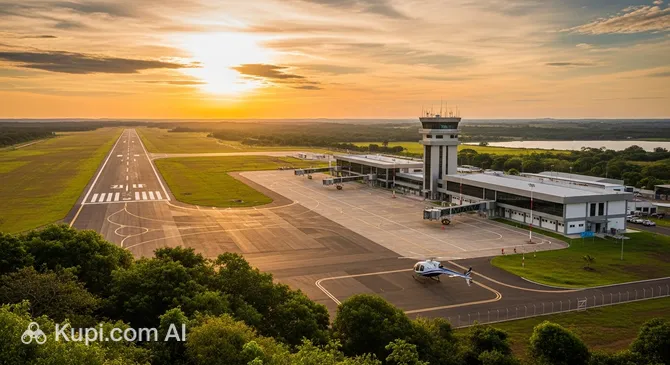
Marica Municipal Airport. Source: Kupi.com Binoculars
Maricá Municipal Airport (Aeroporto de Maricá) is not just a transport node, but the dynamically developing heart of aviation on the Costa do Sol. Following extensive modernisation, this air terminal has transformed from a modest airfield into a key hub serving both vital offshore operations and passenger flights. Located in a picturesque area next to the lagoon, the airport surprises travellers with a blend of modern technology, comfort, and unique social initiatives that make flying more accessible.
IATA Code JMR
ICAO Code SBMI
City Maricá
Distance to Centre 1.5 km
Status Domestic / Offshore
Passengers per Year ~110,000 (2024 data)
Schedule Online board

Airport Features and Advantages

Maricá Airport stands out among other regional airfields in Brazil due to its unique specialisation and high level of service. Here are several key advantages that make it an important point on the map:

Strategic Offshore Hub. The airport is one of the main support bases for Brazil's oil and gas industry. Due to its proximity to the Santos Basin (Bacia de Santos) and the "pre-salt" layer fields, dozens of helicopters depart from here daily to offshore platforms. This ensures the airport possesses the latest navigation equipment and strict safety standards.

Innovative "Voa Maricá" Programme. This is perhaps the most interesting feature for tourists and residents. The airport participates in Brazil's first municipal tariff programme, which allows the purchase of tickets (for example, on Azul Conecta flights) using the social currency "Mumbuca". This makes travel more accessible and stimulates the local economy.

Modern Infrastructure and Comfort. Following recent reconstruction, passengers have access to updated terminals with comfortable waiting areas, a VIP lounge, and complimentary internet. The airport's compactness eliminates long queues, allowing you to complete all formalities in a matter of minutes.

Convenient Location. The airport is located just a few minutes' drive from the city centre of Maricá. This allows travellers to instantly be in the midst of events or reach the region's famous lakes and beaches without exhausting transfers.

Contact Information

To contact the airport administration, check the flight schedule for the "Voa Maricá" programme, or resolve baggage issues, you may use the following contact details:

  • Official Website: voamarica.com.br (ticket purchase and passenger information) or codemar-sa.com.br (airport administration).
  • Support Service Phones (SAC):
    +55 (21) 97134-4781 (Airport Support Service, WhatsApp available)
    +55 (21) 97385-8428 ("Voa Maricá" Customer Support).
  • Central Call Centre:
    4003-1118 (for calls from capitals and metropolitan areas in Brazil)
    0800 887 1118 (for calls from other regions).
  • Airport Address: Rua Jovino Duarte de Oliveira, nº 481 – Eldorado, Maricá – RJ, CEP 24901-130, Brazil.
  • Email: voe.marica@codemar-sa.com.br (for flight and ticket enquiries).
  • Social Media: Official Instagram profile — @aeroportodemarica.
  • Lost Luggage Information: In case of loss or damage to baggage, you must immediately contact the information desk in the terminal or call the central call centre at the numbers listed above.

How to Get to the Airport

Getting to Maricá Municipal Airport (JMR) is quite simple given its proximity to the city centre. The airport is located in the Araçatiba district, just 1.5–2 kilometres from the business centre. Thanks to the city's compactness and the municipality's developed social policy, transport accessibility here is at a high level.

Public Transport: The Famous "Vermelhinhos"

One of the main features of Maricá is the public transport system managed by the EPT company (Empresa Pública de Transportes). The city is served by signature red buses, which locals affectionately call "Vermelhinhos" ("The Little Red Ones").

  • Cost: Travel on municipal EPT buses is absolutely free (Tarifa Zero) for everyone, including tourists. This is a unique initiative for Brazil.
  • Routes: Look for buses heading towards the Araçatiba district or passing through Rua Jovino Duarte de Oliveira. Stops are located within walking distance of the terminal.
  • Metro and Trains: There is no metro or railway service in Maricá itself. If you are travelling from Rio de Janeiro, you need to take an intercity bus to the Maricá Bus Station (Rodoviária), and from there transfer to a free city bus or taxi.

Taxis and Transfers

For those who value comfort or are travelling with bulky luggage, a taxi is the optimal choice. The journey from the city centre takes mere minutes.

  • Apps: Popular ride-hailing aggregators (Uber and 99) operate in the region. This is often the most reliable way to know the price in advance and avoid language barriers.
  • City Taxi: Official taxis are also available; they can be found at ranks in the centre or called by phone.
  • Cost: A trip from Maricá centre to the airport usually costs between 15 and 25 Brazilian Reals (BRL), depending on the time of day and demand.

Car Rental and Parking

Many travellers prefer to rent a car to explore the picturesque surroundings and beaches of the region (such as Ponta Negra or Itaipuaçu). Rental company offices are primarily located in the city centre.

Airport Parking: A parking zone for passengers and well-wishers is provided within the airport grounds. Due to the recent modernisation of the airport, parking conditions have improved, ensuring convenient access to the terminal. It is recommended to check current rates at the entrance, as rules may change as infrastructure develops.

Travel Time

Thanks to its favourable location, the journey to the airport will not take much time:

  • From Maricá Centre: 5–10 minutes by car or 15–20 minutes by bus.
  • From Barra de Maricá Beach: about 15–20 minutes by car.
  • From Ponta Negra: about 30–40 minutes by car.

Nearest Major Aviation Hubs

Since Maricá Airport mainly serves regional flights (e.g., Azul Conecta) and offshore aviation, many tourists arrive in the region via major international airports in neighbouring cities and then travel to Maricá by ground transport.

The main flow of tourists is received by Rio de Janeiro. Closest to Maricá (about 34 km in a straight line, but longer by road across the bay) is Santos Dumont Airport, located in central Rio and handling domestic flights. For international flights, travellers more often use Rio de Janeiro/Galeão–Antonio Carlos Jobim International Airport, which is approximately a 60-70 km drive from Maricá.

If you are planning a trip along the resort coast, an alternative could be Cabo Frio International Airport, located 77 km to the east. The region also hosts Angra dos Reis Airport and Zona da Mata Airport, although they are significantly further away and rarely used as transit points for trips to Maricá.

Terminals and Map

Maricá Municipal Airport (JMR) is distinguished by its compactness and intuitive layout, which is its main advantage over the congested aviation hubs of metropolises. It is impossible to get lost here: all infrastructure is concentrated in such a way that the path from the entrance to boarding the aircraft takes minimal time and effort.

Terminals: Structure and Purpose

Unlike large international hubs, Maricá Airport does not have multiple scattered buildings. It operates based on a single passenger terminal (TPS), which was significantly expanded and modernised after recent reconstruction. The internal space of the terminal is intelligently zoned to separate two main flows of passengers:

  • Commercial Aviation Sector: Intended for tourists and city residents using scheduled flights (e.g., Azul Conecta airlines). Participants of the "Voa Maricá" programme are served here.
  • Offshore Aviation Sector: A specialised zone for oil and gas industry workers flying by helicopter to offshore platforms. This part of the terminal has its own security screening features and briefing rooms.

Transfers between zones: Since both sectors are within the same architectural complex, there is no need for long walks, shuttles, or travelators. All movement is done on foot inside the building, and navigational signs clearly separate the "Embarque Comercial" (Commercial Departure) and "Embarque Offshore" (Offshore Departure) flows.

Departure and Arrival Zones

The airport layout is simple and logical. All key procedures take place on the ground floor, making the airport convenient for passengers with reduced mobility and families with children.

  • Check-in Zone: Located immediately upon entering the terminal. Check-in counters are compact, and queues are practically non-existent due to the small number of simultaneous flights.
  • Security Screening Zone: Equipped with modern X-ray scanners. Passage to the "sterile area" is quick, but in compliance with all federal safety standards of Brazil (ANAC).
  • Departure Lounge: A spacious hall with panoramic glazing offering a view of the runway and the picturesque lagoon. The lounge is equipped with comfortable seating and an air conditioning system.
  • Arrival Zone: Baggage claim takes place in a separate small sector. Due to low transport volumes, suitcases are delivered almost immediately after the aircraft stops.

Terminal Features and Services

Despite its modest size, the updated terminal offers a level of comfort comparable to the business lounges of major airports:

  • VIP Space: Upgraded waiting areas are available for passengers who value privacy.
  • Connectivity: Free high-speed Wi-Fi works throughout the terminal, which is especially relevant for business travellers.
  • Accessible Environment: The terminal is fully adapted for people with disabilities (ramps, specially equipped toilets).
  • Cafes and Retail: The terminal has small catering points where you can drink Brazilian coffee and have a snack before departure (the range of services may vary).

Time for Formalities

One of the main advantages of flying from Maricá is saving time. There is no need to arrive 3–4 hours before departure here.

Recommended arrival time:

  • For commercial flights (domestic flights within Brazil), it is sufficient to arrive at the airport 40–60 minutes before the departure time.
  • The check-in and baggage drop procedure usually takes no more than 10–15 minutes.
  • Security checks on average take 5–10 minutes.

Navigation Recommendations

Orienting yourself in JMR is very easy, but a few tips will make your journey even more comfortable:

  1. Watch the screens: Despite the low traffic, always check your flight number on the information screens, especially if your departure coincides with the shift change of offshore helicopters.
  2. Documents at hand: Keep your passport or ID card ready. In the security zone, the rules are as strict as everywhere else: liquids in containers over 100 ml and sharp objects in hand luggage are prohibited.
  3. Staff: Airport employees are known for their friendliness. If you are unsure where to go, feel free to approach staff in uniform — they will guide you to the correct Gate.

Airport History

Airport History: From Flying Club to Strategic Hub

The history of Maricá Municipal Airport (JMR) is a vivid example of how an infrastructure facility can evolve alongside the regional economy. While a few decades ago it was a quiet ground for aviation enthusiasts, today it is a key element in the logistics of Brazil's oil and gas industry.

The development of the airport is inextricably linked to the discovery of gigantic oil reserves in the "pre-salt" layer (Pre-sal) on the Santos Basin shelf. It was Maricá's proximity to these fields that predetermined the fate of the modest airfield, turning it into a high-tech transport hub.

Early Years: The Flying Club Era

At the beginning of its journey, the airport functioned primarily as a base for the Maricá Flying Club (Aeroclube de Maricá). Founded in the 1970s, it served as a magnet for private pilots, parachutists, and light aviation enthusiasts. Infrastructure in those years was minimal: a dirt strip, later a simple asphalt runway, small hangars, and a lack of complex navigation equipment. For a long time, the airfield remained in the shadow of major capital airports, serving only light single-engine aircraft.

New Era: Modernisation and Codemar

A turning point in the airport's recent history was the transfer of management to the municipal company Codemar (Companhia de Desenvolvimento de Maricá). City authorities realised the strategic potential of the facility and in 2018 launched a large-scale reconstruction programme, which took place in several stages:

  • 2018–2020: Start of capital works. A complete revitalisation of the runway, taxiways, and apron (patio) for aircraft parking was carried out. This allowed for the reception of heavier aircraft and offshore-class helicopters.
  • 2021: Opening of the new passenger terminal. The modest administrative building was replaced by a modern complex with security zones, comfortable waiting halls, and a VIP sector.
  • Flight Safety: An important historical step was the installation of modern equipment for night flights and instrument landing (IFR), which moved the airport into the all-weather category.

Launch of Commercial Aviation

One of the most significant milestones in JMR's history was the commencement of scheduled passenger transport. For a long time, the airport was associated exclusively with oil workers' helicopters, but in the early 2020s, the "Voa Maricá" programme was launched. A partnership with the airline Azul Conecta allowed Maricá to be connected with other cities and states (including São Paulo and Minas Gerais), opening a new chapter in the region's civil aviation.

Interesting Facts and Achievements

In its short history as a modern hub, the airport has managed to mark a number of unique events and records:

  • Social Currency in the Sky: Maricá Airport became the first aviation hub in the world where the option to purchase flight tickets using the local digital social currency "Mumbuca" was officially introduced. This fact went down in history as a unique social experiment making aviation accessible to low-income population groups.
  • Record Traffic Growth: After the completion of reconstruction, the number of operations at the airport grew exponentially. In certain periods of 2023–2024, the airport recorded passenger traffic growth of more than 400% compared to previous years, overtaking many regional airports in the state of Rio de Janeiro.
  • "Offshore" Operations: The airport became one of the main support bases for the giant Petrobras, relieving the congested airports of Jacarepaguá and Cabo Frio.
  • Own Rescue Service: During modernisation, one of the most modern rescue and firefighting services in the region (SESCINC) was created at the airfield, complying with international safety standards.

Services and Facilities

Services and Amenities in the Terminal

Maricá Municipal Airport (JMR) is a modern regional airport that focuses not on giant retail spaces, but on functionality and comfort. Thanks to recent modernisation and an orientation towards the business segment (offshore aviation), passengers can count on a high level of basic services, even despite the terminal's compact dimensions.

Dining and Shops

Since the airport is small, there is no extensive duty-free zone or food court typical of capital hubs here. However, travellers will not go hungry:

  • Cafes and Snack Bars: A cafeteria zone (lanchonete) operates in the terminal, where you can drink fresh Brazilian coffee, order refreshing beverages, and have a snack with traditional bites such as "pão de queijo" (cheese bread) or sandwiches. This is an ideal place for a short wait before departure.
  • Mini-markets: Small kiosks with press, essential goods, and souvenirs are available.

Business Lounges and Waiting Areas

Maricá Airport actively serves executives and specialists in the oil and gas industry, so the quality of waiting areas here is higher than in the average regional airport.

  • General Waiting Hall: A spacious, bright, and air-conditioned hall with a panoramic view of the runway and Araçatiba lagoon. Seats are equipped for long periods of sitting.
  • VIP Lounge (Sala VIP): For passengers valuing privacy and enhanced comfort, a separate lounge zone is provided. Here you can spend time in silence, use the work zone, or hold negotiations before departure.

Connectivity and Charging Devices

Staying connected at JMR is easy. The airport understands the needs of modern travellers:

  • Wi-Fi: Free high-speed wireless internet is active throughout the terminal.
  • Charging Stations: In waiting areas, especially next to seats, a sufficient number of sockets and USB ports are installed for charging gadgets.

Financial Services

ATMs (Caixas Eletrônicos) are installed in the terminal, working with major Brazilian banks and international cards (usually the Banco24Horas network). There are no Currency Exchange points at the airport, as it does not serve international flights directly. Tourists are recommended to carry a small amount in Brazilian Reals or use cards.

For Passengers with Disabilities

The terminal infrastructure fully complies with Brazilian accessibility standards (NBR 9050):

  • Entrance groups are equipped with ramps.
  • Restrooms are adapted for people in wheelchairs.
  • The absence of jet bridges and stairs during boarding simplifies movement: the path from the terminal to the aircraft is on a level surface, and staff are always ready to provide assistance during boarding.

Passengers with Children

Thanks to its compactness and lack of queues, Maricá Airport is very convenient for family travel. Changing tables are provided in the sanitary rooms. The calm atmosphere of the terminal relieves children and parents of the stress typical of large air terminals.

Medical Assistance

A medical point functions within the airport grounds, ready to provide first aid in case of illness. Also, due to the specifics of offshore flights, the airport's emergency response services have high qualifications and modern equipment.

Hotels Nearby

There are no hotels on the airport grounds themselves, but thanks to its location within the city limits, finding accommodation is not difficult. The airport is located in the Araçatiba district, which is known for its beautiful waterfront and cosy accommodation options:

  • Pousada Araçatiba: Located literally a few minutes' drive or within walking distance, offering a home-like atmosphere and a view of the lagoon.
  • Hotels in Maricá Centre: A 5–10 minute taxi ride away in the city centre, there are larger hotels and guest houses (Pousadas) to suit any budget.

Business Services

For corporate clients and business travellers, the airport may provide conference rooms or briefing rooms (Salas de Briefing), which are often used for crew and shift worker briefings but can be adapted for business meetings upon prior request.

Where to Eat

Dining at the Airport: Cafes and Restaurants

The gastronomic infrastructure of Maricá Municipal Airport (JMR) corresponds to its format as a compact regional hub. You will not find huge food courts or fast-food giants typical of international aviation nodes here. Instead, passengers are offered cosy and functional service focused on a quick snack and quality coffee before departure.

All dining points are concentrated in the single passenger terminal, making them easily accessible for both departing passengers and well-wishers.

Cafes and Coffee Shops

The main place to refresh yourself is the cafeteria zone (in Brazil, such establishments are called Lanchonete). The establishment is located in the general area (landside), before passing pre-flight screening. This allows even those who have simply come to meet colleagues or relatives to visit it.

  • Assortment: The menu focuses on traditional Brazilian snacks (salgados). Here you can always find fresh pastries, sandwiches, desserts, and refreshing beverages.
  • Coffee: Brazil is the land of coffee, and even in a small airport, you will be offered an excellent espresso ("cafezinho"), cappuccino, or coffee with milk ("média").
  • Location in the Sterile Area (Airside): After passing security control, the choice becomes more limited. Usually, vending machines with water, soda, and chocolate bars are available in the waiting lounge, or a small "coffee-corner" style point (availability depends on the current service operator).

What to Try: Local Flavours

Even during a short wait for a flight in Maricá, you can touch upon the culinary traditions of the region. In the local cafe, you should definitely order:

  • Pão de Queijo (Cheese Bread): Famous Brazilian cheese buns made from tapioca starch. This is an ideal option for a light breakfast or snack. They are often served warm at the airport.
  • Salgados: Popular pastries with various fillings. Try an empada (tartlet with chicken or palm heart) or baked sandwiches.
  • Natural Juices: If fresh juices are on the menu, choose passion fruit (maracujá) or acerola flavours — this is a real vitamin boost.

Dietary Restrictions (Vegetarian, Vegan, Halal)

Given the small size of the airport, the choice of specialised food here is limited. Passengers with strict diets are recommended to prepare in advance.

For Vegetarians:
Finding meat-free food is quite easy. Cheese buns (pão de queijo), cheese sandwiches (queijo quente), or pastries with palm heart (palmito) are almost always available.

Gluten-Free Food:
The good news is that pão de queijo is traditionally made from manioc (tapioca) flour and does not contain gluten. However, as baking is done in the same zone as wheat products, there is a risk of cross-contamination, which is important for people with celiac disease to consider. You can also find fruit salads or packaged manioc chips.

For Vegans:
Options for vegans are extremely limited. Most likely, you will only be offered fruit, black coffee, or juices. Most local pastries contain cheese, eggs, or milk.

Halal and Kosher:
There are no certified Halal or Kosher dining points at Maricá Airport. Travellers observing these norms are advised to bring food with them. Please note that many savoury snacks (*salgados*) may contain ham or sausages, so it is advisable to check ingredients carefully.

Prices and Opening Hours

The pricing policy at Maricá Airport is moderate. The cost of food and drinks here is higher than in city supermarkets, but noticeably lower than in the major airports of Rio de Janeiro (Galeão or Santos Dumont).

  • Average Bill: Coffee and a bun will cost approximately 15–25 BRL. A light lunch (sandwich and drink) will cost around 30–45 BRL.
  • Opening Hours: Dining points open according to the flight schedule. Usually, the cafe starts working an hour before the first departure (around 06:00–07:00 AM) and closes after the departure of the last evening flight.

Recommendations for Passengers

For a Quick Snack:
The ideal option is to order "café com pão de queijo" immediately upon arrival at the terminal. It is fast, filling, and very Brazilian.

For a Full Lunch:
The airport is not designed for long feasts. Since JMR is located just 1.5 km from the Araçatiba district and the city centre, the best solution would be to have lunch at one of the city restaurants before travelling to the airport. On the Araçatiba waterfront, there are excellent establishments with a view of the lagoon where you can enjoy seafood or steaks, and then reach the terminal in 5 minutes by taxi.
Travel Tips

Useful Tips for Travellers

Travelling through Maricá Municipal Airport (JMR) differs radically from the experience of flying through congested international hubs. A calm atmosphere reigns here, and processes are much faster. However, the specifics of light aviation and regional features dictate their own rules. We have gathered recommendations for you that will help make your flight as comfortable as possible.

Recommendations on Arrival Time

The "arrive 3 hours early" rule does not apply in Maricá. The airport is compact, and queues here are a rarity.

  • Optimal Time: Arrive 45–60 minutes before departure. This is quite sufficient to pass check-in and screening without rushing.
  • Check-in Closure: Remember that counters may close 30 minutes before departure. Despite the staff's loyalty, the system may not allow latecomers through.

Check-in and Security Features

Procedures here are standard but have a nuance of a "home-like" atmosphere. Staff often know regular passengers by sight, but this does not negate strict safety rules.

  • Documents: Keep your identity document (passport) in hand. Electronic boarding passes are accepted, but it is better to save a screenshot in case of internet failures.
  • Screening: The process is quick. You will not have to stand in line for the scanner for long. Be prepared to remove your laptop and liquids, as in any other airport.

Tips on Choosing a Seat on the Plane

Flights from Maricá (e.g., Azul Conecta) are often operated on small aircraft like the Cessna Grand Caravan. This turns a regular flight into a real aerial excursion.

  • Choose a Window: Definitely try to sit by the window. During takeoff and landing, stunning views of the Maricá lagoon system, the ocean coast, and mountains open up.
  • Balancing: Note that on small vessels, seating may be adjusted by the crew right before departure for correct aircraft centring (weight balance). Be prepared to change seats if the pilot asks.

What Can and Cannot be Carried in Hand Luggage

This is a critically important point for light aviation. Overhead bins in small planes are very narrow or non-existent.

  • Dimensions: A standard "cabin size" suitcase (55x40x20 cm) may not fit in the Cessna cabin. Be prepared to check it in or leave it at the steps (procedure "Valet Check" or "Delivery at Aircraft").
  • Backpack: A soft backpack is the best choice for hand luggage in Maricá. It is easier to place under the seat.
  • Prohibitions: ANAC rules are uniform for everyone: sharp objects, aerosols, and flammable substances are prohibited in the cabin.

Recommendations for Passengers with Connections

Maricá Airport operates on a "point-to-point" basis. Through-check of baggage to a final destination in Europe or the USA is usually impossible from here.

  • Allow Time: If you are flying to Maricá with a connection through a major hub (for example, via Viracopos), ensure you have enough time for the transfer.
  • Change of Airport: If your next flight departs from Rio de Janeiro (Galeão or Santos Dumont), allow at least 2–3 hours for ground transfer, excluding traffic jams.

Customs Control Features

Maricá Municipal Airport serves domestic flights. There is no customs or passport control zone (Polícia Federal) for international travellers here.

  • If you are a foreigner, it is sufficient to present your passport at check-in. No migration cards need to be filled out.
  • Veterinary and phytosanitary control may be conducted randomly, especially if you are carrying plants or animals.

Tips for Saving Time and Money

  • Free Transfer: Do not spend money on a taxi unnecessarily. Use the famous free "Vermelhinhos" buses, which circulate throughout the city and take you almost to the terminal.
  • Food to Go: Prices at the airport are moderate, but the selection is limited. Buy a snack and water at a supermarket in the Araçatiba district before going to the airport.
  • Loyalty Programme: If you fly through Maricá frequently, check the conditions of the "Voa Maricá" programme — sometimes social tariffs are available not only to residents but also to certain categories of guests (rules may change).

What to Do in Case of Flight Delay

Light aviation is sensitive to weather, and Maricá is a coastal city where fog or strong winds are possible.

  • Do Not Panic: Delays here are more often related to safety than technical problems. Staff usually provide information promptly.
  • Use Wi-Fi: The terminal has excellent free internet. If the flight is delayed, you can work comfortably or contact relatives.
  • Walk: If the delay is long (several hours), there is no point sitting in the terminal. Call a taxi and go to the Araçatiba lagoon waterfront — it is only a 5-minute drive away, where you can have a great time waiting for the weather to clear.

Reached the end of the page?

That means the route is fully explored