Support

London International Airport

About the Airport

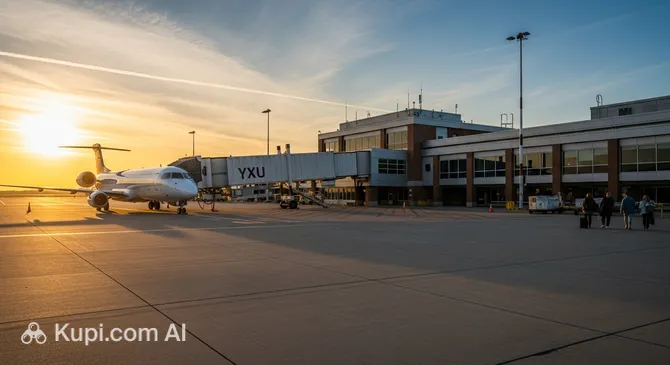
London International Airport. Source: Kupi.com Binoculars

Welcome to London International Airport (YXU) — an air gateway often referred to as the "easiest and most convenient" airport in southwestern Ontario. Located halfway between Toronto and Detroit, it serves as a vital transport hub for both business travellers and tourists. Despite its relatively small size, the airport prides itself on efficiency, offering passengers quick check-in, short waiting times, and a friendly atmosphere. This airport is the ideal starting point for exploring the beauty of Canada or for travelling around the world.

IATA Code YXU
ICAO Code CYXU
City London, Ontario
Distance to centre 9.3 km
Status International
Annual Passengers approx. 332,447 (2023)
Popular Airlines Air Canada, WestJet, Flair Airlines
Schedule online board "London International Airport"

Features and Advantages of the Airport

London International Airport is valued by travellers for its compactness and thoughtful organisation. Here, you will not encounter the long queues and bustle typical of major aviation hubs. Fast security clearance, affordable parking, and clear navigation make the travel process as comfortable and carefree as possible. The airport serves flights from leading Canadian airlines, such as Air Canada, WestJet, and Flair Airlines, offering flights to popular destinations in Canada, the USA, and the Caribbean.

The airport also possesses a rich historical heritage. As a tribute to its history associated with the Royal Canadian Air Force, a Canadair CT-133 aircraft is displayed in front of the main terminal building. Today, YXU is not only an important passenger hub but also a cargo centre for the region, constantly developing infrastructure for the convenience of all its clients. Following the results of 2023, it ranked 17th among the busiest airports in Canada by the number of take-off and landing operations.

Contact Information

Below you will find essential contact information for London International Airport (YXU), which will help you plan your trip and resolve any potential queries.

  • Official Website: flylondon.ca
  • Information Desk Phone: +1 519-452-4015
  • Address: 1750 Crumlin Road, London, ON N5V 1A3, Canada
  • Email: info@flylondon.ca
  • Social Media: The airport actively maintains pages on Facebook, X (formerly Twitter), and Instagram, where it publishes current news and updates.
  • Lost Luggage Information: If you have lost items on board the aircraft or in the baggage claim area, you should first contact your airline's representative. For items lost in other parts of the terminal, contact the airport service via phone or email.
  • Passenger Support: For consultations and assistance with general questions, you can contact the main airport phone number.

How to Get to the Airport

There are several ways to get to London International Airport (YXU), located approximately 11 kilometres northeast of downtown London. The choice of the optimal option depends on your budget, amount of luggage, and personal preferences regarding time and comfort. The trip from the city centre usually takes 20 to 30 minutes by car, but this may vary depending on traffic conditions.

Public Transport is the most budget-friendly method. Buses from the London Transit Commission (LTC) operate throughout the city. Route #36 passes in the immediate vicinity of the airport, however, the stop may be a few minutes' walk from the terminal. This option is suitable for travellers with light luggage but may not be very convenient with a large number of suitcases. There is no direct rail or metro connection to the airport.

Taxis and Ridesharing Services, such as Uber and Lyft, are the most convenient and fastest way to reach the terminal. A car can be ordered at any time of the day, and it will deliver you directly to the entrance of the departure zone. The cost of a trip from downtown London will be approximately 30-40 Canadian dollars. Local taxi services also operate in the city and can be called by phone.

Car Rental is an excellent choice for those planning to actively travel around the region. Offices of major rental companies (Avis, Enterprise, Budget, and others) are represented at the airport. You can reach the airport via major highways, such as Highbury Avenue N. For those arriving in their own vehicle, a convenient car park is provided directly opposite the terminal, offering both short-term and long-term rates.

Finally, you can use the services of shuttles and private transfers. Some companies offer advance booking of trips, which can be a cost-effective solution for groups or families. This guarantees transport availability at the right time and a fixed trip cost.

Terminals and Map

London International Airport (YXU) is distinguished by a compact and well-thought-out structure, making it extremely convenient for passengers. Unlike major metropolises, the airport features one main terminal which serves all domestic, transborder (to the USA), and international flights. Such organisation significantly simplifies navigation and eliminates the need to move between different buildings.

The terminal layout is intuitive. The building has two main levels. On the ground floor, you will find check-in counters, the arrivals area with baggage claim belts, customs control for international flights, and car rental company desks. On the second floor, the departure zone is located: here passengers pass through security screening and enter a spacious waiting lounge with boarding gates, shops, and cafes.

Since there is only one terminal, the concept of "transfers between terminals" is irrelevant here — everything necessary is located within a single building and within walking distance. Departure and arrival zones are clearly separated by floors, which prevents crowding and confusion. After checking in on the ground floor, you simply take the escalator or lift to the second floor to pass through control and wait for your flight.

The main feature of the terminal is its efficiency. Thanks to its small size and logical layout, completing all pre-flight procedures, including check-in and screening, usually takes significantly less time than in large airports. Nevertheless, it is recommended to arrive at the airport 90 minutes before a domestic flight and 2–3 hours before an international one to calmly complete all formalities.

To navigate the terminal, simply follow the clear and understandable signs in English. Airport staff are always ready to help and give directions. Thanks to the compactness of the building, it is practically impossible to get lost here, making travel through London International Airport a comfortable and predictable experience.

Airport History

The history of London International Airport (YXU) began in 1939 when the city purchased land for the construction of a new, more modern airfield. However, its development received a powerful and unexpected boost with the onset of the Second World War. By 1940, the airport was selected as a site for one of the largest aviation training programmes in history — the British Commonwealth Air Training Plan (BCATP). Flight and navigation schools were established here, where thousands of pilots from all over the world underwent training.

After the war, the airport returned to civilian life and came under the management of Transport Canada. It gradually adapted to the growing needs of peacetime. In the 1950s, a new, longer runway was built, and in 1964 a new passenger terminal opened, which was a response to the increasing demand for air travel. This step laid the foundation for the future growth of the airport as an important transport hub for the region.

The largest modernisation in the airport's recent history took place in the early 2000s. A large-scale reconstruction, completed in 2003, completely transformed the terminal. The check-in and baggage claim areas were significantly expanded, a new hall for international arrivals was built, and the general infrastructure was improved. These changes allowed London airport to meet modern standards and substantially increase comfort for passengers.

Today, London International Airport serves not only as an important air gateway for southwestern Ontario but also as a living monument to aviation history. It has journeyed from a simple field to a key training centre and a modern international airport, playing a significant role in the development of the entire region. This airport is a fine example of how historical events can determine the fate and shape the appearance of transport infrastructure for decades to come.

Services and Amenities

London International Airport (YXU) cares about the comfort of its passengers by offering a wide range of services and amenities. While waiting for a flight, you can visit local cafes and snack bars offering beverages and light meals. Additionally, shops operate within the terminal where you can buy souvenirs, travel essentials, and fresh press.

For those for whom staying connected is important, free Wi-Fi is available throughout the airport territory. The waiting lounges feature numerous charging stations for gadgets, so you can always recharge your phone or laptop. Passengers who value enhanced comfort can use the services of the business lounge, which offers a more secluded and quiet atmosphere.

ATMs are installed in the terminal for resolving financial matters. For travellers with small children, mother and child rooms are equipped. The airport is fully adapted for passengers with reduced mobility: there are ramps, lifts, and specially equipped restrooms, and an escort service is available upon prior request. If necessary, one can visit the first aid station.

For business travellers, business services and conference rooms for meetings may be available at the airport. If you have an early departure or late arrival, several hotels are located in the immediate vicinity of the airport where you can comfortably stay and rest.

Where to Eat

At London International Airport (YXU), passengers will find several convenient options for a snack or a full meal. Although the choice of establishments here is not as extensive as in major global hubs, the available cafes and restaurants fully satisfy the needs of travellers waiting for their flight.

Before Security (Landside)

In the public area of the airport, before passing through pre-flight screening, there is a Tim Hortons cafe. This is a classic Canadian coffee shop, ideal for a quick and inexpensive snack. Here you can order their famous coffee, fresh pastries, doughnuts, or sandwiches. It is an excellent place for those seeing off or meeting passengers, as well as for travellers who have arrived at the airport with plenty of time to spare.

After Security (Airside)

The main dining establishment is located in the secure zone, after passing through screening. This is the restaurant and bar On The Fly, offering passengers full service. Here you can sit comfortably while waiting for boarding and order hot dishes, snacks, salads, and various beverages. This place is suitable for a hearty lunch or simply enjoying a refreshing drink.

Menu, Prices, and Special Diets

The menu at `On The Fly` includes North American cuisine: burgers, sandwiches, soups, and salads. The opening hours of the establishments are flexibly adjusted to the flight schedule — they open early in the morning and close after the departure of the last aircraft. Prices are in the average range typical for airports, meaning slightly higher than in the city.

Regarding special dietary requests, vegetarians will be able to find meat-free salads or sandwiches on the menu. Passengers with stricter restrictions (vegan, gluten-free, Halal) are advised to check available options with the staff, as the specialised selection may be limited.

Recommendations:

  • For a quick snack and coffee, Tim Hortons before security is ideal.
  • For a full breakfast, lunch, or dinner in a quiet setting, head to the On The Fly restaurant in the departure zone.

Tips for Travellers

Travelling through London International Airport (YXU) in Canada can be a simple and pleasant stage of your trip if you prepare in advance. To ensure everything goes smoothly, use our tips.

Arrival at the Airport and Check-in. To avoid unnecessary haste, we recommend arriving at the airport at least 2 hours before a domestic flight and 3 hours before an international one. This will give you enough time for calm check-in, baggage drop-off, and passing security control. To save time, use online check-in, available with most airlines 24 hours before departure.

Hand Luggage and Screening. Remember the restrictions on carrying liquids: they must be in containers of no more than 100 ml each and packed in a single transparent zip-lock bag. During screening, be ready to take laptops and other large electronics out of your bag. It is strictly forbidden to carry sharp objects, weapons, and flammable substances in hand luggage. Always check your airline's rules before travelling.

Seat Selection and In-flight Comfort. The choice of seat on the plane can significantly affect your comfort. Window seats are suitable for those who like to admire the views, and aisle seats for those who want the freedom to stand up. If you need more legroom, consider options at emergency exits, but note that special requirements may apply to them.

Transfers and Customs. If you have a connecting flight, study the airport map in advance and check if you will need to collect your luggage and pass security control again. When passing customs control on international flights, have your passport and completed declaration ready. Clear and honest answers to the border officer's questions are the fastest way to pass control.

Savings and Unforeseen Situations. To save money, take an empty water bottle with you (it can be filled after screening) and light snacks. In case of a flight delay, do not panic. First of all, contact your airline representative. They will provide current information on the flight status and, depending on the duration of the wait, may offer vouchers for meals or even hotel accommodation.

Reached the end of the page?

That means the route is fully explored