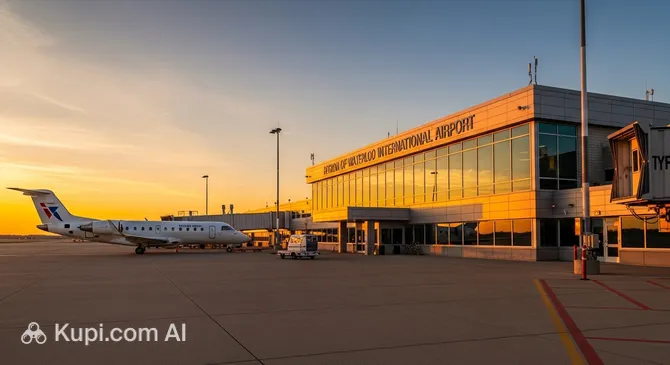
Source: Kupi.com AI
| Characteristic | Value |
|---|---|
| IATA code | YKF |
| ICAO code | CYKF |
| City | Toronto |
| Country | Canada |
| Time zone | America/Toronto |
| Popular airlines | Flair Airlines, WestJet, Air Canada |
| Schedule | Live departures board |
| Characteristic | Value |
|---|---|
| IATA code | YKF |
| ICAO code | CYKF |
| City | Toronto |
| Country | Canada |
| Time zone | America/Toronto |
| Popular airlines | Flair Airlines, WestJet, Air Canada |
| Schedule | Live departures board |
Transport accessibility to the Region of Waterloo International Airport (YKF) has its own specific features. Unlike major hubs such as Pearson International Airport, there are no metro lines or direct express trains leading here. The airport is primarily oriented towards motorists; however, it is possible to get here by other means if the route is planned correctly.
Car and Rental
A personal or rented car is the most convenient way to reach the airport. YKF is located near the high-speed Highway 7 and Ontario's main thoroughfare — Highway 401. The journey from downtown Toronto (approximately 70–80 km) takes about 1 hour in free-flowing traffic, although during peak hours, travel time may increase to 1.5–2 hours.
Counters of international car rental companies (Avis, Budget, Enterprise, National, Hertz) operate in the airport's arrival zone. This is an excellent option for tourists planning a trip not only to Toronto but also to Niagara Falls. For comparison, if you arrive at Buffalo Niagara International Airport, renting a car will also be the main mode of transport, but crossing the border may take additional time.
Taxis and Transfers
This is the only way to get directly to the terminal doors if you are not driving. Official taxi services (e.g., Waterloo Taxi, City Cabs) and popular ride-sharing services (Uber, Lyft) operate in the Kitchener-Waterloo region.
Public Transport (Train + Taxi)
It is important to know: there is no direct bus route or train directly to YKF airport. The nearest public transport stops are several kilometres away. The optimal scheme for budget travellers looks like this:
If you are already in the Waterloo region, you can use the ION Light Rail tram to Fairway Station, and from there transfer to a taxi.
Airport Parking
Parking at YKF compares favourably with capital options such as Billy Bishop Toronto City Airport or Pearson. Shuttles are not needed here: all parking lots are within walking distance of the terminal.
Recommendations for Travellers
If your flight is delayed or cancelled and you urgently need to find an alternative, remember that Hamilton Airport is approximately a 50-minute drive south, and London International Airport is about an hour's drive west. Always allow extra time for the journey to YKF if you are travelling from Toronto via Highway 401, as this section of the road is known for heavy traffic.
Terminal Structure: Compactness and Simplicity
Unlike the huge labyrinths of capital aviation hubs, Region of Waterloo International Airport (YKF) is arranged extremely clearly. All passenger traffic is handled in a single one-story terminal. This is the main advantage of the airport: there is no need to use trains or buses to move between gates, and the risk of getting lost is reduced to zero.
The terminal is designed linearly and logically. Entering through the main doors, you immediately find yourself in the general area where airline check-in counters are located. Thanks to the recent airport expansion, the flows of departing and arriving passengers are now better separated, which has significantly reduced crowding during peak hours.
Departure and Arrival Zones
Navigation inside the building is intuitive, as all key points are within direct line of sight:
Processing Times
Speed of service is the calling card of Waterloo Airport. Queues here are rarely long.
Navigation Recommendations
The terminal is equipped with free Wi-Fi, allowing you to easily pass the waiting time. For passengers with reduced mobility, navigation will also not be difficult: the absence of stairs and thresholds, as well as the presence of ramps for boarding the aircraft, make the airport accessible. If you need assistance (a wheelchair or escort), it is better to order it in advance through the airline, but the compact size of the hall allows staff to respond quickly to requests on the spot as well.
The history of Region of Waterloo International Airport (YKF) is a classic example of evolution from a small airfield to an important regional transport hub. Over nearly a century of its existence, it has gone from dirt strips accepting light biplanes to a modern terminal servicing jet liners.
Foundation and Early Years
Aviation traditions in the region began back in 1929, when the first municipal airport was founded on Lexington Road in Waterloo. However, as the cities of Kitchener and Waterloo grew, along with the increasing need for air travel, it became clear that the old site had no prospects for expansion. In 1948, the Waterloo-Wellington Airport Commission purchased land in the Breslau area, where the airport is located to this day.
The official opening at the new location took place in 1950. At that time, it was a modest airfield, focused mainly on general aviation and pilot training. For a long time, it was known as Waterloo-Guelph Regional Airport, serving the needs of local enthusiasts and business people.
Change of Status and Development
An important turning point was 2004, when the airport received its current name — Region of Waterloo International Airport. This renaming marked a change in strategy: regional authorities decided to turn it into a full-fledged alternative to Toronto's congested airports. Shortly thereafter, the airport received international status, allowing it to accept flights from the USA and resort destinations in the Caribbean.
Era of Modernization
The last decade has been a period of the most active growth in YKF's history. In response to a sharp increase in passenger traffic caused by the arrival of budget airlines, a large-scale reconstruction programme worth more than 40 million dollars was launched.
Records and Achievements
Despite its compact size compared to industry giants, Waterloo Airport holds several significant positions in Canadian aviation:
Interesting Facts
The airport's history is closely intertwined with the region's technological development. Since Waterloo is often called "Canada's Silicon Valley," the airport has historically often hosted private jets of executives from the world's largest technology companies flying in for negotiations at the headquarters of local IT giants. Additionally, events for the Royal Canadian Air Cadets are held here annually, maintaining the site's historical connection with the training of future aviators.
Region of Waterloo International Airport (YKF) is a small regional hub, so the range of services here differs significantly from what tourists are used to seeing in large hubs. You will not find endless rows of branded boutiques or luxury spa centres here. The philosophy of YKF is built on efficiency: passengers spend a minimum amount of time in the terminal, so the infrastructure is oriented towards satisfying basic needs.
Restaurants and Shops
Gastronomic and shopping opportunities in the terminal are limited but sufficient for a short wait for a flight.
Wi-Fi and Charging Devices
For business travellers and those who want to stay connected, the airport offers a stable internet connection.
VIP Lounges and Business Services
It is important to note that there are no airline business lounges or Priority Pass programmes at YKF. The single waiting hall is spacious and comfortable enough, and thanks to moderate passenger flow, it is rarely noisy or crowded. There are no rooms for business meetings or conferences within the terminal itself, but they can be found in nearby hotels or in the city.
Financial Services
ATMs are installed in the terminal building, where you can withdraw Canadian dollars in cash. There are no full-service currency exchange points with a wide selection of currencies at the airport, so international tourists are recommended to take care of exchanging money in advance or use an ATM.
Services for Passengers with Reduced Mobility
Thanks to its compactness and single-story layout, YKF is considered one of the friendliest airports for passengers with limited mobility.
For Passengers with Children
Travelling with children through Waterloo is much calmer than through metropolises.
Medical Assistance
There is no pharmacy or full medical centre with a doctor at the airport. First aid can be provided by security staff who have undergone special training. In the event of serious situations, emergency services arrive from nearby cities (Kitchener or Guelph) in the shortest possible time.
Hotels Near the Airport
There are no hotels directly on the airport grounds, but thanks to the convenient location, the nearest hotels can be reached in 10–15 minutes by taxi or rental car.
The gastronomic map of Region of Waterloo International Airport (YKF) fully corresponds to its concept of "fast and fuss-free." Since the terminal is small and passengers spend a minimum amount of time here before departure, there are no extensive food courts or haute cuisine restaurants at the airport. The catering system here is organized to ensure the basic needs of travellers waiting for boarding.
Departure Zone (Airside): Main Café
The main and only full-service food point is located in the "sterile" zone, where passengers enter only after passing security. A licensed café-bar (Departure Lounge Café) operates here, serving all departing flights.
General Zone (Landside): Quick Snack
In the public part of the terminal (before security control), where the check-in counters are located, there are practically no food options. This zone is equipped only with vending machines. This is an option for those who need to quickly buy a bottle of water, a chocolate bar, or a packet of crisps. If you are seeing someone off or have arrived too early, do not count on a hot lunch here.
Special Meals and Dietary Options
Given the limited café menu, travellers with strict dietary restrictions should be prepared for a modest selection:
Price Range
Prices at YKF airport correspond to the average level for Canadian regional airports — they are slightly higher than in city coffee shops, but do not reach the extreme mark-ups of major international hubs.
Expert Recommendations
The best strategy when flying from Waterloo is to separate the concepts of "lunch" and "snack." If you want a full meal, do so before arriving at the airport. The airport is located near Kitchener and Cambridge, where the dining scene is very developed. Inside the terminal, it is better to count only on a light snack or a cup of coffee while waiting for boarding.
Optimal Arrival Time
Although Region of Waterloo International Airport (YKF) is famous for the absence of long queues, one should not neglect the recommended time buffer. For domestic flights (within Canada), it is optimal to arrive at the terminal 90 minutes before departure. This will allow you to calmly drop off luggage and pass security. For international flights (USA, Mexico, Caribbean Islands), it is better to arrive 2–2.5 hours in advance. Note that check-in counters usually close strictly 45–60 minutes before departure, and being late even by a minute can result in denied boarding.
Check-in and Security Control
To save time, it is strongly recommended to complete online check-in on the airline's website (Flair, WestJet, Sunwing) 24 hours before departure. At the airport, you can proceed directly to the Bag Drop counter or, if flying light, head straight to security.
The security screening procedure is standard for Canada (CATSA standards). Liquids, gels, and aerosols in carry-on luggage must be in containers of no more than 100 ml and packed in a transparent 1-litre bag. Laptops and large tablets must be removed from bags. A feature of YKF is a very compact security zone, so try to prepare your items for scanning in advance so as not to hold up the queue.
Seat Selection and Boarding
When choosing a seat in the cabin, consider an important feature of the airport: there are no jet bridges here. Boarding and disembarking are carried out via the outdoors using ramps or stairs. If you are flying in winter or rainy weather, seats in the front of the aircraft will allow you to leave the plane faster and get into the warm terminal. Additionally, even if you are flying to a hot country, keep a warm jacket handy until entering the aircraft — the walk across the open apron can be windy.
Carry-on Luggage: What is Allowed and Prohibited
Since YKF is actively used by low-cost carriers (e.g., Flair Airlines), control of carry-on luggage dimensions can be strict here. Staff at the gate often ask to place bags in the sizer.
Tips for Transit Passengers
Waterloo Airport is primarily a "point-to-point" destination, not a transit hub. If you do have a transfer planned (for example, flying from Waterloo to Calgary and then to Europe), remember:
Customs Control on Arrival
Arriving on an international flight at YKF is much faster than at major airports. The CBSA (Canada Border Services Agency) zone is compact. To speed up the process, you can use the ArriveCAN mobile app to fill out the declaration in advance (check if this requirement is current before departure). Be prepared to answer questions honestly about goods being imported, especially food products — fines for failure to declare are high.
How to Save Time and Money
What to Do in Case of Flight Delay
Infrastructure for long waits at YKF is limited. If your flight is delayed:
Reached the bottom of the page?
Looks like you know this route inside out
Where travelers fly most — pick a route and check prices