Support

Hamilton Airport

About the Airport

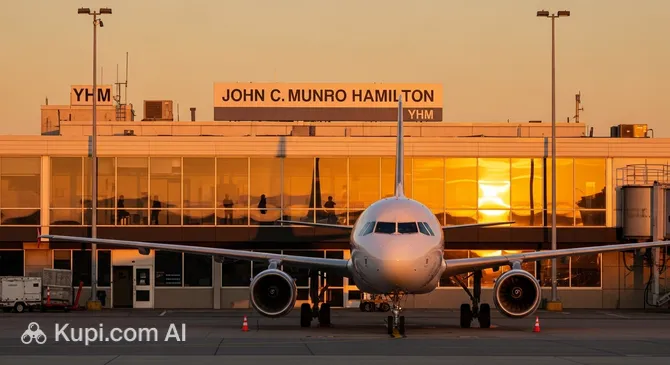
Hamilton Airport. Source: Kupi.com Binoculars

John C. Munro Hamilton International Airport, known by its IATA code YHM, is a significant aviation hub in the Canadian province of Ontario. Located in the Mount Hope neighbourhood, it serves as a convenient and less congested alternative to Toronto's main airport, offering access to the Greater Toronto and Hamilton Area. Originally opened in 1940 as a military airbase, Hamilton has today transformed into a thriving civil airport. It is particularly renowned as Canada's largest hub for overnight express cargo, highlighting its strategic importance in the country's logistics network.

IATA Code YHM
ICAO Code CYHM
City Hamilton, Ontario
Distance to Centre 11 km to Hamilton city centre and 64 km to downtown Toronto
Status International
Passengers per Year 820,011 (in 2023)
Popular Airlines WestJet, Porter Airlines, Air Canada
Schedule Online Board "Hamilton Airport"

Hamilton Airport boasts several advantages that make it attractive for travellers and airlines alike. One of its main benefits is its compactness and efficiency, allowing for much faster check-in and security screening compared to major hubs, thus avoiding long queues. The airport has become a popular base for low-cost carriers, offering more affordable flights to various destinations. Furthermore, YHM is a true giant in the world of cargo transport, serving leaders such as DHL, UPS, and Amazon. For passengers, there are also unique services, such as the bus connection from Air Canada, which links Hamilton Airport to the global route network via Toronto Pearson Airport.

Contact Information

  • Official Website: flyhamilton.ca
  • Helpline Phone: +1 905-679-1999
  • Address: 9300 Airport Rd, Mount Hope, ON L0R 1W0, Canada
  • Email: For general enquiries, you can use the address info@flyhamilton.ca or the feedback form on the website.
  • Social Media: The airport maintains active pages on Facebook, Twitter (X), and Instagram. Look for current links on the official website.
  • Lost Luggage Information: If you have lost luggage during a flight, please contact your airline first. For items lost within the terminal building, you should contact airport security through the dedicated section on the website.
  • Passenger Support Contacts: For advice and support, it is recommended to use the airport's main telephone number or email address.

How to Get to the Airport

Hamilton International Airport (YHM) is located approximately 80 kilometres southwest of downtown Toronto, making it a convenient and often more budget-friendly alternative to the metropolis's major airports, such as Pearson International Airport. There are several ways to reach the airport, and the choice depends on your budget, time, and comfort preferences.

Public Transport is the most economical option. A combined route involves a trip on the GO Transit train from Union Station in Toronto to Hamilton GO Centre station, followed by a transfer to the HSR city bus (Route 20 A-Line Express), which goes directly to the airport. The total travel time is approximately 1.5–2 hours, and the cost is significantly lower than a taxi. Be sure to check the schedule in advance, as frequency may vary.

Taxis, Ride-sharing, and Transfers offer the fastest and most convenient "door-to-door" method to reach the airport. A ride via taxi or apps like Uber and Lyft from downtown Toronto will take about 60–90 minutes depending on traffic conditions. This is also the most expensive option; the cost can easily exceed 100-150 Canadian dollars. There are also specialised shuttle services offering both private and group transfers, which can be slightly cheaper than a private taxi.

Car Rental is an excellent choice for those who value flexibility and plan to travel around the region. Most major rental companies have offices both in Toronto and directly at Hamilton Airport. The route follows major highways QEW and 403. For those driving their own vehicle, the airport provides convenient parking, offering options for both short-term and long-term stays in close proximity to the terminal.

Terminals and Map

Hamilton International Airport (YHM) is distinguished by a simple and clear structure, making it convenient for travellers, especially those who prefer to avoid the hustle and bustle of major aviation hubs. Its main advantage is a single passenger terminal that serves all domestic and international flights.

Thanks to its compactness, navigation through the airport is intuitive. It is impossible to get lost in the terminal building: all key zones are located close to each other. Check-in counters are situated in the main hall immediately after the entrance. After checking in, passengers proceed to the security screening area, which leads directly to the boarding gates. Since there is only one terminal, transitions between zones take minimal time, and there is no need to use shuttles or trains.

Departure and arrival zones are clearly separated. The Departure Hall with gates is located after the security checkpoint. Despite its modest size, it has everything necessary for waiting for a flight: small cafes, shops, and comfortable seating areas. The Arrival Zone is located on the lower level and includes baggage claim belts, customs control counters for international flights, as well as car rental offices and exits to taxis and buses.

Completing all formalities typically takes significantly less time than at major airports. It is recommended to arrive 90 minutes before a domestic flight and 2-3 hours before an international one. However, in most cases, check-in and screening procedures are quick due to the lower passenger volume.

The main recommendation for navigation is simply to follow the signs. The terminal's compact size and the logical layout of all services make Hamilton Airport an excellent choice for a calm start and end to your journey.

Airport History

The history of John C. Munro Hamilton International Airport (YHM), often viewed as a convenient alternative to Toronto airports, begins in 1940. It was founded as the "Mount Hope" military airfield and served as one of the key bases for the British Commonwealth Air Training Plan during World War II, training pilots from around the world.

After the war, the airport was transferred to civil use, and a long journey of transformation began. In the 1980s, it was renamed in honour of John C. Munro, a prominent local politician and Member of Parliament. However, the real breakthrough occurred at the turn of the century. In 1996, the airport was privatised, which gave a powerful impetus to its development. The new management company carried out extensive reconstruction, including runway expansion and passenger terminal modernisation, preparing it to handle a larger flow of passengers and cargo.

A key moment in YHM's modern history was its transformation into a major Canadian hub for air cargo. Giants such as DHL Express, Cargojet, and UPS Airlines chose it as their main base in the country, making Hamilton one of Canada's busiest cargo airports. In parallel, in the early 2000s, the airport became a centre for low-cost airlines, offering passengers more affordable flights to popular destinations.

Among the interesting facts in the airport's history is its unique neighbour. Located on the YHM grounds is the Canadian Warplane Heritage Museum, which houses one of the world's largest collections of flying World War II aircraft, including the famous Avro Lancaster bomber. This makes the airport not just a transport hub, but also an important historical site that preserves the memory of its military past.

Services and Amenities

Hamilton International Airport (YHM) offers passengers all the necessary services for a comfortable wait before their flight. Despite its relatively small size, the airport is well-equipped to ensure your journey begins and ends without unnecessary hassle.

In the terminal, you will find several cafes and eateries where you can have a snack or a coffee before your flight. There are also shops where you can purchase travel essentials, souvenirs, and press. Comfortable waiting areas are provided for relaxation. While there may not be exclusive VIP lounges, the general areas are sufficiently comfortable for passengers.

Staying connected is easy: free Wi-Fi is available throughout the terminal. Special stations are provided for charging electronic devices. Financial matters can be handled via ATMs located within the airport building. Please note that specialised currency exchange bureaus may be absent, so we recommend arranging for local currency in advance.

The airport caters to all categories of passengers. Nursing rooms are equipped for travellers with children. Passengers with reduced mobility are provided with all necessary assistance, including special restrooms, ramps, and staff support when moving through the terminal. First aid is available if needed.

If you need to stay overnight near the airport, there are several hotels of various price categories located in the immediate vicinity. For business travellers, business centre services or conference rooms may be available in nearby hotels, allowing meetings to be held without travelling far from the airport.

Where to Eat

Hamilton Airport (YHM), being compact and passenger-friendly, offers several key dining spots so you can comfortably grab a snack or have lunch before departure. All establishments are located within the single terminal, making navigation very simple.

Before Security (Landside)

In the public area, before screening, you will find an icon of Canadian hospitality — the Tim Hortons coffee shop. This is the ideal place for those meeting passengers and those who have just arrived at the airport. Here you can order their famous coffee, fresh pastries, sandwiches, and soups. It is an excellent option for a quick and budget-friendly snack.

After Security (Airside)

In the departure zone, the choice becomes slightly wider. Here, travellers can find:

  • Detour YHM: This is the main restaurant and bar in the secure area. If you have time, you can have a full lunch or dinner here. The menu includes classic dishes such as burgers, salads, and hot appetisers. A selection of beverages is also available. This is the best place for a relaxed wait before your flight.
  • Tim Hortons: Another branch of the popular chain operates in the departure zone as well. It is perfect for those who want to take coffee and a light snack on board or quickly refresh themselves right before boarding.

Features and Recommendations

Regarding dietary restrictions, vegetarian options can be found on the menus. However, the selection for vegan, gluten-free, or Halal meals may be *limited*, so it is best to check details with the staff. The opening hours of dining establishments are usually synchronised with the flight schedule, ensuring service for passengers on both early morning and evening flights. The price range at Tim Hortons is quite affordable, while prices at the Detour YHM restaurant correspond to the average level for airports.

Travel Tips

Travelling through John C. Munro Hamilton International Airport (YHM), which serves the Toronto area, can be simple and convenient if you know a few tricks. These tips will help you save time, money, and stress during your trip.

Arrival Time and Check-in. Hamilton Airport is significantly smaller than Pearson, so queues here are usually shorter. Nevertheless, it is recommended to arrive 2 hours before domestic flights and 3 hours before international flights. To save time, complete online check-in on your airline's website and save the boarding pass on your phone.

Passing Security Control. Prepare for screening in advance. All liquids in carry-on luggage must be in containers of no more than 100 ml and packed in a single transparent bag with a volume of up to 1 litre. Laptops and other large electronics will likely need to be placed in a separate tray. Keep your boarding pass and passport handy.

Seat Selection. If the airline allows you to choose a seat, consider your preferences. Window seats are ideal for those who enjoy the view. Aisle seats are convenient if you plan to get up during the flight. Seats in emergency exit rows offer more legroom but often come at an additional cost and with certain restrictions.

Customs Control. Upon entering Canada, you will need to pass through customs and immigration control. Fill out the declaration form (this can often be done electronically at special kiosks) and be ready to answer the officer's questions about the purpose of your trip and the duration of your stay. Honest and clear answers are the key to passing control quickly.

Connecting Passengers. If you are flying in transit through Hamilton from another country, you will likely need to clear Canadian customs, collect your luggage, and re-check it for the next flight. Ensure you have enough time between flights — allow at least 2-3 hours for the connection.

Saving Time and Money. Book airport parking online in advance — it is often cheaper. Bring an empty reusable water bottle to fill after passing security. Prices for food and drinks at the airport are high, so a light snack brought from home can help you save.

In Case of Flight Delay. First, contact your airline representative for information. Depending on the reason and duration of the delay, you may be provided with food vouchers or even hotel accommodation. Pre-arranged travel insurance may cover unforeseen expenses. Use the airport's free Wi-Fi to inform loved ones about schedule changes or to find something to do.

Reached the end of the page?

That means the route is fully explored