Support

Redpath Museum

About

The Redpath Museum is a true treasure trove of natural history, located on the picturesque McGill University campus in Montreal. Founded in 1882, it is one of the oldest museums Canada has ever seen. This unique venue combines the functions of a scientific center and a public exhibition, offering guests the chance to explore the diversity of life on our planet.
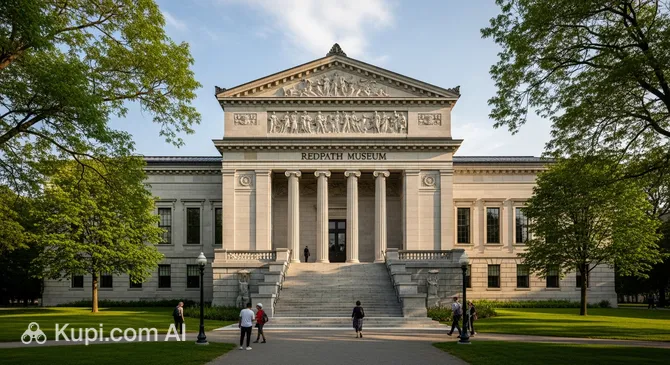
Redpath Museum. Source: Kupi.com AI

The museum's primary highlight is its rich holdings, numbering approximately 3 million items in the fields of paleontology, zoology, mineralogy, and ethnology. Unique fossils, dinosaur skeletons, and rare taxidermy specimens are gathered here under one roof. The museum was established through the generosity of sugar tycoon Peter Redpath and still retains the atmosphere of a classic 19th-century scientific cabinet.

The building itself is an architectural monument: its Victorian style with elements of Ancient Greek architecture attracts the attention of both tourists and filmmakers. Inside, original wooden display cases and ornate plasterwork have been preserved, creating a unique setting for immersion into the history of evolution and ancient civilizations.

Contacts

For those planning a visit to the Redpath Museum, it is helpful to have the organization's current contact details on hand. This will help you clarify details about lectures or book a group tour.

Below is the primary contact information for the museum:

Address 859 Rue Sherbrooke O, Montréal, QC H3A 2K6, Canada
Phone +1 514-398-4861
Official Website mcgill.ca/redpath

What to Do

Every visitor will find something fascinating within the halls of the Redpath Museum. Start your tour in the ground floor foyer, which features an impressive collection of marine animals: from giant crabs to whale skeletons and ancient marine reptiles. Heading upstairs, you'll enter the world of terrestrial inhabitants, where taxidermy gorillas and lions sit alongside rare extinct birds, such as the Carolina parakeet.

The main draw for fans of antiquity remains the exhibition featuring the Gorgosaurus skeleton and authentic Egyptian mummies. This is one of the largest collections of ancient Egyptian artifacts in the country. Equally interesting is the area dedicated to Charles Darwin, where you can see a copy of his famous work "On the Origin of Species" and even a handwritten letter from the great scientist. Nature lovers will be impressed by the Mineral Gallery, which displays over a thousand sparkling specimens from around the world.

In addition to viewing the exhibits, the museum offers a chance to dive into science by attending themed lectures and workshops regularly held for the general public. The atmospheric interiors with massive wooden panels and balustrades make a simple walk through the museum feel like a journey through time, which is especially popular with families and history of science buffs.

Getting There

Getting to this scientific hub in the heart of the city is easy. The Redpath Museum is located at 859 Rue Sherbrooke O, on the main campus of McGill University in downtown Montreal. The most convenient way to reach it is by public transport. You can take the metro to McGill (Green Line) or Peel (Orange Line) stations, from which the walk to the museum takes only 5–10 minutes.

If you prefer the bus, routes 24, 60, 61, 66, 71, 144, and 150 stop in the immediate vicinity of the campus. For those arriving from Montreal-Trudeau International Airport (YUL), the journey takes about an hour: first by express bus to the city center, and then by metro or a walk through the scenic university quarters.

Taxis or ridesharing services are also excellent options, especially if you are coming from more distant neighborhoods. Please note that parking directly on the campus is very limited, so using the metro or a bicycle is often a more practical solution for tourists.

History & Facts

The history of this place began in 1882, when the Redpath Museum officially opened its doors. It was the first building in Canada to be designed and built specifically as a museum. Funding for its construction was provided by Peter Redpath, a successful sugar industrialist and generous philanthropist who wished to memorialize science within the walls of McGill University.

The foundation of the first exhibitions was the personal collection of the prominent naturalist and geologist Sir William Dawson. In those days, only professors and students had access to the exhibits, as the museum was intended solely as a research base. The building, designed by architects Alexander S. Hutchison and Alexander D. Steele, is still considered an architectural gem today thanks to its austere style with Ancient Greek motifs.

Over time, the museum transformed from a closed academic collection into a world-class public space. Today, it is managed by McGill's Faculty of Science and houses approximately 3 million items. Its status as one of the oldest and most significant natural history museums is underscored by the fact that its interiors have remained virtually unchanged for a century and a half, preserving the spirit of the Victorian era for new generations of researchers.

Time Needed

To fully explore all three floors of exhibits and not miss any important details, a typical visitor will need between 1.5 and 2.5 hours. This is enough time to leisurely study the mineral collection, examine the skeletons of ancient predators, and view the ethnological artifacts.

If you are planning a visit with children, who will likely want to linger longer by the Gorgosaurus skeleton or the Egyptian mummies, you should aim for the upper end of this timeframe. Science enthusiasts wishing to study the displays dedicated to Darwin and evolution in detail may need a bit more time—around half a day.

Working Hours

The Redpath Museum follows a specific operating schedule that is worth keeping in mind when planning your walk through McGill University. On weekdays (Tuesday–Friday), the doors are open from 09:00 to 16:30. On Saturdays, the museum operates on a shorter schedule from 10:00 to 16:00.

Please note that Monday and Sunday are closing days. Hours may change on public holidays, so we highly recommend checking the museum's official website for the most up-to-date information before your visit.

Nearby

Its location in the heart of the university campus makes visiting the museum an excellent starting point for further exploration of Montreal's sights. Discovering the surrounding area will help you feel the deeper atmosphere of the city, where historical architecture harmoniously coexists with modern entertainment centers.

Near the museum and within easy reach of it, there are many interesting locations for family vacations and active leisure:

Attraction Name Distance (km)
Voiles en Voiles 2.1
La Ronde 3.9
PI-O Amusement Park 9.0
Centre D'amusement Kazoom Café 9.9
Elevation Trampoline & Amusement Montreal 10.8
Piscine St-Vincent 12.5
BFLY Brossard 13.0
iFLY Montréal Chute Libre Intérieur 14.3
Centre d'amusement Funtropolis 15.0
Club De Trampoline Acrosport 17.2

Reached the end of the page?

That means the route is fully explored