Support

Altay Airport

About the Airport

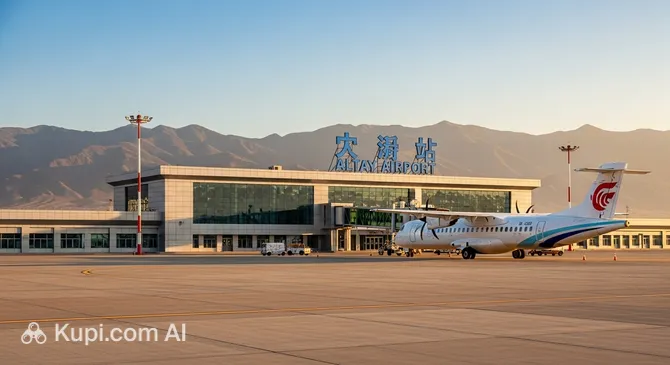
Altay Airport. Source: Kupi.com Binoculars

Altay Airport (AAT) serves as the air gateway to the city of the same name in the north of the Xinjiang Uygur Autonomous Region of China. Situated at the foot of the majestic Altai Mountains, this airport is the starting point for travellers seeking to explore the unique nature and culture of this picturesque region. Despite its modest size, the airport plays a key role in the prefecture's transport system, providing connections to major cities in the country and facilitating the development of tourism in this remote yet incredibly beautiful part of China.

IATA Code AAT
ICAO Code ZWAT
City Altay
Distance to centre 13 km
Status Domestic
Annual Passengers Data for recent years is not published
Popular Airlines China Southern Airlines, China Eastern Airlines, Air China.
Schedule "Altay Airport" online scoreboard

Altay Airport was originally built in 1956 and has since undergone several stages of modernisation to meet contemporary aviation requirements. Its key feature is its location at an altitude of 750 metres above sea level, offering passengers breathtaking views of mountain landscapes during take-off and landing. The terminal serves exclusively domestic flights, connecting the region with major transport hubs such as Urumqi, from where one can reach any point in China. Although it is a small regional airport, it offers passengers the basic amenities necessary for a comfortable wait and serves as an indispensable transport hub for anyone travelling through the Chinese Altai.

Contact Information

Below you will find the main contact information for Altay Airport (AAT). Please note that this is a regional airport, and some communication channels may be limited.

  • Official Website: A dedicated website for Altay Airport may not be available. For information on flights, check-in, and baggage allowance rules, it is recommended to contact your airline's website directly.
  • Information Desk Phone: +86-906-282-65-55. This is the main number for enquiries regarding airport operations. Please consider potential language barriers and time differences.
  • Airport Address: Altay Airport (AAT), Altay City, Xinjiang Uygur Autonomous Region, China.
  • Email: A public email address for general enquiries is generally unavailable. The most reliable method of communication is by phone.
  • Social Media: The airport does not maintain official pages on international social media networks.
  • Lost Luggage Information: For all issues related to lost or damaged baggage, you should contact your airline's representative directly at the airport.
  • Passenger Support Contacts: For immediate assistance and on-site consultations, please speak to staff at the information desk or representatives of your airline.

How to Get to the Airport

You can reach Altay Airport from the city of Altay in several ways, each having its own advantages. The best option depends on your budget, the amount of luggage, and the time available. The journey from the city centre to the terminal usually takes between 30 to 60 minutes, depending on the chosen transport and traffic conditions.

Public Transport

The most budget-friendly way to get to the airport is to use special shuttle buses. They run between key points in the city and the airport terminal. It is recommended to check the schedule and exact stop locations in advance, as they may change. This is an excellent choice for light travellers wishing to save money. The travel time by bus is usually around 40-60 minutes.

Taxi and Transfer

For maximum comfort, especially if you are travelling with family or a large amount of luggage, a taxi is best. A car can be ordered via apps popular in China or hailed on the street. A taxi ride will take approximately 30-40 minutes and will cost more than the bus. You can also book a private transfer in advance — in this case, the driver will meet you at the specified location and take you directly to the terminal, saving you from unnecessary hassle.

Car Rental and Parking

If you plan to actively explore the region, car rental can be a convenient solution. You can rent a car from companies in the city or at the airport. Please note that foreign tourists often require a temporary Chinese driving licence to drive in China. Altay Airport has parking facilities where you can leave your car for both short and long periods. This is convenient for those arriving in their own vehicle.

Terminals and Map

Altay Airport (AAT) is a modern and compact aviation hub with a structure that is intuitive even for first-time visitors. The airport consists of one passenger terminal that handles all domestic and international flights. This organisation makes navigation through the airport incredibly simple and fast, eliminating the need for complex transfers or the use of shuttles.

The terminal layout is logical and straightforward. The ground floor usually houses check-in counters, the arrival area, and baggage claim belts. After check-in, passengers proceed to the first floor, where the departure area is located. Here, travellers pass through pre-flight security and enter the secure area with waiting lounges and boarding gates. Due to the terminal's small size, all key points — from the entrance to the gate — are within walking distance of each other.

Completing all formalities, such as flight check-in and security screening, usually takes little time at Altay Airport. Under standard conditions, this takes no more than 30-40 minutes. Nevertheless, it is always recommended to arrive at the airport in advance, especially during peak hours or the tourist season, to avoid unforeseen delays.

To navigate the terminal, simply follow the signs, which are duplicated in Chinese and English. The entire passenger journey — from the check-in counter to the boarding gate — is linear, so it is practically impossible to get lost. If you have any questions, airport staff are always ready to help. The main advice is not to worry, as everything at Altay Airport is organised to ensure your journey begins comfortably and without fuss.

Airport History

The history of Altay Airport (AAT) begins in the mid-20th century. It was founded in 1956 and officially opened for flights two years later, in 1958. From the very beginning, the airport played a key role in the transport system of the remote and picturesque Altay Prefecture in the Xinjiang Uygur Autonomous Region of China, providing links to other parts of the country.

For decades, the airport served as the region's main air hub, supporting its economic development and gradually growing tourism interest. However, over time, the infrastructure ceased to meet modern requirements and increasing passenger traffic, leading to the need for radical modernisation.

The most significant stage in the airport's history was the large-scale reconstruction carried out in 2016-2017. During these works, the runway length was increased to 2,800 metres, a new modern terminal with an area of over 7,500 square metres was built, and the aircraft parking apron was expanded. This allowed the airport to accommodate larger aircraft and significantly increase capacity. In fact, this was not just a renovation, but the creation of a new, modern aviation complex on the site of the old one.

Today, Altay Airport represents a modern gateway playing an important role in the development of tourism, especially winter tourism. Due to its location near popular ski resorts, it is often called the "airport of China's snow capital". Its history is a vivid example of how the development of transport infrastructure contributes to unlocking the tourism potential of unique natural regions.

Services and Amenities

Altay Airport (AAT), despite its compact size, offers passengers a range of necessary services to make waiting for a flight as comfortable as possible. The terminal houses cafes where you can enjoy coffee and a light snack, as well as several shops selling souvenirs and travel essentials.

A general waiting hall is provided for relaxation before departure. Passengers who value privacy and a higher level of service can use the VIP Lounge. Here, more comfortable conditions are created, drinks and snacks are offered, and an individual approach to service is ensured.

Free Wi-Fi is available throughout the terminal, allowing you to stay connected or work. For passenger convenience, mobile device charging stations are installed in the waiting hall. Financial matters can be handled using ATMs and currency exchange points located within the terminal.

For passengers with small children, a Mother and Child Room is equipped, where you can feed and change your baby in a quiet environment. In case of illness or the need for medical assistance, you can visit the airport's 24-hour medical point.

The airport provides services for passengers with reduced mobility. Specially trained staff will assist in moving through the terminal and boarding the aircraft. To receive this service, it is recommended to contact your airline representative in advance.

There are no hotels or conference halls within the airport building itself; however, several hotels and accommodation options are located in the immediate vicinity, in the city of Altay. Basic facilities for work, such as a quiet space, may be available in the VIP Lounge.

Where to Eat

Altay Airport (AAT) is a small regional hub, so the choice of dining establishments here is quite modest, but sufficient for a snack before departure. The airport consists of a single terminal, so all cafes and kiosks are within walking distance.

The main place for a full meal is usually located in the public area before passport control and security (landside). Typically, this is a small cafe or canteen offering simple Chinese dishes. Here you can order hot meals, such as noodles, rice with vegetables and meat, or dumplings. If you are lucky, the menu may include elements of local Xinjiang cuisine, such as lagman or lamb dishes. This is the best option for those who have time for lunch or dinner.

After passing through security, in the so-called "secure" zone (airside), the choice becomes even more limited. Usually, a small kiosk or buffet operates here, where you can buy drinks (coffee, tea, water), sandwiches, pastries, and packaged snacks like crisps or nuts. This place is suitable for a quick snack immediately before boarding. Vending machines may also be installed in the departure lounge.

Regarding prices, they are expectedly higher than in the city but generally remain moderate compared to major international airports. Opening hours of dining establishments depend directly on the flight schedule — they open a few hours before the first departure and close after the last aircraft leaves.

Passengers with specific dietary needs (vegetarians, vegans, or those adhering to a gluten-free or Halal diet) should note that finding suitable dishes at Altay Airport will be extremely difficult. It is recommended to bring food with you from the city to avoid inconvenience. In general, the best advice is to eat a substantial meal in Altay before travelling to the airport, leaving its facilities for purchasing drinks or light snacks.

Travel Tips

To ensure your journey through Altay Airport goes as smoothly as possible, follow these useful tips. When planning your departure, always arrive early: for domestic flights within China, it is recommended to be at the airport 2-3 hours before departure, and for international flights — 3-4 hours. This will allow you to complete all formalities without rushing.

To save time, use online check-in for your flight. Keep your passport and boarding pass ready at the airport. Security screening procedures can be thorough, so prepare liquids (in containers up to 100 ml) in advance and be ready to remove laptops, tablets, and power banks from your hand luggage for separate scanning.

When choosing a seat on the plane, consider your preferences. A window seat will allow you to enjoy the views during take-off and landing, while an aisle seat offers more freedom to move around the cabin. Emergency exit seats usually have more legroom, but booking them may be restricted for certain categories of passengers.

Carefully study the hand luggage rules of your airline. In addition to standard restrictions on liquids and sharp objects, China has strict rules for carrying external batteries (power banks): they can only be carried in hand luggage, and the capacity marking must be clearly visible on the casing.

Passengers with connections should clarify in advance whether their luggage will be automatically transferred to the next flight or if it needs to be collected and checked in again. Leave enough time between connecting flights, especially if a change of terminal or passport control is required. Follow the "Transfers" signs.

When passing through customs control upon arrival or departure, have all necessary documents with you. If you are carrying goods subject to declaration, be sure to complete a customs declaration form. Be prepared to answer the customs officer's questions about the purpose of your visit and the contents of your luggage calmly and honestly.

To save time and money, check in online, bring an empty water bottle (it can be filled after security at special fountains), and a light snack. Prices for food and drinks in the departure area are generally significantly higher than in the city.

In the event of a flight delay, remain calm. Monitor information on the departure boards and in your airline's app. Contact your carrier's representative counter to learn about your rights — depending on the length of the wait, you may be offered vouchers for meals, drinks, or even hotel accommodation.

Reached the end of the page?

That means the route is fully explored