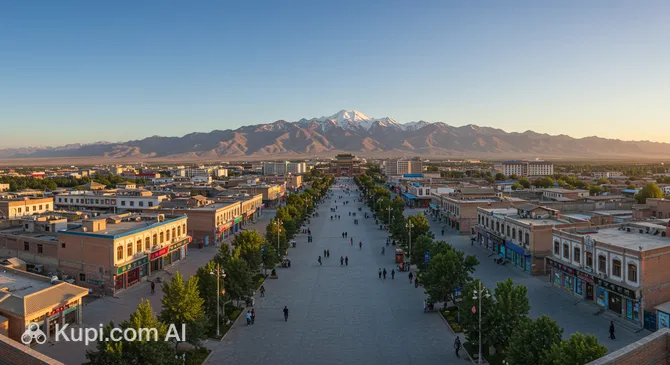
Artux is the administrative heart of the Kizilsu Kirghiz Autonomous Prefecture, located in the majestic Xinjiang Uyghur Autonomous Region in western China. The city possesses a unique character where the traditions of the Uyghur and Kirghiz people intertwine harmoniously. As an agricultural and administrative center, Artux charms visitors with its calm, measured atmosphere, far from the hustle and bustle of the giant metropolises of the east coast.
The city's geographic location at an altitude of about 1,303 meters above sea level among mountain ranges defines its isolated yet picturesque nature. With a population of approximately 240,000 people, Artux remains a cozy regional hub. Getting to know the historical past of this region more closely is worthwhile to see how ancient trade routes and agricultural traditions shaped the look of the modern city.
Artux. Illustration.
Source: Kupi.com AI
Tourists appreciate Artux for its authenticity: here you can see the real life of a region famous for its vineyards and cotton fields. The main points of attraction are local markets and central squares, where daily life hums with activity. A visit to the city is an excellent choice for those seeking immersion in ethnographic diversity and wishing to see the authentic, non-touristic side of Xinjiang.
Weather Overview
The climate in Artux has a distinct continental character, due to its location in a mountainous area. Travelers should expect hot, dry summers and cold winters with little snow. You can find current data on the climatic features of Artux on forecast services, but the general pattern remains stable year after year.
In winter, especially in January, the average temperature is about -5.5°C, and nighttime frosts can reach -10°C. Summer brings true heat: in July, the thermometer averages +25.8°C, often rising above +32°C. Precipitation is a rare occurrence here; most of the rain falls during the spring-summer period (May-August), but even then, it is short-lived.
One feature of the local weather is the spring dust winds that sometimes blow in from desert areas. Thanks to the altitude of 1,303 meters, the air here is usually cleaner than in large industrial centers; however, the mountains can trap dust in the valleys. The best time to visit Artux is late spring or early autumn, when the most comfortable temperatures for walking are established.
Average monthly temperature
Average monthly precipitation
Interesting Facts
Artux is a city with a distinctive character, hiding many interesting details for the thoughtful traveler.
Artux is the capital of the Kizilsu Kirghiz Autonomous Prefecture—the only autonomous entity for ethnic Kirghiz people in all of China.
The city's ethnic composition is unique: more than 80% of the population are Uyghurs, and about 11% are Kirghiz, creating a singular cultural and linguistic environment.
The city is recognized as an important agricultural center for the region; its hallmarks are its cotton fields and extensive vineyards, whose products are valued throughout Xinjiang.
Artux is located in a highland zone—the city's average elevation is about 1,303 meters above sea level, which affects the air clarity and climatic conditions.
Administratively, the city is divided into street committees and townships, maintaining a structure typical of large agricultural counties in western China.
How to Get There
The transport accessibility of Artux is determined by its remote location in the mountainous part of western China. The city is not a major aviation hub, so most travelers use combined routes. You can find more details about various ways to get there on specialized pages, but the primary reference point for any trip remains the neighboring city of Kashgar.
The nearest major airport is located in Kashgar (approximately 30–40 km from Artux). Flights regularly operate from Kashgar to Urumqi, from where you can fly to Beijing, Shanghai, and other metropolises. The journey from the airport to the center of Artux by taxi or bus takes about an hour along scenic mountain highways.
Direct railway connections to Artux are limited, and travelers more frequently use the Kashgar railway station. There is an excellent bus service between the cities: minibuses and taxis run throughout the day. Travel time by bus from more distant points in Xinjiang, such as Urumqi, can take about 18–24 hours, so domestic flights remain the preferred option for tourists.
Station
Passenger traffic
Distance
Kashgar railway station
9
27 km
Yarkant Railway Station
2
175 km
Main Attractions
Artux serves primarily as an important administrative and transit point, so there are no classic world-class tourist sites here. However, the city is interesting for its vibrant daily life. Walking along central streets such as Guangming Road, one can observe the architecture of government buildings and modern administrative quarters, which contrast with traditional residential buildings.
The heart of the city's social life is its local markets. While there are no organized tours, for a traveler, this is the best way to get acquainted with the local culture. The markets of Artux are famous for their agricultural products: here you can find famous Xinjiang grapes, high-quality cotton, and sheep wool products crafted by local artisans.
Artux's natural surroundings also deserve attention. The city is encircled by rugged yet beautiful mountains that create an impressive backdrop for urban landscapes. Although there are few developed parks within the county itself, the proximity to the border and the mountainous terrain make it an interesting destination for those who appreciate wilderness and want to see the foothills of the Tianshan Mountains in their pristine form.
Local Cuisine
The cuisine of Artux is a real feast for lovers of meat dishes and oriental spices. It is based on the traditions of the Uyghurs and Kirghiz, where lamb plays the leading role. Be sure to try the local pilaf, fragrant shashlik grilled over coals, and lagman (hand-pulled noodles), which are prepared here with generous additions of vegetables and meat. A meal is impossible to imagine without fresh naan flatbreads baked in a tandoor.
For those with a sweet tooth, Artux offers an abundance of fruit. Thanks to the hot summer, local grapes and melons are incredibly sweet. Cottonseed oil, produced in the prefecture, is often used as a base for many hot dishes, giving them a specific, recognizable flavor. Dairy products are also highly regarded, especially those made from sheep's milk in the Kirghiz tradition.
As for drinks, green tea with milk and salt in the Kirghiz style is popular, along with traditional Uyghur tea. In hot weather, ayran is perfectly refreshing. Most cafes and small restaurants are concentrated around Guangming Road, where you can find cozy tea houses as well as street food stalls that operate from morning until late at night.
Travel Tips
Preparing for a trip to a region as distinctive as Artux requires attention to detail. These tips will help you feel confident and get the most enjoyment out of your journey.
Clothing and Essentials: Pack your wardrobe based on the sharply continental climate. In summer, light clothing made of natural fabrics and sun protection are necessary, while in winter, warm clothes are essential as temperatures can drop well below zero. Given the region's Muslim traditions, choose modest clothing that covers shoulders and knees, especially when visiting residential neighborhoods.
Transport: Within the city, it is most convenient to get around by taxi or on foot. If you plan trips to the mountains, it is better to arrange a car rental with a driver in advance.
Finance: The primary currency is the Chinese Yuan (RMB). International cards work very rarely, and ATMs may not accept foreign plastic. Always carry a supply of cash with you.
Health and Safety: Artux is a safe city with a low crime rate. However, be cautious when hiking in the mountains after dark. Pharmacies can be found in the center on the main streets.
Communication: English is practically not spoken here. The main languages of communication are Chinese (Mandarin), Uyghur, and Kirghiz. It is recommended to install an offline translator on your smartphone.
Local Etiquette: Local residents are very hospitable. Greet people with a slight bow or the traditional "Assalamu Alaikum" in Muslim environments—this will inspire sympathy and respect.
What to Avoid: Try not to photograph administrative buildings or military sites without explicit permission. Also, it is best not to engage in discussions on political topics.
Connectivity: Wi-Fi is available in some hotels, but for constant internet access, it is better to purchase a local SIM card. Note that many familiar Western services in China only work through specific tools to bypass restrictions.
Artux will open the doors to a world of amazing traditions if you show a little patience and respect for the local way of life. Have a pleasant journey!
Entertainment & Nightlife
Entertainment in Artux is predominantly quiet and family-oriented. You won't find noisy nightclubs or large concert halls here, as the city's rhythm of life follows agricultural cycles and local traditions. The main evening activity is concentrated in the central squares, where locals gather for walks and conversation.
Daytime leisure is often associated with visiting tea houses or strolling through markets, which in this region serve as the primary public spaces. For those seeking more modern entertainment, such as contemporary cinemas or theaters, the best option is a trip to nearby Kashgar, as the infrastructure in Artux is geared toward the basic needs of its residents.
Safety in the city is high, and evening walks through the central districts are quite comfortable. Nevertheless, fans of nightlife should keep in mind that most establishments close early, and the main entertainment for locals remains home gatherings or relaxing in small outdoor cafes.
Parks & Museums
Park infrastructure in Artux is not as developed as in China's major tourist centers. The main green zones are represented by small squares near administrative buildings and walking alleys along main streets. Landscaping the city is a challenging task due to the mountainous terrain, so every green corner is valued by locals as a place to escape the summer heat.
Museums in the traditional sense are rare in the city, as the region's historical heritage lives more in its architecture and the traditions of its inhabitants than in exhibition halls. Nevertheless, the role of an "open-air museum" is played by the old quarters and central squares, where traditional lifestyles can be observed. For nature lovers, the best alternative to parks is a trip outside the city limits to the foothills of the mountains or a visit to the vast vineyards surrounding Artux.
For walks, tourists often choose the central squares, which turn into lively social spaces in the evening. Despite the absence of large galleries, Artux charms with its naturalness—here, history and culture manifest in everyday details, whether it's the patterns on house gates or the traditional clothing of the locals.
Getting Around
The public transport system in Artux is as simple and functional as possible. The main means of transportation for residents and guests are buses and minibuses. The route network covers all major street committees and townships, connecting them with the central part of the city. Fares are inexpensive, and transport runs quite regularly, although trips to remote areas may be less frequent.
Due to Artux's compactness and low population density (about 18.5 people per km²), the city center is very convenient to explore on foot. There are practically no traffic jams, making walks pleasant. As an alternative to buses, you can always use taxi services—cars are easy to find on the main streets, and the cost of a trip within the city remains very affordable.
Bus fares can most often be paid in cash upon boarding or through local payment systems. There are no subways or trams in the city. During the summer, many locals use bicycles, which is also a great way for a tourist to explore the city. For trips to neighboring counties or to Kashgar, it is best to use long-distance buses departing from the central bus station.
Accommodation
The hotel infrastructure in Artux is primarily geared toward business travelers and transit passengers. In the city center, especially along Guangming Road, you can find several mid-range hotels (2–3 star level) that offer a basic set of amenities at very affordable prices. There are no luxury five-star complexes here, but cleanliness and hospitality are guaranteed.
For those planning to stay in the city longer, guesthouses and apartments are available. This option is often chosen by specialists working in the region's agricultural sector. It is recommended to book accommodation in advance, especially if your trip coincides with the harvest season or local holidays, when the demand for rooms in the center increases.
When choosing a place to stay, focus on proximity to central administrative buildings and markets—this will provide the best access to transport hubs and public catering points. Most hotels accept payment in cash or through popular Chinese payment systems, so it is worth making sure you have funds in your account or cash Yuan in advance.
Nearby Cities
Artux is a wonderful starting point for exploring the unique region of Xinjiang, where every neighboring city opens a new page in the history of the Silk Road. The city's surroundings are rich in cultural monuments and natural contrasts.
Just 31 kilometers away lies the legendary Kashgar—one of the oldest cities in Asia. This is a must-visit for any tourist: see the Id Kah Mosque, the old city, and the famous oriental bazaars. A trip to Kashgar takes very little time but offers a wealth of impressions. Also of interest are smaller towns such as Peyziwat and Akto, which allow for a deeper feel of rural life and local hospitality.
Exploring the surrounding counties will reveal views of snow-capped peaks and green oases hidden among the mountains. Don't miss the opportunity to take a small journey outside the city to see the multifaceted nature of this part of China.
Shopping & Souvenirs
Shopping in Artux primarily means visiting colorful markets and small specialized shops. The city is not famous for huge malls with global brands, but it is an ideal place to buy authentic goods. The main shopping area is considered to be Guangming Road, where the region's primary stores and shopping centers are concentrated.
Be sure to pay attention to products made of cotton and sheep's wool—Artux is a major producer of these raw materials, so textile prices here are very attractive. Also popular are Uyghur national fabrics with bright patterns and traditional handmade Kirghiz jewelry, which serve as excellent mementos of the trip.
Don't forget to stop by the food markets for local delicacies: dried grapes, nuts, and spices. Most retail outlets operate from early morning until evening, and payment in small shops is preferred in cash Yuan or through mobile apps, as international bank cards are rarely accepted.