Support

Esbjerg Airport

About the Airport

Esbjerg Airport is not merely an air gateway on the west coast of Jutland, but a strategically vital hub for the North Sea energy industry. It is unofficially known as the "helicopter capital" of Denmark, as hundreds of flights depart from here to offshore oil and gas platforms. For tourists, it serves as a convenient starting point for exploring the unique Wadden Sea coast, a UNESCO World Heritage Site, and the city of Esbjerg itself.
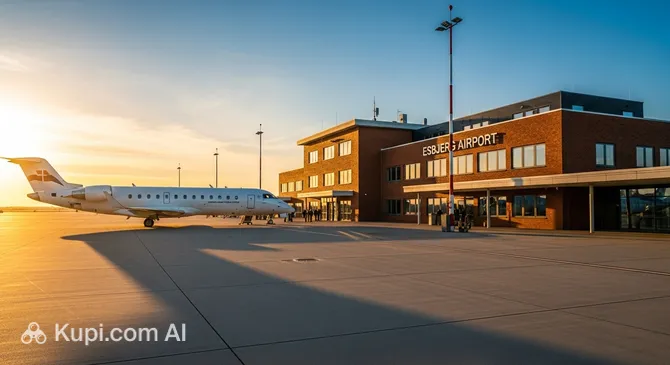
Esbjerg Airport. Source: Kupi.com Binoculars
IATA Code EBJ
ICAO Code EKEB
City Esbjerg
Distance to centre 9 km
Status International
Annual Passengers approx. 50,000 (mainly due to helicopter traffic)
Popular Airlines Loganair, CHC Helicopter Service, NHV Group

The main feature of Esbjerg Airport is its specialisation in serving the offshore industry. It is Northern Europe's largest centre for helicopter transport, which is reflected in its infrastructure: a separate, larger helicopter terminal is located next to the main passenger terminal. For ordinary travellers, this means the airport is rarely overcrowded, and check-in and security procedures are very swift.

The airport's advantages include its compactness and convenient location. The journey from the terminal to the city centre by bus or taxi takes no more than 15-20 minutes. Despite its modest size, the airport has everything necessary for a comfortable wait: a café, car rental desks, and complimentary Wi-Fi access. Regular flights connect it with Aberdeen (Scotland), making the airport an important node for business travel in the energy sector.

Contact Information

Below you will find the contact details for Esbjerg Airport (EBJ), which will assist you in planning your trip and resolving any potential queries.

  • Official Website: www.esbjergairport.dk
  • Information Service Phone: +45 76 12 14 00
  • Airport Address: John Tranums Vej 29, 6715 Esbjerg N, Denmark
  • Email: eba@esb.dk
  • Social Media: Current information and airport news can be found on the official pages on Facebook and LinkedIn.
  • Lost Luggage Information: If your luggage was lost during the flight, please contact your airline's representative first. Regarding items left within the airport terminal, please contact the information service.
  • Passenger Support Contacts: For consultations and assistance, you may call the main information service number or write to the airport's email address.

How to Get to the Airport

Getting to Esbjerg Airport from the city centre of Esbjerg is effortless due to its close proximity — just 9 kilometres to the northeast. Travellers have access to several convenient transport options, allowing trips to be planned according to budget and preferences.

Public Transport is the most economical way to reach the airport. Special bus routes run regularly between the city centre and the air harbour. The bus journey usually takes about 20-30 minutes. This is an excellent choice for tourists with light luggage wishing to save money. We recommend checking the current schedule and fares on the website of the local transport operator, Sydtrafik, in advance, as they may change depending on the season and day of the week.

Taxi or Pre-booked Transfer offers maximum comfort and speed. The car journey from the city centre to the terminal will take just 10-15 minutes, making this option ideal if you are in a rush for a flight or travelling with bulky luggage and young children. The cost of a taxi ride will be significantly higher than a bus, but it ensures convenience and "door-to-door" delivery.

Car Rental is a wonderful choice for those planning to actively explore the coast and surroundings of Denmark. Offices of international and local rental companies operate at the airport and in the city. Having your own vehicle gives you complete freedom of movement. For car owners, the airport provides convenient parking, where you can leave your car for both short and long periods. You can find out rates and book a spot on the airport's official website.

It is also worth noting that there are other airports in the region. The largest of them is Billund Airport (BLL), located just 45 km away. It serves many international destinations and can be a convenient alternative point of arrival or departure. Also within a 100 km radius are Westerland – Sylt Airport (GWT) in Germany, Karup Airport (KRP), and Sønderborg Airport (SGD), which serve mainly domestic and European flights.

Terminals and Map

Esbjerg Airport (EBJ) has a simple and logical structure consisting of two main buildings: a passenger terminal and a separate, larger helicopter terminal. For tourists arriving in the region on regular flights, it is the passenger terminal that is important, serving both domestic and international destinations.

The passenger terminal is notable for its compactness. All key zones — check-in counters, security checkpoint, departure lounge, and arrival area — are located in one building a short distance from each other. Thanks to this, it is practically impossible to get lost here, and navigation is intuitive. Since all passenger operations are concentrated under one roof, transfers between terminals are not required.

The helicopter terminal is a separate facility used mainly for transporting personnel to offshore oil and gas platforms in the North Sea. Ordinary travellers usually do not encounter it. Its presence merely underscores the status of Esbjerg as a significant energy and industrial centre.

Check-in and security procedures at the airport are significantly faster than at major hubs. Due to moderate passenger traffic, queues are rare here, and completing all formalities usually takes no more than 20-30 minutes. Nevertheless, it is always recommended to arrive at the airport in advance, especially before international flights.

Navigating the passenger terminal is easy — simply follow the clear signs in Danish and English. This simplicity makes the airport a convenient and welcoming gateway for travelling through the western part of Denmark.

Airport History

The history of Esbjerg Airport (EBJ) is closely linked to the economic development of the region and the exploration of the North Sea. The airport was officially opened on 4 April 1971. Its creation was a direct response to the growing needs of the oil and gas industry, which began to develop actively on the Danish continental shelf during those years. From the very beginning, the airport was designed not only for passenger and cargo aircraft but also as a key base for helicopter connections with offshore platforms.

A major stage in the airport's development was its transformation into one of the largest helicopter hubs (heliports) in Europe. Almost from the moment of opening, helicopter operations became a dominant part of its activity. This unique combination of regular passenger flights and intensive helicopter traffic defined the entire history of its expansion. Infrastructure was constantly adapted to service heavy helicopters and ensure the rapid and safe transport of personnel and cargo to offshore facilities.

Significant modernisation took place at the end of the 20th century. In 1998, a new, more modern and spacious passenger terminal was opened, which improved the quality of passenger service and separated the flows of oil and gas industry workers and ordinary tourists. In subsequent years, regular reconstructions of the runway, taxiways, and helicopter aprons were carried out to meet strict international safety standards and growing traffic.

An interesting fact: Esbjerg Airport has witnessed and participated in all key stages of the development of the Danish sector of the North Sea. Its history is not just the story of a transport hub, but a chronicle of Denmark's transformation into an energy power. Today, it is a modern and efficient airport continuing to play a vital role in the economy of the western part of the country, successfully combining the service of commercial aviation and the needs of the offshore industry.

Services and Amenities

Esbjerg Airport (EBJ) is a modern and convenient regional airport offering passengers all key services for a comfortable journey. Despite its compact size, the terminal is well-equipped and allows for a pleasant time while waiting for a flight.

For those feeling hungry, the EJB Restaurant operates within the airport building, offering a menu with hot meals, light snacks, and beverages. There is also a small shop where you can purchase newspapers, souvenirs, and essential items. After passing security control, a duty-free shop is available to passengers.

Complimentary Wi-Fi is available throughout the terminal, and special sockets and USB ports are provided for charging gadgets. For passengers wishing to spend time in a quieter environment, a business lounge is open, which can also be used for business meetings. Here you can relax or work in silence.

The airport is fully adapted for passengers with reduced mobility: assistance is provided for moving through the terminal and boarding. Baby care rooms are equipped for families with small children. Although there is no full bank branch or currency exchange office at the airport, ATMs are installed in the terminal. Medical assistance is provided upon request by airport staff.

For business travellers, conference rooms are available for rent to hold negotiations or events. There is no hotel within the airport itself, but in the immediate vicinity and in the city of Esbjerg, located just 10 km away, you can find numerous accommodation options to suit any taste and budget.

Where to Eat

Esbjerg Airport (EBJ), being a compact regional air hub, offers passengers basic but convenient opportunities for snacks and full meals. Dining options are concentrated in the main terminal building and are designed so you can refresh yourself before departure or upon arrival.

The main establishment at the airport is a café-restaurant located in the public area (landside), before security control. This makes it convenient for both departing passengers and those meeting them. Here you can quickly have a coffee or enjoy a leisurely lunch. The café's opening hours are generally synchronised with the flight schedule, so it is open during periods of peak activity at the airport.

The menu focuses on popular Danish and European dishes. You can try the classic Danish smørrebrød (open-faced sandwich), fresh pastries, sandwiches, salads, and hot daily specials. It is an excellent place for those who want a quick bite or a more substantial lunch. The price range is average, corresponding to standard prices in Northern European airports.

Regarding dietary restrictions, basic vegetarian options, such as salads or cheese sandwiches, are usually available. However, choices for vegans or those requiring gluten-free and Halal meals may be extremely limited. It is recommended to check the ingredients with the café staff. For those with very little time or travelling at hours when the café is closed, vending machines with beverages and light snacks are also installed in the terminal.

Tips for Travellers

To ensure your journey through Esbjerg Airport goes smoothly, make use of these tips. Esbjerg Airport (EBJ) is a small and modern regional airport, so there are usually fewer queues here than in major hubs. Nevertheless, it is recommended to arrive 1.5-2 hours before flights within the Schengen zone and EU, and 2-3 hours before international flights. To save time, complete online check-in for your flight and save the boarding pass on your phone. At security, be prepared to place electronics and liquids in a separate tray. Standard EU rules apply: liquids in hand luggage must be in containers up to 100 ml, packed in a transparent bag.

When choosing a seat on the plane for short flights from Denmark, there are no special tricks: a window seat offers beautiful views during takeoff and landing, while an aisle seat provides more legroom and the ability to stand up without disturbing neighbours. Regarding hand luggage, always check the baggage allowance with your airline, as it may vary. Besides restrictions on liquids, it is forbidden to carry sharp objects, weapons, and flammable substances. Power banks and other lithium batteries are generally permitted only in hand luggage.

Passengers with connections should pay attention to the ticket type. Esbjerg Airport is rarely used as a major transit hub, so most connections might be self-transfers. This means you may have to collect your luggage and check it in again. Regarding customs control, for passengers arriving from EU countries, the "Green Channel" applies, meaning no formal check. If you are flying from a country outside the EU, be prepared for standard customs procedures and potential luggage inspection.

To save time and money, use public transport or book parking in advance if you are driving your own car. Take an empty reusable water bottle with you — it can be filled after passing security control. Also, try to travel light to avoid excess baggage fees. Packing food for a light snack will also help save money, as prices in airports are traditionally higher.

In case of a flight delay or cancellation, first of all, contact your airline representative for information. Depending on the length of the delay and the flight distance, under EU laws (Regulation 261/2004), you are entitled to assistance and compensation. The airline is obliged to provide you with beverages, meals, and for long delays — hotel accommodation. Be sure to keep all receipts for necessary expenses to present them later for reimbursement.

Reached the end of the page?

That means the route is fully explored