Support

Taba International

About the Airport

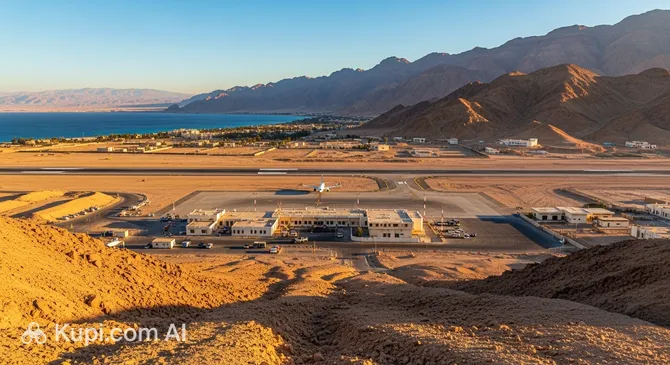
Taba International. Source: Kupi.com Binoculars

Taba International Airport is not merely a transport hub, but a true gateway to a world of historic landscapes and the azure waters of the Red Sea. Located on a plateau amidst the majestic granite mountains of the Sinai, it immerses travellers in the unique atmosphere of the Egyptian desert from the very first moment. Thanks to its compact size and distance from the hustle and bustle of metropolises, this airport offers tourists a calm start to their holiday, devoid of the usual stress of large aviation hubs. Landing here is an attraction in itself: the view from the window offers a breathtaking panorama of the Gulf of Aqaba and the meeting point of three countries' borders.

IATA Code TCP
ICAO Code HETB
City Taba
Distance to centre 15 km
Status International
Passengers per year Depends on the charter programme (capacity ~600 pax/hour)
Schedule Seasonal (predominantly charters)

Airport Features and Advantages

Taba Airport (TCP) possesses a number of advantages that make it a convenient arrival point for a specific category of tourists. Despite its modest size, its infrastructure fully meets the needs of travellers heading to the resorts of the Sinai Peninsula.

Strategic Location. The airport's main trump card is its proximity to the Taba Heights resort area and the borders of neighbouring states. It is an ideal entry point for those planning a combined tour visiting attractions not only in Egypt but also in neighbouring countries, or for those wishing to reach hotels in the north of the Gulf of Aqaba as quickly as possible.

Speed and Comfort. Thanks to the small passenger flow, which is formed mainly by charter flights, completing all formalities here takes significantly less time than in the congested airports of Sharm El Sheikh or Cairo. Queues at passport control and baggage claim generally move quickly, allowing tourists to start their holiday sooner.

Scenic Views. The location amidst a mountainous landscape makes taking off and landing in Taba unforgettable. The airport is situated on high ground, and the views of the desert and sea opening up from the aircraft steps often become the first vivid photos in a traveller's album.

Contact Information

Below is the contact information for Taba International Airport (TCP). Please note that this is a small regional airport, and some communication channels may be limited.

  • Official Website: Taba International Airport is managed by the Egyptian Airports Company (EAC). The airport does not have a separate official website; general information can be found on the management company's portal.
  • Inquiry Service Phone: +20 69 350 0741. When calling from within Egypt, the local number format may be used.
  • Address: Taba, South Sinai Governorate, Egypt. The airport is located approximately 14 km northwest of the city.
  • Email: There is no direct public email address for contacting the airport. For urgent matters, it is recommended to use the telephone.
  • Social Media: Taba Airport does not have official pages on social media platforms.
  • Lost Luggage Information: For all issues related to lost or damaged luggage, you must contact your airline's representative directly. The airport service does not process such requests.
  • Passenger Support Service: For general information, flight schedules, and assistance for passengers with special needs, please use the main airport inquiry phone number.

How to Get to the Airport

Getting to Taba International Airport (TCP) from the resort area of Taba city and back is quite simple, however, it is worth noting that this is a small airport oriented mainly towards charter flights. Therefore, transport options are limited, and it is better to plan your trip in advance.

Taxi and Tourist Transfer

This is the most popular and reliable way to get to the airport. Most hotels in Taba and Taba Heights organise group or individual transfers for their guests. It is strongly recommended to book this service in advance through your hotel or tour operator. The journey from the Taba Heights resort area to the airport takes approximately 40-50 minutes. You can also use local taxi services, but in this case, be sure to agree on the fare before the trip begins, as meters are not always used.

Car Rental

If you prefer independence when moving around Egypt, renting a car is an excellent solution. You can rent a car both in the resort area and by pre-order with delivery to the airport. The road to the airport is simple and well-marked. Taba Airport has parking facilities where you can leave a vehicle for a short or long term.

Public Transport

Please bear in mind that there is no direct public transport connection (city buses, trains, or minibuses) to Taba Airport. The main flow of passengers is served by tourist shuttles and taxis, so one should not rely on scheduled buses.

Features and Alternative Airports

Taba's unique location on the border of three countries opens up additional opportunities for travellers. Some tourists arrive in the region via neighbouring airports and cross the border. The nearest ones are: Ramon Airport (ETM) in Eilat and King Hussein International Airport (AQJ) in Aqaba, Jordan. You will also need to take a taxi from the border crossings to Taba Airport. Additionally, a popular alternative is the major Sharm El Sheikh Airport (SSH), although the transfer from there to Taba will take several hours.

Terminals and Map

Taba International Airport (TCP) is a compact and functional aviation hub, serving primarily charter flights for tourists arriving at the resorts of the Sinai Peninsula in Egypt. Its structure is extremely simple, making navigation intuitively clear even for those visiting for the first time.

The airport consists of one passenger terminal, which handles both international and domestic flights. Thanks to this, travellers need not worry about transferring between different buildings — all procedures from check-in to boarding take place in one location. The terminal layout is logical: departure and arrival zones are clearly separated but are within walking distance of each other.

Upon entering the terminal, you find yourself in the general area where check-in counters are located. After receiving a boarding pass and checking in luggage, passengers undergo passport control and security screening, after which they enter the departure zone. Here, there is a small Duty Free shop, several cafes and souvenir stalls, as well as comfortable waiting lounges. The arrival zone is equally simple: after disembarking, passengers proceed to passport control, then to the baggage claim hall, and after passing through customs inspection, exit to the tour operator counters and transport parking.

Despite the compact size, queues can form during peak hours and days with many charter arrivals/departures. It is recommended to arrive at the airport well in advance — approximately 2.5-3 hours before departure. This time will be sufficient to calmly complete all formalities without unnecessary haste. Thanks to the simple layout, getting lost in Taba Airport is practically impossible: all signs are clear, and staff are always ready to assist with navigation.

Airport History

The history of Taba International Airport is unique and closely linked to the political events of the region. The airport was not built as a civil facility, but as a military airbase. Its construction was completed in 1972 during the period of control over the Sinai Peninsula, and it initially bore the name "Etzion" Airbase.

A key moment in the airport's history was 1982. Under the Camp David Accords and the peace treaty between Egypt and neighbouring territories, the Sinai Peninsula was returned to Egyptian sovereignty. Along with the territory, the airbase was transferred to Egypt, which was then transformed into a civil airport to serve the growing flow of tourists to the Red Sea resorts.

With the transition to Egyptian management, the airport began a new life. It became an important aerial gateway for tourists coming for holidays in Taba and nearby resort areas. To meet international standards and increasing passenger traffic, the airport has been modernised repeatedly. The most significant reconstruction took place at the turn of the century, when in November 2000 a new, more modern and spacious passenger terminal was opened, capable of serving up to 1,000 passengers per hour.

Interesting fact: thanks to its strategic location near the borders of three countries, Taba Airport is often used by tourists as a convenient transfer hub for journeys not only around Sinai but also for visiting nearby Eilat and Aqaba in Jordan. Its history is a vivid example of how a military facility can be successfully transformed into a peaceful infrastructure project promoting tourism and international connections.

Services and Amenities

Taba International Airport (TCP) offers passengers a set of essential services necessary for a comfortable wait for their flight. Despite its modest size, the terminal is equipped with everything needed for travellers arriving at the resorts of Taba and other cities on the Sinai Peninsula.

There are several cafes and snack bars operating within the airport where one can have coffee and a snack before departure. In the departure zone, there is a Duty Free shop offering a standard range of goods: perfumes, cosmetics, tobacco products, and Egyptian souvenirs. There are also small kiosks with travel essentials.

For a more comfortable wait, passengers can utilise the services of the VIP lounge. It offers a secluded atmosphere, refreshing beverages, snacks, and the latest press. Regarding connectivity, access to the Wi-Fi network in the terminal may be limited or provided for an additional fee. Special charging stations with power outlets are equipped for recharging gadgets.

Financial services are represented by bank branches and currency exchange points, where money can be exchanged upon arrival or before departure. ATMs are also installed in the terminal. In case of necessity, passengers can visit the medical point for first aid. A mother and child room is provided for travellers with young children.

The airport is equipped to serve passengers with reduced mobility: there are ramps, special restrooms, and the option to request assistance services. There are no hotels directly within the terminal building, however, the nearest hotel complexes are located in the Taba resort area, a few minutes' drive away. Specialised conference halls or business centres are absent in the airport, but basic conditions for work can be found in the VIP lounge.

Where to Eat

Taba International Airport (TCP) is small and primarily serves seasonal and charter flights, so the choice of dining establishments here is limited. Nevertheless, passengers can find several options for a snack before departure. The main food outlets are concentrated in the departure zone, after passing through passport control and security screening.

Several cafes and snack bars operate in the airport, offering a standard selection for travellers. Here you can buy sandwiches, pastries, crisps, chocolate, as well as hot and cold beverages: coffee, tea, juices, and sparkling water. This is quite sufficient for a quick bite while waiting to board a flight. There are generally no full-service restaurants with a hot à la carte menu here.

All establishments are located in the airside zone (the "secure" departure area), as this is where passengers spend most of their time. Their opening hours depend directly on the flight schedule — they open a few hours before aircraft departures and close after the last flight leaves. In the general area before check-in, the selection may be extremely sparse or non-existent.

Regarding special dietary needs, as throughout Egypt, the food offered complies with Halal standards. Simple vegetarian options can also be found, for example, sandwiches with cheese or vegetables. However, specialised vegan or gluten-free dishes will be difficult to find, so passengers with strict dietary restrictions are advised to bring food with them. Prices in the airport, as expected, are higher than average for the country.

For a quick snack, a coffee with a croissant or a sandwich from a local cafe is ideal. If you are counting on a more substantial lunch, it is better to eat beforehand at your hotel or in one of the city's restaurants, as the airport does not provide opportunities for a full dinner. The main function of the local catering is to help pass the time before departure with a cup of drink and a light snack.

Tips for Travellers

To ensure your journey through Taba International Airport goes as smoothly as possible, make use of our tips. Simple planning will help avoid stress and save time.

Arrival Time and Check-in. For international flights, it is recommended to arrive at the airport 2.5–3 hours before departure. Although Taba Airport is not very large, control procedures can take time. If you have completed online check-in, this will speed up the process, but you will still need to check in luggage and undergo screening. Keep your passport, visa, and tickets to hand.

Passing Control. Security procedures in airports in Egypt can be quite thorough and include several stages of checking. Remain calm and follow the staff's instructions. After checking in for your flight, passport control awaits you, followed by a personal search and hand luggage check. Customs operates "green" (if nothing to declare) and "red" channels.

Choosing a Seat on the Plane. If the airline allows you to choose a seat, consider your preferences. Window seats will grant you magnificent views of the Sinai mountains and the Gulf of Aqaba during take-off or landing. Aisle seats are convenient if you plan to get up during the flight.

Hand Luggage. Standard rules apply: liquids are permitted in containers up to 100 ml, packed in a transparent bag. Sharp objects, weapons, and flammable substances are prohibited. Always check the current requirements of your airline, as they may differ.

Transfers. Taba Airport mainly serves direct charter flights and is not a major transit hub. If you have a self-arranged connection, allow maximum time between flights. You will likely have to collect luggage and check in again, and this may require an Egyptian visa.

Economy and Convenience. Exchange only a small amount at the airport for initial expenses — the rate here is usually less favourable than in the city. Bring an empty water bottle with you to fill it after passing security. Prices for food and drinks in the "secure zone" can be inflated.

In Case of Flight Delay. If your flight is delayed, first contact your airline representative for information. Depending on the length of the delay, you may be provided with drinks, meals, or even hotel accommodation. Since waiting facilities in the airport are limited, it is useful to have a book, a charged power bank, and headphones with you.

Reached the end of the page?

That means the route is fully explored