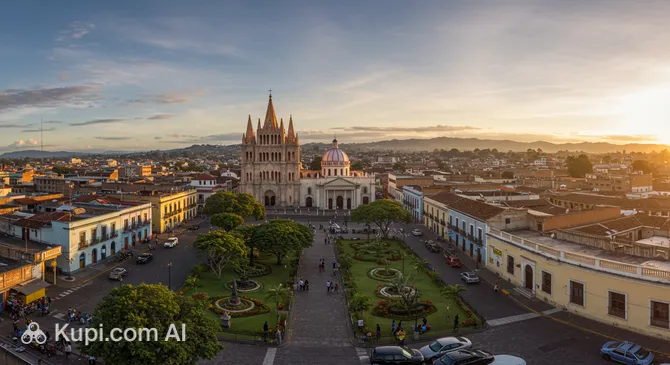
San Miguel is a dynamic and lively city, rightfully considered the economic and commercial capital of the eastern part of El Salvador. As the country's third-largest metropolis, it attracts travelers not so much with a glossy tourist facade as with its authentic energy, the colonial layout of its central districts, and its proximity to majestic natural giants.
San Miguel. Illustration.
Source: Kupi.com AI
The city is nestled at an altitude of about 130 meters above sea level at the foot of the Chaparrastique stratovolcano. Its population exceeds 218,000 people, making San Miguel an important administrative and urban hub. The city's history began in the 16th century, and today its streets represent a fusion of ancient heritage and modern commercial bustle.
The main event that draws thousands of guests is the famous San Miguel Carnival, held at the end of November. The rest of the time, the city serves as an excellent base for exploring nearby archaeological sites, such as Quelepa, and relaxing on picturesque Pacific beaches, which can be reached in just an hour's drive. We invite you to plunge into the atmosphere of the authentic Salvadoran East, where traditions are closely intertwined with the daily rhythm of life.
Weather Overview
The climate of San Miguel is typical of the tropical lowlands of Central America. Two seasons are clearly distinguished here: dry (from November to April) and rainy (from May to October). The city is known for its high temperatures, which fluctuate throughout the year in the range of 25°C to 30°C; however, during midday hours, the thermometer often rises to the 34–35°C mark.
The most comfortable time for a visit is considered to be the period from December to February, when stable sunny weather is established and air humidity is minimal. If you are planning a trip during the summer months, be prepared for tropical downpours, which most often occur in the afternoon. A detailed weather forecast in the city will help you pack your suitcase correctly and prepare for the local heat.
The proximity of the Chaparrastique and Aramuaca volcanoes creates a special microclimate in the city's surroundings. Despite periodic cloudiness during the rainy season, San Miguel remains one of the hottest places in the country, so having air conditioning in your hotel will be a necessity for a comfortable stay rather than a luxury.
Average monthly temperature
Average monthly precipitation
Interesting Facts
San Miguel was founded in 1530 under the proud name San Miguel de la Frontera, which emphasized its role as a frontier outpost of the Spanish possessions.
The San Miguel volcano (Chaparrastique) is considered one of the most active in El Salvador: more than 30 significant eruptions have been recorded since the beginning of the 20th century alone.
The local Carnival, held on the last Saturday of November, is recognized as one of the largest folk celebrations in all of Central America.
Just a few kilometers from the modern city is the Quelepa archaeological zone, which was a major cultural center of the Lenca people for fifteen hundred years.
The city has experienced rapid demographic growth: over the past 50 years, its population has nearly quadrupled, turning it into a powerful urban hub.
How to Get There
San Miguel is the most important transport hub in eastern El Salvador, so getting here is easy. The main transport artery is the famous Pan-American Highway, which connects the city with the capital and neighboring regions. To plan your route as efficiently as possible, it is worth studying detailed information in advance on how to get to this bustling trade center.
If you are arriving from abroad, your primary destination will be the Monseñor Óscar Arnulfo Romero International Airport (IATA: SAL), located approximately 140 kilometers from San Miguel. From the airport to the city, you can take a taxi, private transfer, or bus, but keep in mind that the journey can take 3 to 5 hours due to heavy traffic around the capital.
For domestic travel, intercity buses are the most popular. They depart regularly from the Oriente terminal in San Salvador. This is an inexpensive and colorful way to travel, allowing you to see life in the Salvadoran provinces. Railway communication in the region is currently not a primary mode of passenger transport, giving way to a developed network of bus routes.
Station
Passenger traffic
Distance
1
225 km
Main Attractions
Although San Miguel is primarily a commercial center, there are several noteworthy places here for architecture and history buffs. The central object and spiritual heart of the city is the Cathedral Basilica of Our Lady of Peace. This majestic building with its rich interior decoration is considered one of the most significant religious monuments in the region and attracts pilgrims from all over the country.
For those looking for outdoor recreation without leaving the vicinity of the city, Turicentro Altos de la Cueva is an excellent option. This is a popular spot for family leisure, where you can enjoy swimming in pools and walking in the shade of tropical greenery. The complex provides opportunities for a peaceful pastime away from the busy shopping streets.
Outside the historical center, the San Miguel volcano, also known as Chaparrastique, invariably attracts the attention of tourists. Its perfect cone dominates the landscape and serves as a reminder of the powerful natural forces of this region. Also nearby is the Quelepa archaeological complex—an ancient settlement of the Lenca culture, where the remains of pyramidal structures and terraces have been preserved, lifting the veil of mystery over the pre-Columbian history of El Salvador.
Local Cuisine
The gastronomy of San Miguel is a real treat for fans of simple and hearty dishes. As in all of El Salvador, pupusas reign supreme here—thick corn tortillas with various fillings, from melted cheese and beans to pork rinds. They are traditionally served with curtido (spicy pickled cabbage) and tomato sauce. A local feature is that in the eastern regions, the recipe and presentation can have their own unique flavor nuances.
For a full meal, it's worth trying yuca frita (fried cassava) or the rich sopa de pata soup. A popular place to get acquainted with the local cuisine is the Torolomo restaurant, where you can taste traditional meat dishes. If you want to spend time in a more European setting over a cup of coffee, stop by Tartaleta Bistro & Café.
For drinks, be sure to try refreshing horchata (a drink based on morro seeds with cinnamon) or tamarind juice. Locals often eat in small eateries called comedores or buy food directly at markets, where you can always find the freshest tropical fruits and authentic street food. The city's culinary scene reflects its character: it is honest, accessible, and very diverse.
Travel Tips
Preparing for your trip to San Miguel will help make your journey comfortable and safe. Use these practical tips to feel confident in the eastern capital of El Salvador:
Clothing and Essentials: It is hot in the city year-round, so choose light clothing made from natural fabrics. Don't forget sunscreen, sunglasses, and a hat. When visiting churches, such as the Cathedral, a modest dress code (covered shoulders and knees) is recommended.
Transport: It is most convenient to get around the city by taxi. Use official services or apps. Be prepared for traffic jams on the Pan-American Highway during peak hours.
Finance: The official currency of El Salvador is the US dollar. Major shopping centers accept cards, but you will definitely need small denomination cash at markets and on buses.
Health and Safety: Drink only bottled water. In the evening, stick to well-lit central streets and avoid walking alone on the outskirts. Pharmacies are easy to find in shopping areas and near markets.
Communication: The main language is Spanish. English is not widely spoken, so learn basic phrases or use an offline translator. A local SIM card can be bought at any shopping mall.
Local Etiquette: Salvadorans are very polite and friendly people. A "Buenos días" or "Buenas tardes" greeting is mandatory when entering a shop or restaurant.
What to Avoid: You should not display expensive equipment or large amounts of money in crowded places. Also, refrain from discussing political topics or criticizing local customs.
Additional Tip: If you plan to climb the Chaparrastique volcano, be sure to do so only accompanied by a licensed guide and check the current seismic activity.
Following these simple rules will allow you to fully enjoy the hospitality of San Miguel and discover all the facets of this amazing city!
Entertainment & Nightlife
The entertainment scene in San Miguel reaches its climax in late November, when the entire city transforms into a huge festival venue for the annual Carnival. This is a time of live music, street parades, and dancing until dawn. On ordinary days, the city's nightlife is concentrated in cozy bars and restaurants where locals gather after a day's work.
If you are looking for a place for a pleasant evening with drinks and good food, check out Fontana Bar and Restaurant. The establishment is famous for its relaxed atmosphere and is popular with both young people and an older crowd. Another great option for an evening out is Backyard Bar, where you can enjoy refreshing drinks in the open air.
For those who prefer daytime entertainment, the city offers walks through the central squares and markets, where life is in full swing from early morning. Nighttime safety is higher in the central, well-lit areas; however, tourists are recommended to use official taxis or mobile ride-hailing apps to move between venues after sunset.
Parks & Museums
The green zones of San Miguel are mainly represented by cozy city squares and natural sites in its immediate vicinity. One of the most popular recreational areas is Turicentro Altos de la Cueva. This park offers relaxation by the water surrounded by tropical vegetation, which is especially valuable in the hot climate of eastern El Salvador.
History and archaeology enthusiasts should pay attention to Quelepa. Although it is not a museum in the traditional sense, this open-air archaeological park is the region's most important cultural site. Here you can see the remains of ancient structures that testify to the high level of development of pre-Columbian civilizations. There are few museums in the city itself, so travelers' focus usually shifts to architectural monuments such as the cathedral.
For peaceful walks, residents and guests of the city choose the central squares, which become centers of social life in the evening. If you long for more grand natural landscapes, the majestic silhouette of the Chaparrastique volcano always remains the main decoration of any view in the city, inspiring trips to its foot to experience the power of Salvadoran nature.
Getting Around
The transport system of San Miguel is typical for large cities in the region and is focused on bus services. The backbone of public transport consists of city buses and nimble minibuses, called busetas here. They connect the center with the outskirts and neighboring villages. Navigation may seem confusing due to the lack of clear schedules at stops, so the best way to find your way is to ask the driver or locals for directions.
Fares are paid in cash to the driver or conductor, and the cost of the trip is very low. During rush hours, buses can be very crowded, and traffic on main arteries slows down due to congestion. For faster and more comfortable movement around the city, tourists often choose taxis or motor rickshaws, which are particularly convenient for short trips through the narrow streets of the center.
It is worth noting that there is no metro or tram system in San Miguel. The regular grid of streets in the historical part of the city makes it easy to find your way while walking; however, due to high humidity and heat, walking long distances can be tiring. To call a car in the evening, it is recommended to use proven taxi services or mobile apps.
Accommodation
The housing stock in San Miguel is primarily geared toward business travelers and transit tourists, so practical and functional accommodation options prevail here. In the city center and along major transport routes, you can find many inexpensive guesthouses and mid-range hotels that offer basic amenities, air conditioning, and parking.
Travelers planning to stay in the city for a longer period should consider renting an apartment. Since the city is a major administrative hub, such offers are common in newer residential areas. For those who prefer a higher level of service, look for modern hotels near major shopping centers, such as Metrocentro.
It is recommended to book accommodation in advance if your trip coincides with the November Carnival, as hotel vacancies in the city disappear instantly during this time. During the rest of the year, there are usually no problems finding a place to stay, and prices remain at an affordable level compared to the capital.
Nearby Cities
Thanks to its location at the intersection of key roads, San Miguel serves as an excellent starting point for exploring the eastern regions of the country. The city's surroundings are rich in picturesque settlements, each of which has its own unique flavor and traditions.
Just 10 kilometers away is the town of Moncagua, known for its thermal springs and natural pools, where locals love to relax. If you are interested in mountain landscapes and coffee traditions, head to Chinameca or the cozy San Jorge, located on the slopes of a volcanic range. A trip to these towns will allow you to trade the noisy rhythm of the metropolis for the peaceful atmosphere of the Salvadoran outback.
City
Population
Distance
Moncagua
22 659
10 km
Chinameca
22 311
19 km
San Jorge
9 115
19 km
Chapeltique
10 728
20 km
Lolotique
14 916
20 km
We recommend not limiting yourself to city walks and taking the time to explore these small towns. This will give you a more complete picture of the culture and natural diversity of eastern El Salvador.
Shopping & Souvenirs
Shopping in San Miguel is, above all, an acquaintance with its bustling markets and modern shopping complexes. The city lives by trade, and this is felt on every street in the center. The main place for comfortable shopping for world brands and visiting food courts is Metrocentro San Miguel. This is a large and modern mall that is considered the main shopping hub for the entire east of the country.
Another noteworthy shopping site is El Encuentro El Sitio Shopping Center, where you can also find a wide selection of goods and services in a modern environment. However, for those who want to feel the real local flavor, the central markets are a must-visit. Here, among the labyrinths of stalls, everything is sold, from exotic fruits to folk crafts.
As souvenirs from San Miguel, it is worth bringing back handmade products, traditional textiles, and, of course, the famous Salvadoran coffee. Shops usually operate from early morning until evening, and large shopping centers accept bank cards. In the markets, you will definitely need cash, and polite bargaining is quite appropriate here.