Support

El Salvador International Airport

Airports in the city

About the Airport

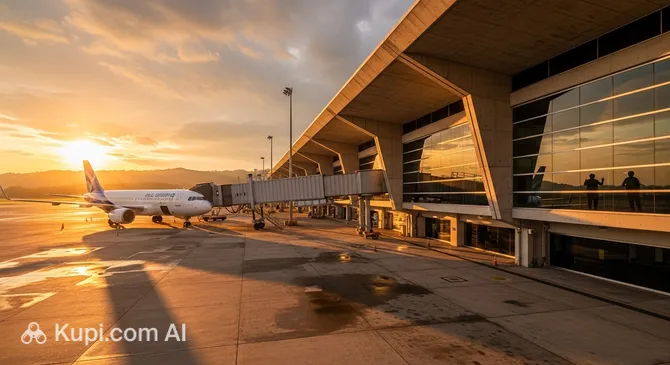
El Salvador International Airport. Source: Kupi.com Binoculars

El Salvador International Airport (formerly known as Comalapa) is not merely a transport hub, but a true gateway to the "Land of Volcanoes" and Pacific waves. Nestled amidst tropical greenery, it immerses travellers in the atmosphere of Central American hospitality from the very first minutes and serves as the main hub for those heading to legendary surf spots. It is a modern and safe air harbour, bearing the name of Saint Oscar Arnulfo Romero, welcoming millions of tourists from around the world annually.

IATA Code SAL
ICAO Code MSLP
City San Salvador (located in San Luis Talpa)
Distance to centre ~40 km
Status International
Passengers per year Over 4.5 million
Schedule Available on the online board

Airport Features and Advantages

El Salvador Airport is considered one of the most efficient and convenient in Central America. Thanks to recent modernisation and the expansion of the passenger terminal, it offers a high level of comfort: from spacious waiting lounges to modern aerobridges. Excellent conditions have been created for transit passengers, as the airport is a key connecting hub for Avianca airlines, linking North and South America.

A unique feature of the airport is its proximity to the coast — the Surf City project. The famous beaches of La Libertad and El Tunco can be reached in just 30–40 minutes, making it an ideal starting point for surfers. Inside the terminal, travellers can appreciate the local flavour: there are cafes serving traditional Salvadoran pupusas (stuffed tortillas), as well as shops selling world-renowned local coffee and handmade souvenirs.

Contact Information

For your convenience, we have compiled the main contact information for El Salvador International Airport Saint Oscar Arnulfo Romero (SAL).

  • Official Website: Up-to-date information on flights, services, and regulations can be found on the official website of the management company CEPA: www.cepa.gob.sv/aeropuerto-de-el-salvador/
  • Information Desk Phone: For immediate information, you can call: (503) 2339-9455.
  • Airport Address: Autopista Comalapa Km. 42, San Luis Talpa, La Paz, El Salvador. It is important to note that the airport is located approximately 45 kilometres southeast of the capital city, San Salvador.
  • Email: For general enquiries and to contact customer support, you can use the email: atencionalcliente.aies@cepa.gob.sv
  • Social Media: It is convenient to follow airport news and updates on the official social media pages of the management company CEPA, for example, on X (formerly Twitter) under the handle @CEPASV.
  • Lost Luggage Information: If your luggage was lost or damaged during the flight, you should immediately contact your airline's representative at the airport. For items left behind in the terminal building, please contact the information desk.
  • Passenger Support Contacts: Most issues can be resolved using the phone number or email address listed above.

How to Get to the Airport

El Salvador International Airport (SAL), the country's main aviation hub, is located approximately 50 kilometres from the capital city, San Salvador. Given this distance, it is important to plan your route to the terminal in advance. There are several ways to get to the airport, suitable for different budgets and preferences.

Public Transport is the most budget-friendly option. A special express bus, route 138-A, and the regular bus, route 138, connect the airport with the centre of San Salvador. The express version is more comfortable and makes fewer stops. The cost of the trip is minimal, but be prepared for the regular bus to be crowded, and the journey may take about 1.5–2 hours. This method is best suited for travellers without bulky luggage.

Taxis and Transfers are the most popular and convenient choice for tourists. You can order an official taxi with a fixed fare right at the terminal, which guarantees safety and price predictability. Ride-hailing apps, such as Uber, also operate in the country, which may prove slightly cheaper. A car journey to the city centre will take from 45 to 60 minutes depending on traffic. Many hotels offer transfer services, which is a very convenient option.

For those planning to travel around the country independently, car rental is a good solution. Counters for several major international and local rental agencies are located at the airport. It is recommended to book a car online in advance to guarantee availability and secure a better rate. Paid parking with zones for short-term and long-term parking is available near the terminal, which is convenient for those seeing someone off or arriving in their own vehicle.

Terminals and Map

El Salvador International Airport, also known as Saint Oscar Arnulfo Romero Airport, has a structure that is simple and easy for passengers to understand. It consists of a single two-storey passenger terminal that serves both domestic and international flights. This compact organisation significantly simplifies navigation and eliminates the need to transfer between different buildings.

The terminal layout is intuitive. The Upper Level is entirely dedicated to the Departures zone. Here you will find airline check-in counters, security checkpoints, and passport control. After completing formalities, passengers enter the general waiting area with boarding gates, Duty Free shops, and restaurants. The gates are located along one long corridor, making it easy to find the right one.

The Lower Level is designed for arriving passengers (Arrivals). You arrive here after disembarking from the aircraft. Located on this floor are immigration control counters, the baggage claim area, and customs inspection. The arrivals hall houses car rental offices, taxi stands, tourist information desks, and the meeting area.

Since the airport consists of a single terminal, transitions between zones take place within the building and do not require special transport. Navigation is simple thanks to clear signage in Spanish and English. Check-in and security screening times are usually short, but as with any international airport, it is recommended to arrive 2-3 hours before departure, especially during peak seasons, to complete all procedures without rushing.

Airport History

The history of El Salvador International Airport (SAL), officially bearing the name of Saint Oscar Arnulfo Romero, is closely linked to the development of modern El Salvador. The decision to construct it was made in the 1970s when it became evident that the old Ilopango Airport in San Salvador could no longer cope with the growing passenger traffic and could not accommodate large long-haul aircraft. Construction of the new airport began in 1976 on the coastal plain, which provided ample space for a long runway and future expansions.

The airport was officially opened for flights on 15 January 1980. This event coincided with the beginning of a challenging period in the country's history. Despite the difficulties, the airport continued to function, remaining a vital link for El Salvador with the outside world, facilitating both passenger and cargo transport, which were critical for the economy.

One of the landmark events in the airport's history was its renaming in 2014. It was given the name of Oscar Arnulfo Romero, the Archbishop of San Salvador, canonised by the Catholic Church. This step highlighted the cultural and spiritual significance of his figure for the Salvadoran people. In subsequent years, the airport underwent several stages of modernisation, including the expansion of the passenger terminal and infrastructure improvements to enhance passenger comfort and safety.

Among interesting facts, it is worth noting that El Salvador International Airport is one of the busiest in Central America and serves as a major hub for Avianca airlines. Its single runway is 3,200 metres long, allowing it to accommodate almost all types of modern aircraft. The airport is also known for its efficient organisation and is considered one of the most modern in the region.

Services and Amenities

El Salvador International Airport (SAL), the main aviation hub of El Salvador, offers passengers a wide range of services for a comfortable wait before their flight. In the terminal, you will find various dining outlets: from restaurants offering local and international cuisine to cosy cafes where you can have a quick snack or a coffee. For shopping enthusiasts, there are Duty Free shops featuring perfumes and tobacco products, as well as souvenir stalls where you can purchase memorable gifts and items from local artisans.

For those who value enhanced comfort, VIP lounges such as the Avianca Lounge operate at the airport. Here, passengers can relax in a quiet atmosphere, enjoy complimentary snacks and beverages, and catch up on work. Free Wi-Fi is available throughout the terminal, and numerous power outlets and special charging stations are provided to keep your gadgets powered up so you can stay connected.

Financial matters can be easily resolved at the airport: bank branches, ATMs, and currency exchange points are at your service. In case of unforeseen health situations, a medical station operates 24/7 in the terminal, ready to provide first aid.

The airport is equipped to welcome passengers with special needs. Ramps, lifts, and specially equipped restrooms are provided. If necessary, an assistance service can be booked in advance. For travellers with small children, there are nursing rooms where you can take care of your baby in a peaceful environment.

For business travellers, conference rooms or business services may be available. Although there is no hotel directly within the airport building, several hotels of varying comfort levels are located a few minutes' drive away, many of which offer complimentary transfers for their guests, which is particularly convenient for long layovers or early departures from San Salvador.

Dining

At El Salvador International Airport (SAL), travellers will find diverse dining options to suit every taste and budget. Whether you are looking for a quick snack before departure or a full meal, there is plenty to choose from in both the public area (landside) and after security control (airside).

The main recommendation for experiencing local cuisine is undoubtedly the pupusa — the national dish of El Salvador. This is a thick corn or rice tortilla stuffed with cheese, beans, or meat, served with tomato sauce and pickled cabbage (curtido). You can find kiosks or cafes offering freshly made pupusas in the departure area. Also, do not miss the opportunity to enjoy a cup of excellent Salvadoran coffee — it is a great way to energise before a flight.

The airport features establishments of various formats:

  • For a quick snack: Coffee shops and fast-food outlets offering sandwiches, pastries, salads, and drinks are located in both zones of the airport. This is an ideal option if you are short on time.
  • For a full meal: The majority of sit-down restaurants are located in the departure zone (airside). Here you can find establishments with international cuisine (pizza, burgers) as well as restaurants offering Latin American dishes in a more relaxed atmosphere.
  • Lounges: Several lounges in the departure zone offer a wide selection of local and international beverages, where you can relax while waiting for your flight.

Most establishments operate according to the flight schedule; many are open from early morning until late at night. Prices at the airport are generally higher than in the city, which is standard practice. Regarding special dietary needs, vegetarian options (such as pupusas with cheese or beans) are quite easy to find. For gluten-free or vegan dishes, it is recommended to study the menu carefully or check with the staff at the specific establishment, as specialised restaurants may not be available.

Travel Tips

To ensure your journey through El Salvador International Airport goes smoothly, make use of these tips. Located near San Salvador, the airport is the main transport hub of El Salvador and requires some preparation, especially during peak hours.

Arrival Time and Check-in: For international flights, it is recommended to arrive at the airport 2.5-3 hours before departure. This will give you enough time to complete all formalities without rushing. To save time, complete online check-in for your flight if your airline offers this option. This will allow you to head straight to the baggage drop counter or, if you are travelling light, to the security checkpoint.

Security Screening and Hand Luggage: Be prepared for the standard screening procedure: you will need to remove laptops and other large electronics, as well as liquids, from your hand luggage. Please be reminded that liquids can be carried in containers of no more than 100 ml, packed in a transparent bag. Sharp objects, weapons, and flammable substances are prohibited in hand luggage. If you are carrying famous Salvadoran coffee as a souvenir, it is better to pack it in your checked luggage to avoid unnecessary questions at security.

Seat Selection and Transfers: El Salvador is a land of volcanoes, so a window seat will offer you unforgettable views during take-off or landing. An aisle seat will be more convenient if you wish to stand up freely during the flight. For passengers with connecting flights, the airport is quite convenient due to its compactness. Follow the "Conexiones" (Connections) signs to quickly find the correct boarding gate. Usually, re-screening for transit passengers is not required, but it is best to verify this with airport staff.

Customs Control: Upon arrival, have your passport and completed customs declaration ready (often distributed on the plane). Be prepared to answer standard questions about the purpose and duration of your visit. The process usually goes quickly if you have no goods to declare.

Savings and Unforeseen Situations: To save money, bring an empty reusable water bottle with you — after security, it can be filled at drinking fountains. Prices for food and drinks at the airport are higher than in the city. In case of a flight delay, contact your airline representative first to learn about your rights regarding meals or accommodation. The waiting halls have cafes, Duty Free shops, and free Wi-Fi to help pass the time.

Reached the end of the page?

That means the route is fully explored