Support

Toncontin Airport

Airports in the city

About the Airport

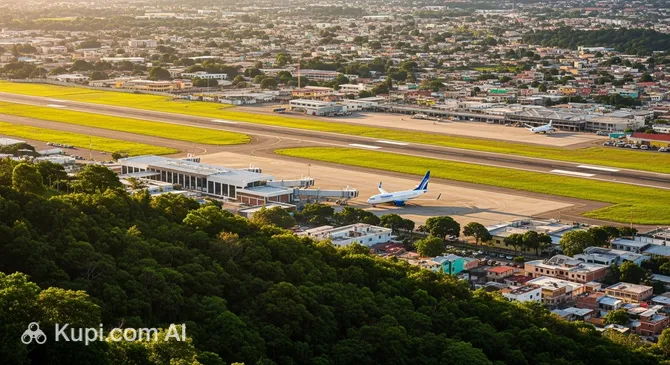
Toncontin Airport. Source: Kupi.com Binoculars

Welcome to Toncontin — an airport rightfully considered one of the most impressive and technically complex in the world. Located in a mountain valley at an altitude of over 1,000 metres above sea level, it requires the highest level of skill from pilots to execute the landing approach. Despite its reputation as "extreme", Toncontin has served as the main air gateway to the capital of Honduras for decades and remains a key transport hub for domestic flights.

IATA Code TGU
ICAO Code MHTG
City Tegucigalpa
Distance to Centre 6 km
Status Civil/Military, primarily for domestic flights
Annual Passengers approx. 617,000 (based on 2018 data)
Popular Airlines American Airlines, Avianca, Copa Airlines
Schedule "Toncontin Airport" online schedule

The main feature of Toncontin Airport is its unique location and challenging landing approach. The short runway, surrounded by mountains, forces pilots to execute a sharp turn almost immediately before touching down, which has become the trademark of this location. Due to these limitations, the airport can only accommodate aircraft no larger than a Boeing 757. Although most international flights are now serviced by the new Palmerola Airport, Toncontin continues to play a vital role in the country's transport system, connecting the capital with other regions.

Contact Information

  • Official Website: Finding a dedicated official website for Toncontin Airport can be difficult. Up-to-date information is provided by the management company EHISA (Empresa Hondureña de Infraestructura y Servicios Aeroportuarios) on their portal: www.ehisa.hn.
  • Information Desk Phone: +504 2233-1115
  • Airport Address: Bulevar Comunidad Económica Europea, Tegucigalpa, Honduras.
  • Email: A direct email address for general inquiries is not publicly provided. It is recommended to contact them by phone or via the feedback form on the management company's website.
  • Social Media: Official and verified social media pages for the airport may be absent or not actively maintained. For news, please monitor information on the EHISA website.
  • Lost Luggage Information: If your luggage was lost during a flight, you should primarily contact your airline's representative at the airport. For items left within the terminal building, you can contact the airport information service via the main phone number.
  • Passenger Support Contacts: For assistance and enquiries, you can use the airport information desk phone: +504 2233-1115.

How to Get to the Airport

Getting to Toncontin Airport from the centre of Tegucigalpa is quite simple, as it is located just a few kilometres from key districts of the city. The choice of transport depends on your budget, time, and comfort preferences.

Taxi and Transfer — the most popular and recommended method. A trip from the city centre will take approximately 20-30 minutes depending on traffic. It is strongly recommended to use official taxi services or order a car through your hotel. Always agree on the price before starting the trip to avoid inflated fares. Booking a pre-arranged transfer is an even more reliable and safe, albeit slightly more expensive, option.

Public Transport in the form of city buses (colectivos) is the most budget-friendly option. However, it is worth noting that there is no direct route to the terminal, and you will likely have to walk some distance. This method may be inconvenient for tourists with large luggage and those who are unfamiliar with the city or do not speak Spanish. It is also considered less safe, especially in the evening.

Car Rental is suitable for those planning independent trips around Honduras. Several rental companies have offices both at the airport and in the city. Driving in the capital requires a certain level of skill due to chaotic traffic. If you arrive at the airport in your own car, paid parking is available, offering both short-term and long-term parking options.

Terminals and Map

Toncontin Airport (TGU) has a simple and clear structure consisting of one passenger terminal, which primarily serves domestic and some regional international flights. This makes navigation for travellers extremely simple, as there is no need to move between different buildings.

The terminal layout is quite logical. The building is functionally divided into two main zones: departures and arrivals. In the Departures Zone, there are airline check-in counters, followed by a security checkpoint and a small waiting hall with boarding gates. The Arrivals Zone includes immigration control counters, baggage claim belts, and a customs point. All services are located in close proximity to each other.

Since all operations are concentrated in one building, the concept of "transfers between terminals" does not apply here. Moving between the arrival and departure zones or to the boarding gates takes just a few minutes. Navigation is intuitive, but it is worth being prepared for the fact that the terminal itself may seem somewhat dated and cramped, especially during peak hours.

Check-in and screening procedures at Toncontin usually go faster than at major airports. Nevertheless, to avoid rushing, it is recommended to arrive at the airport 2-3 hours before an international flight and 1.5-2 hours before a domestic one. This time buffer is sufficient to calmly complete all formalities, even if small queues arise.

For easy navigation, simply follow the standard signs "Salidas" (Departures) and "Llegadas" (Arrivals). The compactness of the airport is its main advantage — it is practically impossible to get lost here. All necessary infrastructure, including cafes and shops, is located within sight.

Airport History

The history of Toncontin Airport (TGU) is inextricably linked with the development of aviation in Honduras. The airport was founded in 1934, in an era when air travel was just beginning to play a significant role in connecting remote regions of the country. Originally built to serve the capital, Tegucigalpa, it quickly became the state's main air hub, accepting both civil and military flights.

For decades, Toncontin was known as one of the most difficult and demanding airports in the world for pilots. Its main feature, which has become part of its history, is the short runway located in a mountain valley. This required pilots to perform a complex manoeuvre with a sharp turn immediately before landing. This fact made the airport a legend in aviation circles and the subject of numerous documentaries and reports.

Due to growing safety requirements and the increasing size of modern airliners, the airport underwent several stages of modernisation throughout its history. However, geographical limitations did not allow for a radical solution to the short runway problem. A major event in the modern history of Toncontin was the opening of the new Palmerola International Airport (XPL) in 2021, which took over all international flights that previously served the capital. This step marked the end of an entire era in the history of Honduran aviation.

Today, Toncontin Airport continues to function, serving mainly domestic and regional flights. It remains an important transport facility for the capital and a living monument to aviation history. Despite its past reputation, the airport has played a key role in the economic and social development of Tegucigalpa, serving as its main air gateway for almost 90 years.

Services and Amenities

Toncontin Airport (TGU) offers its passengers all necessary services for a comfortable wait for their flight. Despite its compact size, the terminal features several cafes and eateries where you can try both local cuisine and familiar international snacks. Travellers can drink a cup of famous Honduran coffee or purchase souvenirs and travel goods in several shops, including Duty Free.

For those who value enhanced comfort, a VIP Lounge operates at the airport, offering a quieter atmosphere, beverages, and snacks. Free Wi-Fi is available throughout the terminal, allowing you to stay connected or handle work matters. Special stations and power outlets are provided in waiting areas for charging electronic devices.

Financial services are represented by bank branches, ATMs, and currency exchange points, where you can easily exchange money upon arrival or before departure. This is particularly convenient for international tourists who need local currency immediately after landing.

The airport cares for all categories of passengers. Mother and child rooms are equipped for travellers with children. Passengers with reduced mobility can count on staff assistance and the availability of ramps and specially equipped washrooms. In case of need, a medical point is available in the terminal to provide first aid.

Although there are no hotels or large conference centres within the airport building itself, several hotels of varying comfort levels are located in the immediate vicinity, many of which offer transfers for their guests. For business travellers, the VIP Lounge can serve as a convenient place to work in a quiet environment.

Where to Eat

At Toncontin Airport (TGU), which serves domestic flights for Tegucigalpa, the selection of dining establishments is modest but sufficient for a snack before a flight. Most cafes and kiosks are concentrated in the main passenger terminal, primarily in the public zone (landside), before passing security control. This is an important point, as after screening (airside), the choice is reduced to a minimum.

The main spot for coffee connoisseurs is Espresso Americano — a popular local coffee shop chain. Here you can try authentic Honduran coffee, order sandwiches, pastries, or desserts. This is an excellent option for both a quick snack and a more relaxed wait for a flight. Besides this, small eateries operate in the terminal where you can get acquainted with the street food of Honduras. Be sure to try a baleada — a wheat flour tortilla filled with mashed beans, cheese, and cream, which is a hallmark of the local cuisine.

Prices at the airport are higher than in the city but remain acceptable. A cup of aromatic coffee will cost approximately 60-80 HNL (about $2.5-3.5 USD), and a hearty baleada or sandwich — 100-200 HNL ($4-8 USD). Most establishments operate according to the flight schedule: opening early in the morning, around 5:30-6:00, and closing after the departure of the last aircraft, approximately at 21:00. All dining points are closed at night.

Passengers with specific dietary requirements, such as vegetarian or gluten-free diets, may find it difficult to find suitable dishes. The selection is limited, so it is recommended to check ingredients with staff or carry your own snacks. For a full lunch or dinner, it is better to eat in the city before arriving at the airport, as the focus here is on fast and light dining formats.

Tips for Travellers

Flying through Toncontin Airport can be a unique experience, especially due to its location within the city limits. To ensure your journey goes smoothly, use these tips. It is recommended to arrive at the airport 2–3 hours before regional international flights and 1.5–2 hours before domestic ones. It is important to note that most long-haul flights are now served by another airport. Despite Toncontin's modest size, it can be busy, especially during peak hours, so extra time is always helpful.

To save time, complete online check-in if your airline provides this option. This will allow you to avoid queues at the counters. When passing security control, be ready to present liquids (in containers up to 100 ml, packed in a transparent bag) and electronic devices. A special feature of Toncontin Airport is its world-famous landing approach. To fully appreciate the breathtaking view of the city and mountains, try to secure a window seat. This is one of those landings you will definitely remember!

Standard hand luggage rules apply here as well. Sharp objects, flammable liquids, and weapons are prohibited. Always check baggage and hand luggage allowances directly with your airline, as rules may differ slightly. If you have a transfer in Tegucigalpa, check whether you need to collect your luggage and go through check-in and security control again, especially when changing flight types.

When passing customs control, have your passport and completed migration card ready. Be prepared to answer standard questions about the purpose of your visit and the duration of your stay in Honduras. To save money, it is better to have a snack before arriving at the airport, as prices in the terminal are usually higher. It is also recommended to book a transfer in advance or use the official airport taxi services to avoid inflated fares.

In case of a flight delay, contact your airline representative first to get up-to-date information and possible options (rebooking, provision of food vouchers, or hotel accommodation for long delays). The airport is small, and the choice of entertainment is limited, so just in case, have a book, a charged power bank, and headphones with you to make the waiting time more comfortable.

Reached the end of the page?

That means the route is fully explored