Support

Les Bourgeois de Calais

About

In front of the majestic Town Hall in the city of Calais, one of the most poignant stories in the art of France is frozen in bronze. "The Burghers of Calais" (Les Bourgeois de Calais) is a world-renowned masterpiece by the great sculptor Auguste Rodin, dedicated to the heroism and incredible self-sacrifice of ordinary people to save their home.
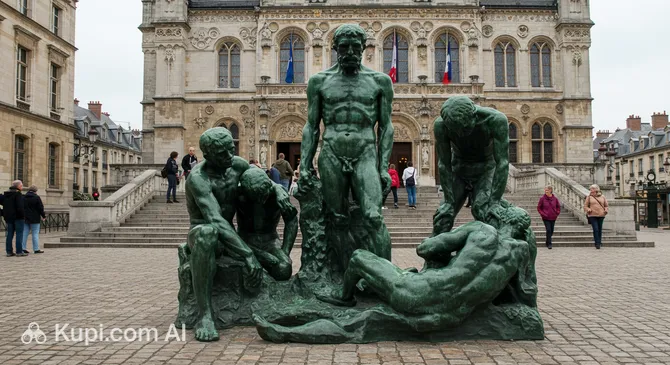
The Burghers of Calais
The Burghers of Calais. Иллюстрация. Источник: Kupi.com AI

The sculptural group consists of six life-sized figures. This is not a typical monument to victors on a high pedestal, but a living embodiment of human drama. Each figure conveys its own unique reaction to inevitable death: from courageous resignation to deep despair. Rodin intentionally moved away from traditional pathos, focusing instead on the individual experiences of each hero.

Today, this monument is considered a symbol of civic duty and one of the key works of European sculpture. Located on the Square of the Unknown Soldier (Place du Soldat Inconnu), it is a must-visit for everyone who appreciates profound historical art and wants to feel the spirit of old Europe.

Contacts

To find out more about events or visiting the adjacent Town Hall, you can use the official contact details of the city's municipal services.

How to contactContact
AddressPl. du Soldat Inconnu, 62100 Calais, France
Phone+33 3 21 46 62 00
Websitewww.calais.fr

What to Do

The main thing to do at the monument is to walk slowly around the entire group. "The Burghers of Calais" was created to be viewed from all sides. Pay attention to the hands, the poses, and, of course, the facial expressions: the bronze captures the determination of Eustache de Saint Pierre, as well as the terror and confusion of the younger members of the group.

After a detailed study of the sculptures, it is worth taking a walk through the adjacent Parc Saint-Pierre. This is a quiet and picturesque spot where you can rest on a bench while admiring the view of the monument and the Town Hall building, which is an architectural masterpiece in its own right. Don't forget to take photos — the combination of Rodin's expressive bronze and the Flemish Gothic style of the Town Hall looks impressive in any light.

Many tourists combine their visit to the monument with a stop at the Information Center located nearby to learn more about the events of the Hundred Years' War. It is also an excellent place to start a walking route through the historic city center, exploring the old streets and other monuments of Calais.

Getting There

The famous monument is located on Place du Soldat Inconnu, directly in front of the magnificent City Hall building. This is the heart of the city, so finding the monument is easy — it is marked on all tourist maps and is clearly visible from a distance.

If you are arriving by train, the walk from the Calais-Ville railway station takes about 10–15 minutes. Simply head towards the city center, following the signs for the Town Hall (Hôtel de Ville). For those who prefer comfort, you can always order a taxi from the station or the port, which will take you to the square in a few minutes.

For travelers by car, Calais is easily accessible via the French motorway network. There are parking spaces near the square, from where you can begin your walking tour of the historic center and Saint-Pierre Park.

Ближайший город: Calais

History & Facts

The story of the monument takes us back to 1347, at the height of the Hundred Years' War. After eleven months of an exhausting siege, King Edward III of England agreed to spare the inhabitants of Calais on the condition that six of its most prominent citizens walk out to him barefoot, bareheaded, with nooses around their necks, carrying the keys to the city for their subsequent execution.

The first volunteer was the wealthiest citizen, Eustache de Saint Pierre, followed by five others. Although their lives were eventually saved through the intercession of the English Queen, Philippa of Hainault, their readiness for self-sacrifice became legendary. The idea of immortalizing this feat in bronze emerged centuries later, and in 1884, the genius Auguste Rodin received the commission for the monument.

Rodin's work was revolutionary for its time. Instead of the usual elevated pedestal, the sculptor wanted to place the figures directly at ground level so that viewers could meet the heroes "face to face." This decision emphasized the humanity and deep tragedy of the moment. Interestingly, during the world wars, the monument was carefully hidden to protect it from destruction, and it wasn't until 1924, after the master's death, that his wishes regarding the placement of the sculptures were fully realized.

Time Needed

To simply view the monument and take a few photos with the Town Hall in the background, 30–45 minutes is sufficient. This is enough time to appreciate the scale of the work and the overall composition.

However, if you want to carefully study each of the six figures, examine the emotions on their faces, and feel the atmosphere created by Rodin, it is better to set aside about 1–1.5 hours. This extra time will also allow you to stroll through Saint-Pierre Park and view the City Hall building, located just a few steps away.

Working Hours

As "The Burghers of Calais" is installed in an open city square, it is available for viewing 24 hours a day. You can visit the sculptural group at any convenient time, whether early in the morning or late in the evening.

After dark, the monument and the Town Hall building are illuminated, giving the figures a particularly mystical expressiveness. If you plan to visit the interior halls of the City Hall located nearby, it is recommended to check the institution's operating schedule on its official website in advance.

Nearby

The location in the very center of the city makes the square an excellent starting point for exploring the region's historical heritage. A walk through the surrounding area will allow you to see both ancient defensive structures and interesting modern sites.

NameDistance
Saint-Pierre Park0.1 km
Second World War Museum0.2 km
Café Le Mirador0.3 km
La Cafétoria0.4 km
Richelieu Park0.4 km
Cité de la Dentelle et de la Mode0.5 km
Museum of Fine Arts of Calais0.5 km

Reached the end of the page?

That means the route is fully explored