Support

Tour du Guet

About

In the heart of the city of Calais stands the Tour du Guet (Watchtower) — a silent witness to centuries of history and rightfully considered the city's oldest surviving building. This 13th-century medieval structure, nearly 39 meters high, was once a key observation point used to monitor ships approaching from across the strait.
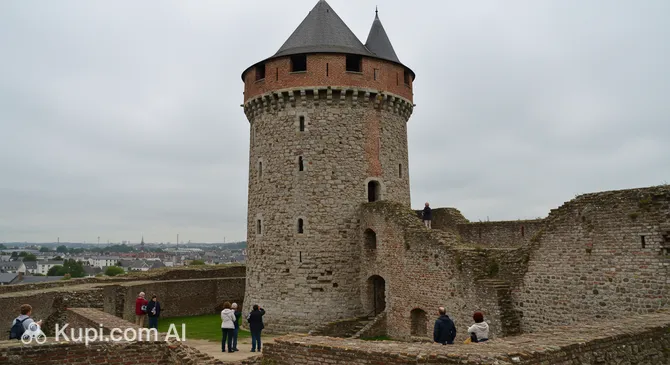
Tour du Guet
Tour du Guet. Иллюстрация. Источник: Kupi.com AI

This massive stone building in France is located on the main square, Place d'Armes. The tower stands out for its austere architecture and unique details, such as an ancient dovecote that was used for postal communication in the past. For the city's residents, it is not just a monument but a symbol of resilience that has survived numerous sieges and natural disasters.

Today, the Tour du Guet serves as a magnificent landmark for tourists and a beautiful backdrop for photographs. A statue of Charles de Gaulle is installed nearby, creating an interesting dialogue between the medieval past and the country's modern history. Despite its venerable age, the tower retains its grandeur and is a must-see on the itinerary of any traveler interested in European fortification architecture.

Contacts

For those planning to visit this historic site, the basic contact information and coordinates for navigation are provided below.

How to contactContact
AddressPl. d'Armes, 62100 Calais, France

What to Do

When visiting the Tour du Guet, it is worth taking the time for a detailed inspection of its facade. Look for the signs of numerous reconstructions — every layer of stone here can tell its own chapter of history. A careful eye will notice the ancient dovecote, which was once a vital communication hub for transmitting reports.

Place d'Armes, where the tower stands, is a great place for photography. The best shots are captured in clear weather, when the austere silhouette of the medieval stone contrasts with the bright sky or the evening illumination of the neighboring Town Hall. Don't forget to walk over to the monument to Charles de Gaulle and his wife Yvonne, located nearby, to complete your impression of the city's cultural context.

This location is ideal as a starting point for a walking route. After exploring the tower and the information plaques, you can head for a walk to Notre-Dame Cathedral or towards the port to feel the sea breeze. City markets or festive events often take place on the square, allowing you to immerse yourself in the modern life of the locals surrounded by ancient walls.

Getting There

The landmark is easy to find, as the Tour du Guet (Watchtower) is located in the heart of the historical center on Place d'Armes. If you arrive in the city by ferry or train (Calais-Ville station), the walk to the tower will take only about 10–15 minutes. The main route usually goes through the lively Rue Royale, which leads directly to the central square.

For those who prefer public transport, the Hôtel de Ville and Place d'Armes stops are within walking distance, served by the city's main bus routes. If you are traveling by car, you can use the parking lots on the adjacent streets by using the square's address for navigation.

A taxi from any point in the city center will take you to the tower in minutes. The area around the site is pedestrian-friendly and very comfortable for leisurely walks, so the best way to get there is to combine your journey with a look at the windows of local shops and cafes.

Ближайший город: Calais

History & Facts

The majestic Tour du Guet began its history in the early 13th century. It is believed to have been built between 1214 and 1229 by order of Philip I, Count of Boulogne. Initially, the structure was built as a key element of the city's defensive system, allowing for control over not only the settlement's territory but also the vast sea horizons.

This place holds the memory of fateful events: it was from here in August 1347 that Governor Jean de Vienne announced to the residents the harsh terms of the city's surrender after an exhausting siege. Over the centuries, the tower survived many trials — from a devastating earthquake in 1580 that literally split it in half, to fires and shelling by English cannonballs at the end of the 17th century. However, each time, the residents restored their symbol of resilience.

In the 19th century, the tower's function changed: in 1818, a rotating lantern was installed on it, and until the middle of the century, it served as a lighthouse and an important optical telegraph station. Today, it is the oldest surviving building in the city, embodying the region's centuries-old history in stone.

Time Needed

Visiting this attraction does not require much time, as viewing is currently mainly possible from the outside. Usually, 30–45 minutes is enough for tourists to examine the architectural details of the medieval masonry, read the information boards, and take commemorative photos against the backdrop of the ancient walls.

If you plan to combine your visit with a break on Place d'Armes or a visit to the nearby Town Hall, it is worth allowing about one hour. This time is quite sufficient to feel the atmosphere of the medieval port and enjoy the view of the tower, which contrasts effectively with the surrounding buildings.

Working Hours

You can admire the architectural appearance of the tower and walk around the square at any convenient time. The landmark is available for external viewing daily and around the clock.

Operating schedule of the site (access to the square):

  • Monday – Sunday: 24/7

Круглосуточно

Nearby

The tower's location in the historical core of the city makes it an ideal starting point for further exploration of the region's heritage. A walk through the surroundings will allow you to see powerful fortifications and interesting cultural sites within walking distance.

NameDistance
L'Ardoise0.1 km
The Purple Café0.2 km
Museum of Fine Arts of Calais0.3 km
Notre-Dame Church of Calais0.3 km
Calais Lighthouse0.4 km
Richelieu Park0.4 km
Saint-Pierre Park0.7 km

Reached the end of the page?

That means the route is fully explored