Support

Giessen

About

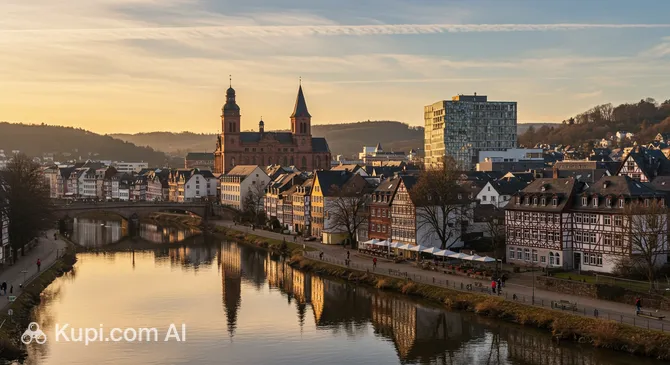
Giessen is a picturesque and cozy city located in the heart of the state of Hesse. This corner of Germany demonstrates the country's ability to combine natural beauty with urban comfort, situated just 50 kilometers from the vibrant Frankfurt am Main. The city is nestled among green hills, rivers, and lakes, ensuring fresh air and a peaceful atmosphere that is perfect for leisurely strolls.

Although the population is around 91,000, Giessen serves as an important administrative center with a well-developed infrastructure. However, the unique spirit of the place remains its defining feature: it is home to one of the country's oldest universities, which infuses the city’s steady life with youthful energy. The rich history of Giessen is harmoniously interwoven with a modern student drive, creating an unforgettable cultural landscape.

Giessen. Illustration.
Source: Kupi.com AI

Tourists are drawn to the city not only for its architecture but also for its rich cultural life, including fascinating museums and theaters. It is an excellent destination for those seeking a balance between educational tourism and relaxation. After sightseeing, you can unwind in one of the many cozy cafes or head out into nature, which literally surrounds the city blocks.

Giessen is a friendly city worth visiting for its warmth and special charm. It is perfectly suited for short weekend getaways as well as peaceful family vacations, leaving travelers with the fondest memories.

Weather Overview

The climate in this region can be described as moderately warm, making the city accessible for visits year-round. Summer here is usually comfortable and not too hot: in the warmest months, July and August, the average temperature is about 18–19°C, and during the day, the air warms up to a pleasant 23°C. This is an excellent time for walking, though you should keep in mind that rain is possible even in summer.

Winter in Giessen is cool but generally mild. In January, the coldest month, the average temperature stays around 2°C, and nighttime temperatures rarely drop significantly below freezing. Expect moderately warm summers with occasional rain and cool, fairly damp winters.

Precipitation is distributed fairly evenly throughout the year: the number of rainy days varies from 11 to 16 per month. To ensure your trip is as comfortable as possible and you can pack properly, we recommend checking the detailed weather in Giessen for the dates of your visit.

Average monthly temperature

Average monthly precipitation

Interesting Facts

In addition to its status as a university city, Giessen holds many fascinating secrets and unique attractions that surprise even seasoned travelers. Here are a few facts that reveal this German city from an unexpected perspective:
  • It is home to the world's first interactive math museum—the Mathematikum. Unlike strict academic institutions, the rule here is "Please touch!", allowing adults and children to grasp complex formulas through games, soap bubbles, and puzzles.

  • The city has a rather eccentric unofficial symbol, which locals ironically call "Elefantenklo" ("Elephant's Loo"). This giant concrete structure over a crossroads, serving as a pedestrian bridge and a popular meeting spot, earned its nickname due to its characteristic shape and massiveness.

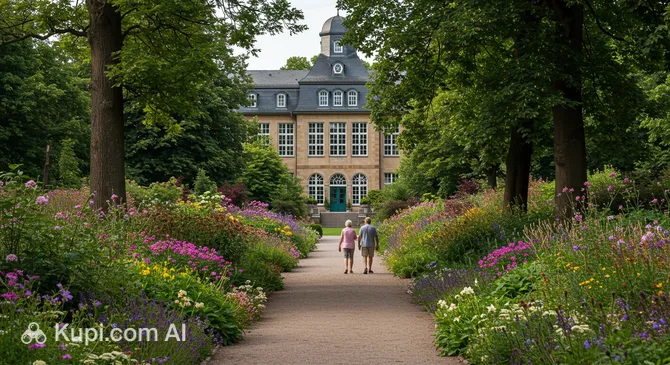
  • The Giessen Botanical Garden is considered the oldest in Germany among those preserved in their original location. Founded over 400 years ago, it is a living open-air museum where you can see rare plants collected over centuries of scientific work.

  • Giessen is the city where modern agrochemistry was literally born. The famous scientist Justus von Liebig lived and worked here; his discoveries in the field of mineral fertilizers revolutionized agriculture. A museum is open in his honor, preserving the atmosphere of a 19th-century laboratory.

  • Although the city looks modern, its roots go back to the deep Middle Ages: it was founded as a water fortress as early as 1152. This historical heritage can be traced in the layout of the old streets and the architecture of the local theater, which is a true artistic masterpiece.

Giessen Botanical Garden. Illustration.
Source: Kupi.com AI

Traveler photos:

How to Get There

Thanks to its central location in the state of Hesse, getting to the city is quite simple, regardless of your choice of transport. You can find more about how to get to Giessen by exploring all available routes, but most often tourists use the major transport hubs of neighboring metropolises, which are just an hour's drive away.

There is no airport in the city of Giessen itself, but this is not a problem for travelers. The main air gateway for the region is Frankfurt Airport (IATA: FRA). This is one of Europe's largest aviation hubs, located in Frankfurt am Main, just 61 km from Giessen. The journey by taxi or rental car takes about 50 minutes, and direct trains also run regularly from here.

An alternative option is Cologne/Bonn Airport (IATA: CGN), located in the city of Cologne. The distance to Giessen is about 114 km, which takes approximately 1 hour and 40 minutes by car. For budget travelers, Frankfurt-Hahn Airport (IATA: HHN) may be of interest; despite its name, it is far from Frankfurt and is located 123 km from Giessen (about 2 hours away).

For clarity, here is summary information on the main airports:

AirportPassenger trafficDistance
Frankfurt Airport61.6 mln61 km
Frankfurt Egelsbach Airport80 00069 km
Kassel-Calden Airport107 615104 km
Paderborn Lippstadt Airport818 378114 km
Cologne Bonn Airport10 mln115 km

Rail connections in Germany are excellent. While Giessen has its own station, many tourists traveling from afar on high-speed trains first arrive at major hub stations in neighboring cities. The closest and most convenient is Frankfurt (Main) Hauptbahnhof (Frankfurt Main Central Station), located in Frankfurt am Main, about 53 km from Giessen. From this station, you can reach the center of Giessen by regional train or taxi in less than an hour.

Below is information on the nearest major railway hubs that are convenient for planning your route:

StationPassenger trafficDistance
Frankfurt (Main) Hauptbahnhof127.8 mln53 km
Koblenz Hauptbahnhof14.6 mln82 km
Kassel-Wilhelmshöhe Station10.9 mln97 km
Bonn Hauptbahnhof24.5 mln113 km
Mannheim Hauptbahnhof36.5 mln124 km

Main Attractions

The attractions in Giessen offer a wonderful combination of science, history, and modern leisure. The city is famous for its unique educational centers and green zones that make walking here particularly pleasant. Whether you have come for knowledge or simply want to relax, you will find a place that suits your taste.

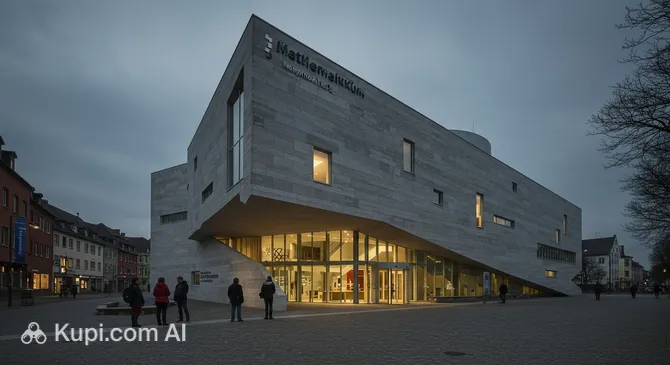
An absolute magnet for tourists of all ages is the Mathematikum. This is the world's first mathematics museum based on the principle of interactivity: exhibits can and should be touched. Here, "dry" science turns into a thrilling adventure featuring giant soap bubbles, mirror mazes, and puzzles. It is an ideal spot for a family visit, proving that math can be fun and accessible to everyone.

Mathematikum. Illustration.
Source: Kupi.com AI

Traveler photos:

For those seeking harmony with nature, the Giessen Botanical Garden is a must-see. It is the oldest university garden in Germany to have been preserved in its original historical location. It houses a vast collection of plants from around the world, from exotic greenhouse specimens to century-old trees. A walk along its paths brings a sense of peace and allows for a break from the city bustle surrounded by beauty.

Fans of shopping and modern architecture should stop by the Westoria Giessen shopping center. This is more than just a place to shop; it is an important part of the city's infrastructure with an interesting industrial design. Here, you can refresh your wardrobe at brand-name stores or spend time in one of the cafes while observing the rhythm of the city.

Local Cuisine

Giessen's cuisine is a true paradise for foodies who appreciate hearty German traditions with a unique Hessian flair. Dishes made from fresh farm products are highly valued here, and locals take pride in supporting the culture of consuming seasonal vegetables, high-quality sausages, and cheeses. The city's gastronomic scene harmoniously combines the coziness of old taverns with the dynamism of modern street food.

The undisputed favorite of local gastronomy is a dish with the intriguing name "Handkäse mit Musik". This is a marinated cheese served with a generous portion of onions, vinegar, oil, and a slice of rye bread. The "music" in the name is an ironic nod by locals to the after-effects of consuming raw onions, but don't let that deter you: the snack's flavor is truly memorable. Gourmets should also pay attention to the various sausages and hearty potato pancakes often sold right on the street.

No meal in this region is complete without the famous apple cider, or Apfelwein. In Giessen, it is traditionally served in gray-and-blue ceramic jugs, which adds a special charm to the meal. This drink, with its light tartness, is very refreshing and perfectly complements the taste of meat dishes.

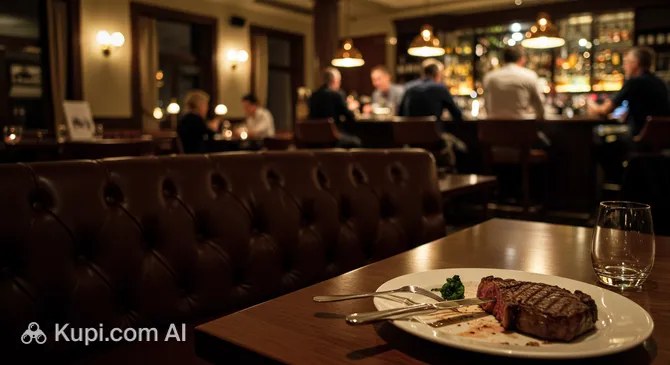
Primecut Steakhouse. Illustration.
Source: Kupi.com AI

Traveler photos:

To experience authentic flavors, we recommend stopping by the Giessen Weekly Market (Gießener Wochenmarkt). A festive atmosphere reigns here: you can try fresh pretzels, homemade pies, honey, and smoked meats while chatting with friendly farmers. If you want to spend the evening in a more refined setting, the city offers an excellent selection of establishments, such as Primecut Steakhouse, where you can enjoy high-quality steaks and relax after your walks.

Travel Tips

Welcome to Giessen! To ensure your trip to this cozy university city is as comfortable and carefree as possible, we have prepared a list of useful recommendations to help you navigate local realities with ease.

  1. Clothing and Weather: The climate in the region is moderate but changeable. Even in summer, it's worth having a light jacket and an umbrella—rain can start suddenly. Be sure to bring comfortable flat shoes: the historical center and parks are ideal for long walks, and cobblestones can be a challenge for heels.
  2. Transport: Giessen is compact, and many attractions are within walking distance. For trips to the outskirts, the bus network (SWG) is excellent. Taxis are quite expensive here, so we recommend downloading the RMVgo app to plan routes and buy tickets for public transport. Cycling is also a popular way to get around, with rental points available across the city.
  3. Finance: The official currency is the Euro (€). Despite progress, Germany remains a country where people love cash. Cards are accepted in supermarkets and large restaurants, but in small bakeries, kiosks, or at the market, you will need bills and coins. It is customary to leave a tip of 5–10% of the bill, simply rounding up the total when paying.
  4. Health and Safety: Giessen is a quiet and safe city. Pharmacies are easily recognized by the red letter "A" (Apotheke); the schedule for duty pharmacies working at night is usually posted on the door of any pharmacy. Tap water here is of excellent quality and safe to drink, which will help you save on buying bottled water.
  5. Communication: Thanks to the large number of students, English is very common here, and you will easily find someone to talk to. However, learning a couple of phrases in German, such as "Guten Tag" (Good day) or "Danke" (Thank you), will certainly win you the sympathy of the locals. Free Wi-Fi is available in many cafes and public areas (Free Wifi Gießen network).
  6. Local Etiquette: Germans value peace and order. On Sunday, most shops are closed (except at train stations and gas stations), and it is not customary to make noise, mow lawns, or do renovations on this day. It is polite to greet those present when entering small shops or an elevator.
  7. What to Avoid: The main safety rule on the streets is to never walk on the bike lanes. Cyclists in Giessen ride fast and confidently, considering this territory exclusively theirs. Also, strictly follow traffic signals: crossing on red, even when no cars are visible, is considered poor form and can lead to a fine.
  8. Pfand (Deposit) System: Don't rush to throw away empty plastic bottles and cans. Germany has a deposit system: there is a special symbol on the label indicating that the container can be returned to special machines in supermarkets. For each bottle, you will receive a receipt (usually 25 cents), which can be used to pay at the checkout.

Giessen is a city that reveals itself to those ready to slow down and enjoy the moment. By following these simple tips, you can feel like a welcome guest rather than just a tourist, immersing yourself in the rhythm of life in real Germany.

Entertainment & Nightlife

Entertainment:

The nightlife in Giessen is a reflection of its status as one of Germany's "youngest" cities. Thanks to the massive student population, the city never goes to bed early, and the concentration of bars and pubs per capita is among the highest in the region. The evening atmosphere here is free from the pretension of major metropolises—it is democratic, boisterous, and very friendly.

The epicenter of night entertainment is undoubtedly "The Mile" (Die Meile) in the area of Ludwigstraße. This is where life bustles until dawn. On warm evenings, crowds of young people spill out of packed bars directly onto the street, creating the feeling of one big open-air festival. You can find venues for every taste, from traditional German pubs (Kneipe) to trendy cocktail bars and Irish pubs.

If you are looking for a place to dance and enjoy high-quality music, check out the KOIA club. It is a popular location among locals and visitors alike, hosting energetic parties. The crowd is diverse but predominantly young, and the music styles range from current hits to electronic music.

For those who prefer to start the evening with an exquisite dinner and a glass of wine in a more relaxed setting, the Primecut Steakhouse is an excellent choice. This venue sets the right tone for the beginning of the night: its stylish interior and excellent cuisine allow you to relax before exploring the city's bar scene. The dress code in most Giessen establishments is casual, but it is better to avoid sportswear when visiting high-end clubs and restaurants.

Practical Advice and Safety:

Giessen is a safe city, and nighttime walks through the center, especially around Ludwigstraße and the train station, do not cause issues. However, as with anywhere, you should exercise reasonable caution and keep an eye on your belongings. Drink prices here are quite moderate, catering to a student budget. You can get home at night by taxi (stands are located in the center) or by using the "Saturn" night buses that run on weekends to the most popular districts and suburbs.

Daytime entertainment in the city is just as diverse. Connoisseurs of fine art should visit the Stadttheater Gießen (Giessen Municipal Theatre) on the Südanlage (South Ring), which offers a rich repertoire of opera and drama productions. In good weather, locals spend time in Schwanenteich Park, where you can rent a boat or simply have a picnic on the grass.

Parks & Museums

Giessen wonderfully combines the dynamics of a university center with the serenity of green oases, offering tourists a rich leisure program. The city is literally immersed in greenery, and its museum collections can surprise even those far from science, turning complex knowledge into an engaging game.

Among the natural attractions, a true gem is the Giessen Botanical Garden. It is the oldest university garden in Germany, preserved in its historical location since 1609. Here, in the shade of ancient trees and among exotic plants in the greenhouses, a feeling of complete tranquility reigns, perfect for leisurely strolls. Another favorite spot for city dwellers is Schwanenteich Park, situated around a large pond. It is a spacious recreational area where you can rent a boat, have a picnic on the lawn, or simply watch the waterfowl. Also worth noting is the Wieseckaue Park—a modern landscape with themed gardens and sports grounds, created for a horticultural show and now serving as the city's "green lungs."

The city's museum map is unique because it makes science accessible to everyone. The main magnet for tourists is the famous Mathematikum. This is the world's first interactive math museum, where over 170 exhibits invite visitors to experiment: here you can stand inside a giant soap bubble or build a Leonardo bridge without a single nail. For chemistry history buffs, the Liebig Museum is a must-visit. It is located in Justus von Liebig's historical laboratory, where the 19th-century setting is preserved, and you can learn how mineral fertilizers and baking powder were invented.

The cultural heritage of the region is carefully preserved in the Upper Hesse Museum (Oberhessisches Museum), whose exhibitions are housed in three historical buildings, including the Old Castle (Altes Schloss) and the Wallenfels House. Here you will find art collections, archaeological finds, and everyday objects telling the story of Hesse. The 14th-century Old Castle itself, with its half-timbered elements, is an important architectural monument reflecting the city's medieval past.

If you want to feel like a true local, head to Schiffenberg Monastery (Kloster Schiffenberg), located on a hill just outside the center. It is not just a historical 12th-century basilica, but also a popular venue for summer open-air concerts with an excellent beer garden offering a picturesque view of the surroundings.

Getting Around

Giessen's transport system is characterized by German punctuality and convenience, making travel around the city comfortable for any visitor. Since the city is quite compact, the historical center and main attractions are easily explored on foot. However, for trips to university campuses, the botanical garden, or outlying districts, you will find public transport useful. There are no subways or trams here; buses are the primary means of transport.

The bus network is managed by the municipal company SWG and covers all city districts. Most routes intersect in the very center at Berliner Platz, which serves as the main transfer hub. Transport runs from early morning until midnight, with intervals ranging from 15 to 30 minutes. The buses are modern, low-floor, and equipped with information displays, which is very convenient for tourists.

Giessen is part of the "Rhine-Main" (RMV) transport association. This means that a ticket purchased for a bus journey is also valid for regional trains (S-Bahn/Regionalbahn) within the paid tariff zone. A single trip for an adult costs approximately 2.50–3.00 euros. If you plan to move around a lot, it is more economical to purchase a day ticket (Tageskarte) or a group day ticket (Gruppentageskarte), which allows a group of up to 5 people to save significantly.

Tickets can be purchased from the driver (often cash only), from vending machines at stops, or via the RMVgo mobile app. The latter is the most convenient option: the app allows you to buy tickets without queuing and helps plan the optimal route. An important detail: tickets purchased in advance that do not have a printed date must be validated in special machines (usually orange or blue) upon boarding. Fines for fare evasion in Germany are high, and inspections are carried out regularly, so it is best to always have a valid pass with you.

At night, especially on weekends, the city life doesn't stop. For "night owls," special "Saturn" night buses operate, taking passengers from the center to residential areas and suburbs. This is a safe and budget-friendly way to get to your hotel after a party.

Given its status as a student city, cycling is incredibly popular in Giessen. The city's terrain is flat, and bike lanes are everywhere. Tourists can use the nextbike bike-sharing system: rental stations are located throughout the city, and rentals are handled via the app. For those who prefer a car, taxi and car-sharing services are available, though it's worth remembering that parking in the center can be paid and time-limited.

Accommodation

Accommodation in Giessen is characterized by practicality and comfort, perfectly matching the spirit of this university city. It is difficult to find luxury five-star resorts with vast grounds here; however, the choice of housing is quite broad: from democratic youth hostels and guest houses to solid mid-range hotels and modern apartments. The hotel stock caters to both business travelers and tourists coming to explore the region.

When choosing a place to stay, most guests prefer the city center (Innenstadt). This is an ideal location for those who want to be in the heart of the action: the main pedestrian street, Seltersweg, numerous cafes, and the Westoria Giessen shopping center are nearby. Staying here allows you to walk to the main attractions and feel the rhythm of the city's evening life.

Westoria Gießen. Illustration.
Source: Kupi.com AI

Traveler photos:

Another strategically convenient area is the vicinity of the Railway Station. Hotels in this zone are perfect for travelers planning to use Giessen as a base for trips around Hesse or to Frankfurt. The transport links here are excellent, and prices are often slightly lower than in the very heart of the historical center.

Booking Tips: Although Giessen is not a mass tourist destination, the demand for housing can spike suddenly. This is due to the university calendar (start of semesters, conferences) and major exhibitions in neighboring Frankfurt. Therefore, if your trip falls on weekdays or during large events, we strongly recommend booking a room in advance, at least 2–3 weeks out.

The price range in the city can be described as moderate, especially compared to Germany's major metropolises. Most offers fall into the budget and mid-range segments. Booking accommodation is easiest through popular international online platforms, which feature a wide selection of options with reviews; however, some small family guesthouses (Gasthaus) may offer better terms when booking directly through their own websites.

Nearby Cities

For those looking to explore the surrounding area, Giessen serves as an excellent starting point for day trips to several interesting nearby locations. Its position in the center of Hesse allows you to reach cities with completely different characters and histories in just half an hour.

Just 25 km to the north lies the fairy-tale town of Marburg. This university city is famous for its "Upper Town" (Oberstadt), a labyrinth of medieval streets and stairs leading to the majestic Landgrafen Castle. This is where the Brothers Grimm studied, and a fairy-tale atmosphere is felt at every step. Marburg is perfect for history buffs and fans of long walks with panoramic views.

Very close by, literally a 15-minute drive away, is Wetzlar. This is a city with a rich cultural heritage, inextricably linked to the name of Goethe and the history of the Leica optical industry. It is worth seeing the unique Wetzlar Cathedral, whose architecture combines Romanesque and Gothic styles, and strolling through the picturesque old center along the Lahn River.

If you are looking for relaxation, head to Bad Nauheim. This elegant resort is known for its thermal springs and an impressive ensemble of Art Nouveau (Jugendstil) architecture. The vast resort park and the famous graduation towers, which create a sea-breeze effect, make it an ideal place for a wellness getaway.

CityPopulationDistance
Lollar10 3957 km
Langgons11 68310 km
Reiskirchen10 31011 km
Lich13 93812 km
Wetzlar52 96913 km

These nearby destinations provide insight into the diverse culture and landscapes of the region, complementing the impressions from your visit to Giessen.

Shopping & Souvenirs

Shopping in Giessen is pleasantly surprising with its variety and convenience. As the central city of Middle Hesse, it attracts shoppers from across the region. It lacks the chaos of huge metropolises, but the range of stores can satisfy any request: from fashion by famous brands to unique items in small designer boutiques. The compact historical center allows you to visit the main shopping spots on foot, turning a shopping trip into a pleasant stroll.

The heart of the city's commercial life is Seltersweg. This is the main pedestrian artery, considered one of the busiest shopping streets in the entire state of Hesse. Flagship stores of popular international chains, department stores, and cosmetic boutiques are concentrated here. If you turn onto the side streets, such as Löwengasse or Katharinengasse, you can find more intimate shops with clothing, books, and accessories, where a cozy atmosphere prevails.

Fans of comfortable shopping under one roof should visit the Westoria Giessen shopping center. This modern space, located in a building with interesting industrial architecture, offers an excellent selection of clothing, electronics, and home goods. Besides shopping, you can relax in the food court. Also popular is the "Galerie Neustädter Tor" shopping complex, located near the center and convenient due to its large parking lot.

Special attention should be paid to the famous Weekly Market (Wochenmarkt), which takes place in the city center on Wednesdays and Saturdays. This is not just a place to buy fresh farm products, but also an important part of Giessen's social life. Tourists come here for local delicacies: Hessian sausages, cheeses, fresh bread, and seasonal fruits. The market atmosphere is very friendly and colorful.

Common souvenirs from Giessen include items related to its unique attractions. Intellectual puzzles or games from the museum shop at the Mathematikum make excellent gifts for both children and adults. Also popular are traditional ceramic jugs for apple wine (Bembel) and souvenirs featuring university symbols or the ironic image of the "Elephant's Loo" (Elefantenklo)—the city's unofficial symbol.

Shops in Giessen generally operate from Monday to Saturday, from 10:00 to 19:00 or 20:00. Large supermarkets may stay open longer, until 21:00 or 22:00. It is important to remember that on Sundays, almost all shops are closed, except for bakeries (in the morning) and shops at gas stations or the train station. Regarding payment, major centers and chain boutiques accept cards (Visa, Mastercard) without issues, but in small shops, cafes, and at the market, cash euros remain the preferred, and sometimes only, method of payment.

Tourists residing permanently outside the European Union can take advantage of the Tax Free system (VAT refund) for purchases over 50 euros on a single receipt. Look for stores with a "Global Blue" or "Tax Free" sticker in the window and remember to ask for a special form at the checkout to process the refund when leaving the country.
Reached the end of the page?

That means the route is fully explored