Support

Giessen Botanical Garden

About

Imagine a living open-air museum that has preserved gardening traditions for over four centuries. The Giessen Botanical Garden is not just a park, but a true scientific treasure belonging to Justus Liebig University. Located in the heart of the city of Giessen, this garden holds the proud title of the oldest botanical garden in Germany to have remained in its original historical location.
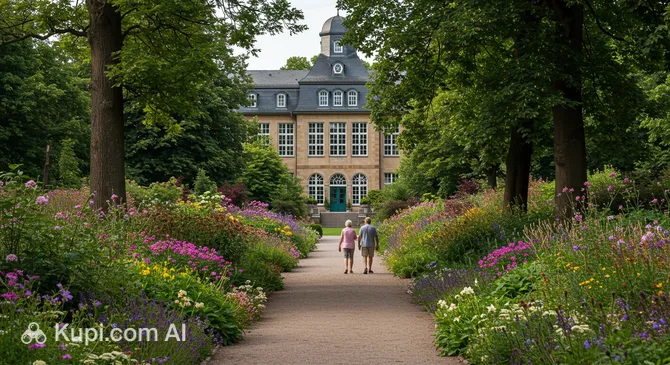
Giessen Botanical Garden
Giessen Botanical Garden. Иллюстрация. Источник: Kupi.com AI

Across a cozy 4-hectare area, an incredible biodiversity is gathered: around 8,000 plant species from all corners of the globe grow here. Strolling along its paths, you can encounter both rare exotic flowers and majestic trees, including a standout 200-year-old ginkgo—a symbol of longevity and natural wisdom.

For residents and visitors alike, the garden serves as an ideal green oasis where the academic precision of the collections harmoniously blends with an atmosphere of peace and relaxation. It is a place where nature and science meet to inspire visitors and provide new knowledge about our planet's plant world.

Contacts

To confirm details before your visit, you can use the institution's official contact information.

How to contactContact
AddressSenckenbergstraße 6 (Eingang:, Sonnenstraße, 35390 Gießen, Germany
Phone+49 641 9935240
Websitewww.uni-giessen.de

What to Do

A stroll through the garden is a wonderful way to combine relaxation with learning. Be sure to visit the unique Evolution Path (Evolutions-Denkpfad): it consists of over 120 interactive stops that explain in an accessible way how the plant world has evolved over millions of years. This activity is engaging for students and families with children alike.

Fans of the exotic should step into the tropical greenhouses, where a jungle atmosphere prevails even in cool weather. Here, you can see a collection of succulents, lush ferns, and vibrant orchids. In the open-air section of the garden, don't miss the artificial hill—it conceals the remains of old fortress walls, a reminder of the city's past.

For those seeking solitude, the garden offers many picturesque corners. You can watch butterflies, take stunning macro photos of rare flowers, or simply sit under the canopy of the ancient ginkgo tree. The garden is beautiful at any time of year: in spring, it delights with vibrant blooms, and in autumn, with the golden hues of its century-old trees.

Getting There

The Botanical Garden is located in the heart of the city at Senckenbergstraße 6, in close proximity to the Justus Liebig University buildings. If you are already walking through the city center, reaching it on foot is easy—just look for the Heathens’ Tower (Heidenturm), which offers a lovely view of the garden's lush greenery.

For those using public transport, it is most convenient to take buses to stops in the center (such as the University or Brandplatz), from where the entrance is just a 5–10 minute walk. If you are coming from Frankfurt am Main, a train will get you to Giessen Hauptbahnhof in about an hour. From the station, you can take bus No. 1 or No. 11 (about 10 minutes) or enjoy a 20–25 minute walk.

Travelers by car are recommended to leave their vehicle in one of the city center parking lots or near the university. Cyclists will also find convenient paths leading directly to the garden. The main entrance is on Senckenbergstraße, with an additional entrance on the Sonnenstraße side.

Ближайший город: Giessen

History & Facts

The history of this remarkable place dates back to 1609. It was then that Landgrave Ludwig V granted part of his palace park to the new university to establish a hortus medicus—a medicinal herb garden. This makes the site the oldest botanical garden in Germany to still occupy its original location.

Over its centuries of existence, the garden has faced many trials. It fell into decline during the 17th century, but its revival began in the 18th century with the addition of the first orangery and glass greenhouse. By 1773, the site's status had evolved from a purely medical garden into a full-scale botanical garden, dedicated to the study of a wide variety of plants.

The garden's modern layout took shape in the 19th century under the direction of Johann Bernhard Wilbrand, who consolidated various plots and incorporated the space of the former fortress walls. Although the tropical house was destroyed during the Second World War, the garden was fully restored, preserving its scientific value and historical charm.

Time Needed

For a quick tour of the main paths and the tropical greenhouse, 1.5–2 hours is usually sufficient. This is enough time to enjoy the tranquility, take beautiful photographs, and see the primary natural exhibits.

If you plan to explore the Evolution Path in detail, spend time reading the information plaques, or simply want to relax on a bench surrounded by exotic flowers, you should set aside about 3–4 hours. The garden encourages leisurely contemplation, so there is no need to rush.

Working Hours

The Giessen Botanical Garden welcomes visitors daily. Please note that opening hours vary slightly between weekdays and weekends:

Monday to Friday: from 08:00 to 19:00.
Saturday and Sunday: from 08:00 to 18:00.

A pleasant bonus for tourists is that admission to the garden is completely free, making it one of the city's most accessible yet significant attractions.

DayWorking hours
Понедельник8:00 – 19:00
Вторник8:00 – 19:00
Среда8:00 – 19:00
Четверг8:00 – 19:00
Пятница8:00 – 19:00
Суббота8:00 – 18:00
Воскресенье8:00 – 18:00

Nearby

Exploring the surroundings of the Botanical Garden will allow you to dive deeper into the city's atmosphere and see its historical heritage from different angles. Most points of interest are within walking distance.

NameDistance
KOIA0.4 km
Pit’s Pinte0.5 km
Scarabée0.9 km
Knossos0.9 km
Mathematikum1.1 km
Tora Sushi Bar & Asia Cuisine1.2 km
Bistro Moskau1.3 km

Reached the end of the page?

That means the route is fully explored