Support

Schwebebahn

About

Imagine a train that glides smoothly above the city bustle and the surface of the water — this is the Wuppertal Suspension Railway (Schwebebahn). Located in the city of Wuppertal, this unique transport system is the oldest operating monorail in the world. It has become a true symbol representing the technical progress of Germany at the beginning of the 20th century.
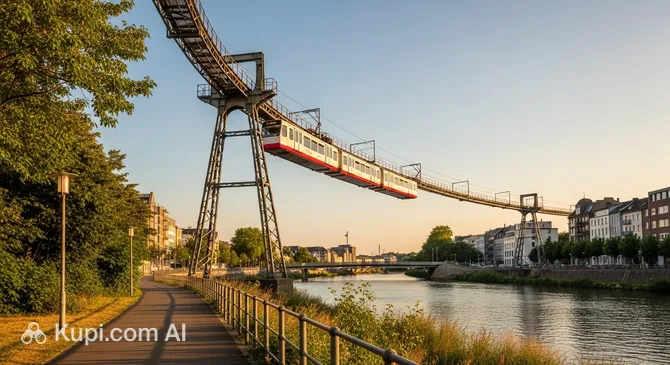
Wuppertal Suspension Railway
Wuppertal Suspension Railway. Иллюстрация. Источник: Kupi.com AI

The total length of the track is 13.3 kilometers. Most of the route runs at a height of about 12 meters directly above the bed of the Wupper River, while the remaining sections pass over city streets. Massive triangular steel supports and futuristic cars that literally float in the air make this place a must-visit for every traveler.

This is not just an open-air museum exhibit, but a fully functioning public transport system that carries tens of thousands of people every day. Thanks to its unusual design and rich history, the suspension railway consistently receives high praise from tourists and is considered one of the most engineeringly perfect objects in Europe.

Contacts

To plan your trip on the legendary monorail, it's useful to know the official coordinates of the operating company and the main access point in the city center.

How to contactContact
Address42103 Вупперталь, Германия
Websiteschwebebahn.de

What to Do

The main reason thousands of tourists come here is the opportunity to "take a flight" over the city. A ride on the Schwebebahn offers a completely different sensation than an ordinary tram or subway: you gently sway in the air, watching the waters of the Wupper River, rooftops, and busy intersections pass beneath you. The entire route includes 20 stations, each with its own architectural style.

Special attention should be paid to finding the famous "Kaiserwagen" (Imperial Car). This is the same historical carriage in red and gold tones in which Emperor Wilhelm II rode in 1900. On certain days, it is used for special excursion trips where you can drink coffee and listen to guides' stories in an authentic atmosphere from the beginning of the last century.

Photography enthusiasts are recommended to stop at stations with panoramic views, such as the Zoo or the Vohwinkel area. A trip during daylight hours will allow you to see industrial landscapes and green parks, while an evening trip will impress you with the lights of the night city reflecting in the water. This is the perfect way to see all of Wuppertal at once without getting stuck in traffic jams.

Getting There

Getting to this engineering marvel is very easy, as the Wuppertal Suspension Railway runs through the entire city from east to west. The main hub stations are Oberbarmen and Vohwinkel. If you arrive at the main station Wuppertal Hbf, you just need to head to the Hauptbahnhof suspension railway station, which is within walking distance.

For those traveling from other cities, it is most convenient to use the train. The journey from Düsseldorf takes about 30–40 minutes, and from Cologne about 50 minutes. Wuppertal's city transport network is fully integrated: your train or bus ticket may also be valid for a ride on the suspension monorail.

If you prefer a taxi or private transport, head for the central districts along the Wupper River. Parking is available at the terminal stations, but it is more convenient to move around the city center by public transport to avoid searching for a parking spot on the narrow streets.

Ближайший город: Wuppertal

History & Facts

The idea for such an unusual transport system arose at the end of the 19th century. At that time, the towns of Barmen and Elberfeld (which later became part of Wuppertal) were experiencing rapid industrial growth. The narrow river valley did not allow for conventional tram tracks or a subway, so engineer Eugen Langen proposed an innovative solution — suspending the carriages in the air.

Construction began in 1898 and was a real challenge for that time. About 19,200 tons of iron were required to create the structure. Even before the official opening, in October 1900, the system was personally tested by Kaiser Wilhelm II and his wife. Regular service opened on March 1, 1901, and the railway has hardly stopped operating since then.

During its long history, the railway has seen many surprising events. The most famous incident occurred in 1950, when a young elephant named Tuffi was brought into a carriage for advertising purposes. Frightened by the noise, the elephant broke through the side of the car and fell 10 meters into the Wupper River. Remarkably, the animal escaped with only minor scratches and lived a long life, and this incident became a city legend.

Despite its venerable age, the system is constantly being modernized. It survived restoration after 1945 and a large-scale reconstruction of the supports in the late 90s. Today, it is not just a historical monument, but a high-tech form of transport that continues to be the most reliable and fastest way to get around the region.

Time Needed

To simply ride the entire line from Vohwinkel station to Oberbarmen, you will need about 30–35 minutes. This is a great option for a quick look at the city architecture right from the carriage window.

However, tourists are recommended to allow 1.5 to 3 hours for their visit. This is enough time to get off at the most beautiful historical stations, take photos of the "floating" trains from the side, and perhaps take a return trip to look at details you might have missed the first time.

Working Hours

The suspension railway operates on a standard city transport schedule. On weekdays and Saturdays, service begins around 05:00 and continues until 00:00. On Sundays and public holidays, trains start running a bit later — usually from 07:00 or 09:00 in the morning.

Intervals between trains are only 3–10 minutes, so you won't have to wait long on the platform. Nevertheless, it is recommended to check the operator's official website before your trip to verify the current schedule or find out about possible maintenance breaks.

Nearby

A walk through Wuppertal is not limited to just the suspension railway. The surroundings of the stations offer many interesting locations, from historical towers with panoramic views to cozy parks and cultural centers that help you better feel the atmosphere of industrial but very green Germany.

NameDistance
City-Arkaden Wuppertal0.1 km
Open Ground0.2 km
60 Seconds to Napoli0.2 km
Von der Heydt Museum0.3 km
Wuppertal Central Station Shopping Mall0.3 km
Underground Wuppertal0.4 km
Room Thirteen0.5 km

Reached the end of the page?

That means the route is fully explored