Support

Santorini International Airport

About the Airport

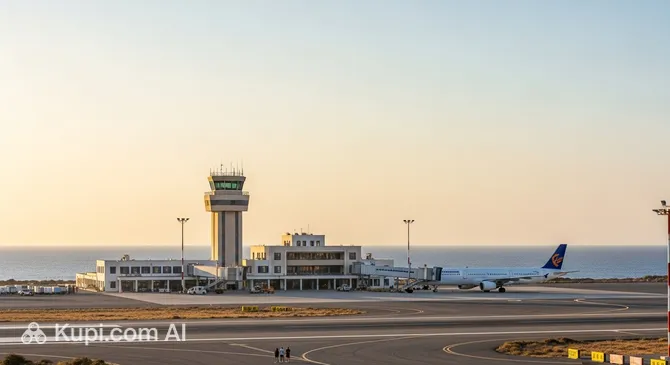
Santorini International Airport. Source: Kupi.com Binoculars

Santorini International Airport (Thira) is not merely a transit hub, but a true gateway to a world of white architecture and volcanic landscapes. Located on the eastern, flatter coast of the island, it is the first to welcome travellers arriving for the famous sunsets and the romance of the Cyclades. Despite its compact size, this air terminal serves millions of guests annually, successfully combining modern technology with unique island charm. Following a large-scale renovation, it has become not only more functional but also more welcoming, with a design reminiscent of traditional Greek houses.

IATA Code JTR
ICAO Code LGSR
City Fira (Santorini)
Distance to Centre ~6 km
Status International
Passengers per Year ~2.8 million
Schedule Seasonal Schedule

Airport Features and Advantages

The main pride of the air harbour is the new terminal, the renovation of which was completed in 2021 under the management of Fraport Greece. The building was completely reimagined: it now blends harmoniously with the landscape thanks to elements of Cycladic architecture, while maintaining modern infrastructure inside. The number of check-in counters and security checkpoints has been significantly increased, allowing for faster formalities even during the peak tourist season.

The airport enjoys a unique location — it is just a few minutes' drive from the popular resort of Kamari with its black beaches. You can reach the island's capital, the city of Fira, quickly and inexpensively by public bus, with a stop located right outside the terminal exit. Additionally, the renovated complex features a modern Duty Free area, offering not only international brands but also local products: famous Santorini delicacies and Greek olive oil.

It is important to note that the airport has a joint-use status (used by both civil and military aviation), so photography on the runway is strictly prohibited. Due to the destination's popularity, it can be crowded in summer, so travellers are advised to arrive for their flight well in advance.

Contact Information

Below is the contact information for Santorini International Airport (JTR), which may be useful when planning your trip.

  • Official Website: www.jtr-airport.gr. Here you will find flight schedules, service information, and the latest news.
  • Information Desk Phone: +30 22860 28400. For immediate information.
  • Airport Address: Santorini (Thira) Airport, 847 00, Santorini, Greece.
  • Email: To contact the airport administration, it is recommended to use the special contact form available on the official website.
  • Lost Luggage Information: If your luggage has been lost, first contact your airline's representative. You can also find contacts for ground handling agents who deal with these issues on the airport website.
  • Passenger Support Service: For general inquiries and assistance within the terminal, you can call the main airport phone number.

How to Get to the Airport

Santorini International Airport (JTR) is located just 6 km southeast of the island's capital, the city of Fira. Thanks to its convenient location, getting to the centre and other resorts on one of Greece's most picturesque islands is possible via several methods suitable for any budget and travel style.

Public Transport is the most economical option. KTEL buses depart directly from the airport to the central bus station in Fira. The journey takes approximately 15-25 minutes, and the ticket costs around 2-3 Euros. From the Fira bus station, it is easy to transfer to buses heading to other popular locations such as Oia, Kamari, or Perissa. It is important to remember that the schedule depends on the season, so it is best to check it on the carrier's official website before travelling.

Taxis and Private Transfers offer a higher level of comfort and speed. The taxi rank is located directly outside the arrivals area. A trip to Fira will take 10-15 minutes and cost approximately 25-35 Euros. During the peak tourist season (July-August), taxi queues can be long. An excellent alternative is booking a transfer online in advance — the driver will meet you with a sign, and the price will be fixed beforehand.

Car Rental is the ideal choice for those who want maximum freedom to explore Santorini. In the arrivals hall, you will find desks for many international and local rental agencies. By booking a car in advance, you can start your journey around the island immediately after collecting your luggage, without depending on public transport schedules. This allows you to easily reach remote beaches, farms, and stunning viewpoints.

For travellers arriving at the airport in their own or rented vehicles, a parking area is provided in front of the terminal building. Spaces are available here for both short-term stops to drop off or pick up passengers, and for long-term vehicle storage.

Terminals and Map

Santorini International Airport (JTR) is a compact transport hub subject to seasonal loads. Its layout is quite simple, which facilitates navigation, but during peak months, it requires patience and early arrival from passengers.

A key feature of the airport is its single terminal, which serves both domestic and international flights. The terminal building is divided into two main functional zones: the arrivals area and the departures area. Due to the small size of the terminal, there are no transitions between separate buildings — all processes take place under one roof.

The Arrivals Area is located on the ground floor. Immediately after disembarking, passengers enter the passport control zone (for non-Schengen flights), and then the baggage claim hall. Here you will also find counters for several car rental companies, a tourist information office, and the exit to taxi ranks and the public transport stop. The process of completing arrival formalities usually does not take much time unless several flights have landed simultaneously.

The Departures Area is also located on the ground floor. Airline check-in counters are situated here. After receiving a boarding pass and checking in luggage, passengers proceed to the upper level for security screening. It is worth noting that in summer months, queues for check-in and screening can be very long. It is recommended to arrive at the airport at least 2.5–3 hours before an international flight and 1.5–2 hours before a domestic one.

After passing through security, passengers enter a rather tight waiting area with several boarding gates. Seating is limited, so be prepared for the possibility of waiting for your flight while standing. In this area, there is a small Duty Free shop and several cafes where you can buy beverages and snacks. Navigating the terminal is easy thanks to signs in Greek and English; however, due to large crowds in the high season, the atmosphere may seem chaotic. Watch the information screens carefully, as gate numbers may change.

Airport History

The history of the airport on the island of Santorini, which is today one of the busiest in Greece, especially during the summer season, begins with its military past. It was originally built as a base for the Hellenic Air Force and still retains a dual, civil-military designation. A turning point in the history of the island and the airport itself was 1972, when it was opened for commercial civilian flights.

From that moment, a new stage of Santorini's development as a global tourist destination began. The initial terminal was modest and was not designed for the huge flow of travellers that poured onto the island in subsequent decades. As the resort's popularity grew, the airport infrastructure gradually expanded, but by the beginning of the 21st century, it was struggling to cope with peak loads.

The most significant modernization in the airport's history began in 2017 when it came under the management of Fraport Greece. As part of a large-scale programme, reconstruction and expansion works were carried out. A new, modern terminal was built, and the number of check-in counters, boarding gates, and security zones was increased. These changes, completed in 2021, significantly improved throughput and passenger comfort, transforming it into a modern and functional transport hub.

Among the interesting facts about Santorini Airport is its location. The runway is situated on the eastern side of the island, close to the coast and the edge of the famous caldera. This makes the approach and take-off incredibly spectacular for passengers, allowing them to appreciate the unique landscape of this volcanic island from the air. Although the airport cannot boast records in size, its achievement is the ability to efficiently serve millions of tourists in a relatively small area, playing a key role in the region's economy.

Services and Amenities

Santorini International Airport (JTR), despite its modest size, provides passengers with all necessary services for a comfortable wait. Although the selection here is not as extensive as in major metropolitan hubs, you will find everything needed to prepare for your flight or relax after arriving on the island.

Dining and Shopping: The terminal houses several cafes and snack bars where you can have coffee, grab a sandwich, or try local pastries. The main retail point is the Duty-Free shop, offering a standard assortment of perfumes, cosmetics, and tobacco products. You can also purchase Greek souvenirs, olive oil, and local delicacies as gifts for loved ones.

Comfort and Connectivity: For passengers preferring enhanced comfort, the airport features a VIP lounge where you can relax in a quiet environment. Free Wi-Fi is available throughout the terminal, allowing you to stay connected. Charging stations for mobile devices are also available, though their number may be limited during peak hours.

Financial and Other Services: ATMs are installed in the airport building, and a currency exchange point is in operation. A medical station is available for first aid. Passengers with small children can use the baby care room. For travellers with reduced mobility, special facilities and staff assistance are provided, which is recommended to be booked in advance through the airline.

Accommodation and Business Services: There are no hotels directly inside the airport building; however, many accommodation options are located just a few minutes away by taxi in nearby towns such as Kamari and Fira. Dedicated conference rooms or business centres are absent at the airport, as it is primarily oriented towards tourist flows.

Where to Eat

When planning a departure from Santorini International Airport (JTR), it is important to consider that this is a small and very busy airport during the season, so the choice of dining establishments here is quite limited. If you have time, it is best to have a full lunch or dinner in one of the island's towns before travelling to the airport.

The main opportunities for a snack are concentrated in two zones. In the general area (landside), accessible before security control, usually one or two cafes are open. This is a convenient option if you have arrived early or are meeting someone. Here you can have coffee, tea, soft drinks, as well as buy a sandwich, pastries, or a salad. The assortment is standard and designed for a quick bite.

After passing security control, in the departures area (airside), there are also several food outlets. Typically, these are small bars and cafes offering a similar range of items: packaged sandwiches, croissants, Greek pies (for example, cheese tiropita or spinach spanakopita), crisps, chocolate, and beverages. This is your last chance to have a snack before boarding your flight.

Although you will not find restaurants with exquisite local cuisine here, you can catch a hint of Greek flavour by ordering a traditional frappe or Greek coffee. For a more substantial meal, the choice is unfortunately small and limited to sandwiches or portioned salads. Regarding special dietary requests (vegetarian, vegan, gluten-free), finding suitable dishes can be very difficult. The selection is usually limited to perhaps a fruit salad or some types of nuts. If you have strict dietary restrictions, it is strongly recommended to bring food with you.

Be prepared for the fact that prices at Santorini Airport, like most tourist airports, are significantly higher than in the city. Opening hours are usually tied to flight schedules, especially in the high season (May to October), when they are open from early morning until late at night. In the off-season, some outlets may close earlier.

Travel Tips

When planning a departure from Santorini Airport, especially during the height of the tourist season (June to September), it is worth considering its small size and high congestion. It is recommended to arrive at the airport at least 2.5–3 hours before an international flight and 2 hours before a domestic one. This will give you a sufficient buffer of time in case of queues at check-in counters and security control, which are not uncommon here.

To save time, be sure to complete online check-in for your flight if your airline provides this option. This will allow you to go straight to the bag drop or, if you are travelling only with hand luggage, to security screening. Security checkpoints here are standard, but due to the dense flow of passengers, the process can be slow. Be prepared in advance and pack all liquids according to the rules.

Want to enjoy unforgettable views during take-off or landing? When departing from Santorini, try to choose a window seat on the right side of the aircraft (seats F) — the best view of the caldera opens from here. Accordingly, when arriving in Fira, choose seats on the left side (seats A). This little secret will allow you to take stunning farewell or welcome photos.

Hand luggage rules at Santorini Airport comply with general European standards. All liquids over 100 ml, including local beverages, olive oil, or honey, must be packed in checked luggage. Souvenirs purchased in Duty Free shops after passing security control can be taken on board in addition to the established hand luggage allowance.

Santorini Airport is not a major transfer hub, so most transit flights are operated via Athens. If you have a transfer planned, ensure there is enough time between flights, especially if you are flying with different airlines and need to check in and drop off luggage again.

Customs control for passengers arriving from non-Schengen countries is a standard procedure. If you are travelling within the European Union, you will only need to pass security control. Tourists from countries outside the EU may need to present a passport and possibly answer questions about the purpose of their visit to Greece.

To save money, take care of food and drinks in advance. Prices in the few cafes and vending machines at the airport can be significantly higher than in the city. Also, booking a taxi or transfer from the airport in advance will help avoid inflated prices and long waits upon arrival.

In case of a flight delay, be prepared for the fact that waiting conditions at the airport are quite modest: the number of seats is limited, especially in the departures area. If the delay is lengthy, check with the airline representative for information about your rights (in accordance with EU Regulation 261), which may include the provision of drinks, meals, or even hotel accommodation.

Reached the end of the page?

That means the route is fully explored