Support

Sitia Airport

About the Airport

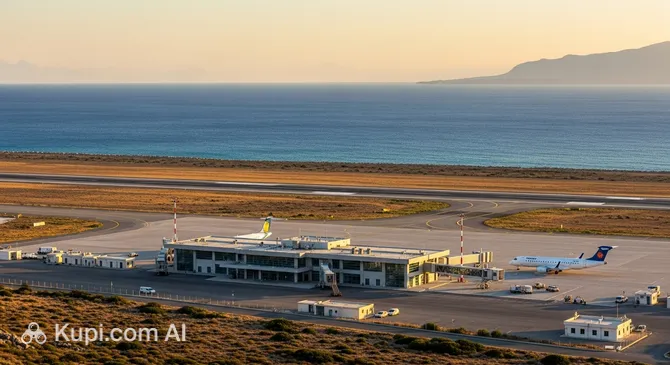
Sitia Airport. Source: Kupi.com Binoculars

Welcome to Sitia Public Airport "Vitsentzos Kornaros" (JSH) — your aerial gateway to the distinctive and enchanting eastern part of Crete. Named after the great Cretan poet of the Renaissance era, this small and cosy airport began operations on June 9, 1984, and today serves as a starting point for travellers seeking seclusion, untouched nature, and authentic Greek atmosphere. Its compact size and convenient location make arrivals and departures quick and comfortable, allowing you to begin exploring the treasures of the Lasithi region without delay.

IATA Code JSH
ICAO Code LGST
City Sitia, Greece
Distance to Centre approx. 1 km
Status Domestic, with seasonal international charters
Annual Passengers approx. 88,000 (2023)
Popular Airlines Olympic Air, Sky Express, Aegean Airlines
Schedule Online Board "Sitia Airport"

Features and Advantages

The main advantage of Sitia Airport is its compactness and proximity to the city. It is located just a few minutes' drive from the centre of Sitia, which saves transfer time. Although the airport primarily serves domestic flights connecting Crete with Athens and other Greek islands, during the summer season it also receives charter flights from European countries. This makes it an ideal choice for those planning a holiday in eastern Crete, known for its picturesque beaches, such as the famous Vai palm beach, and historical landmarks, including Toplou Monastery. It is worth noting that public transport does not run directly from the airport, so it is best to use a taxi or rent a car for further travel.

Contact Information

If you need to contact Sitia Airport (JSH), please use the following contact information. We recommend checking the validity of the data on official resources before your trip, as it may change.

  • Official Website: Sitia Airport is managed by the Hellenic Civil Aviation Authority (HCAA). Official information can be found on the relevant page of the HCAA website (www.hcaa.gr).
  • Information Desk Phone: +30 28430 24424. When calling from outside Greece, do not forget to use the international code.
  • Address: Sitia Public Airport "Vitsentzos Kornaros", Sitia 723 00, Crete, Greece.
  • Email: For general inquiries, use the official address kasthl@hcaa.gr.
  • Social Media: Small regional airports typically do not have their own official social media pages. News and updates can be tracked on Crete regional tourism portals.
  • Lost Luggage Information: For questions regarding lost or damaged luggage, you should contact your airline directly. Airport staff do not handle luggage tracing — this is the responsibility of the carrier.
  • Passenger Support Contacts: For general questions regarding your stay at the airport, you can use the information desk phone number.

How to Get to the Airport

Getting to Sitia Airport (JSH) from the city of the same name in Crete is quite simple, as it is located just a few kilometres from the centre. The choice of transport depends on your budget, time, and personal preferences.

Taxi or Private Transfer is the fastest and most convenient method. A trip from the centre of Sitia to the terminal will take no more than 5-10 minutes. Given the short distance, the cost of the trip will be approximately 5–10 Euros. This is an ideal option if you are travelling with bulky luggage, children, or have an early flight. Cars can be found at designated stands in the city, called by phone, or you can book a transfer online in advance for complete peace of mind.

For budget-conscious travellers, public transport is the best choice. Local buses from the KTEL company connect the city with the airport. This is the cheapest way to get to the terminal; the ticket price is usually just a couple of Euros. It is important to remember that buses run according to a schedule, so be sure to check the current departure times on the official KTEL website, especially during the low season, to avoid missing your flight.

If you plan to explore the picturesque surroundings and the eastern part of Crete, car rental would be an excellent solution. You will be able to not only move freely around the island but also drive comfortably to the airport on the day of departure. Most rental agencies in Greece offer a car return service directly at the airport, which is very convenient. There is a parking lot near the terminal where you can leave a car for both short and long terms.

Terminals and Map

Sitia Airport (JSH) is a small regional airport distinguished by its compactness and simplicity. All its infrastructure is concentrated in one passenger terminal, serving both domestic and international flights, most of which are seasonal charters. Thanks to this, it is virtually impossible to get lost here, even if you have arrived for the first time.

The terminal layout is extremely simple. Immediately after entering, you find yourself in the general area where the check-in counters are located. The departure and arrival zones are in the same building and clearly separated, but located very close to each other. Navigation is intuitive, and signs in Greek and English will help you orient yourself easily. Since there is only one terminal, the question of transfers between them is irrelevant — all necessary services are within walking distance.

Check-in and pre-flight security checks at Sitia Airport usually take little time due to the low passenger flow. Outside of peak loads, all formalities can be settled quite quickly. However, at the height of the tourist season (from June to August), when several charter flights arrive and depart simultaneously, queues may occur. Therefore, it is recommended to arrive at the airport generally 1.5–2 hours before departure to complete all procedures without rushing.

The main advice for navigating Sitia Airport is not to worry. Its compact size is more of an advantage than a disadvantage. All key areas — from check-in counters to boarding gates — are located in one small hall. Simply follow the signs, and you will easily find everything you need for a comfortable start or end to your journey through eastern Crete.

Airport History

The history of the airport in Sitia is a story of the gradual transformation of a small municipal airfield into an important aerial gateway for eastern Crete. Officially, the airport, known as Sitia Public Airport "Vitsentzos Kornaros" (JSH), began operations on June 7, 1984. On this day, the first aircraft landed here — a small Dornier Do-228 of Olympic Airways, marking the beginning of air connections with this picturesque region of Greece. Initially, the infrastructure was modest and included a runway just 650 metres long.

As tourist interest in the eastern part of Crete grew, the airport began to develop actively. The first significant stage of modernisation occurred in May 1993, when a new terminal and control tower were put into operation. At the same time, the runway was expanded, allowing for larger aircraft. However, the key moment in the airport's history was May 2003, when the runway was extended to its current 2,074 metres. This opened the possibility for charter flights from Europe, which radically changed the tourism landscape of the region.

The most large-scale reconstruction was completed in 2016 with the opening of a completely new, modern terminal covering an area of 7,500 square metres. This project significantly increased the airport's capacity and improved the level of comfort for passengers. The appearance of the new terminal became a powerful stimulus for the economic development of the entire Lasithi region, making famous places like the Vai palm beach and the secluded bays of the east coast much more accessible to travellers from all over the world.

Interesting fact: the airport bears the name of Vitsentzos Kornaros, the great 17th-century Cretan poet and author of the epic poem "Erotokritos". This name symbolises the connection between the modern development of the region and its rich cultural and historical heritage, of which the locals are so proud. Thus, Sitia Airport is not just a transport hub, but an important part of the identity of eastern Crete.

Services and Amenities

Sitia Airport (JSH) is a small regional airport that ensures a comfortable start and end to your journey through eastern Crete. Despite its compact size, it offers passengers all the necessary basic services and amenities for a pleasant wait for their flight.

Dining and Shopping. Several cafes and snack bars operate in the terminal, where you can drink coffee, have a sandwich, or buy refreshing beverages. The choice of establishments is small but sufficient to refresh yourself before departure. There is also a shop with souvenirs, local products, and essential items.

Waiting Areas and Facilities. A general waiting hall with a sufficient number of seats is equipped for passengers. Although there are no separate VIP or business lounges at the airport, the general atmosphere here is quite calm. Free Wi-Fi is available throughout the terminal, and power outlets for charging electronic devices can be found in the waiting hall.

Financial and Other Services. An ATM is installed in the airport building where you can withdraw cash. A currency exchange point may not be available, so it is recommended to take care of exchanging money in advance. For emergencies, a first aid station is provided.

Services for Passengers with Special Needs. The airport is equipped for the comfortable movement of passengers with reduced mobility — there are ramps and specially equipped toilets. for travellers with small children, there are mother-and-child rooms where you can change a baby in a quiet environment.

Accommodation and Business Services. There are no hotels within the airport building itself, however, many accommodation options can be found in the city of Sitia, which is just a few minutes' drive away. Specialised conference rooms or business centres are absent at the airport, as it is oriented primarily towards serving tourist flows.

Where to Eat

Sitia Airport (JSH) is a small regional airport, so the choice of dining establishments here is quite limited. It is designed primarily for passengers waiting for their flight and does not offer the variety of restaurants found in major international hubs. Nevertheless, having a snack before departure is quite possible.

The main place where you can eat is a small cafe-buffet located in the public departure area, before passing security control. Here you will find a standard set of snacks: fresh pastries, sandwiches, crisps, as well as hot and cold beverages. Sometimes the assortment includes traditional pies of Greece, for example, tiropita (cheese pie) or spanakopita (spinach pie), allowing you to experience local flavours in miniature.

After passing security control (in the so-called "airside" zone), the choice becomes even more modest. Typically, it is limited to a small kiosk with drinks and packaged snacks. Therefore, if you plan to have a full meal, it is better to do so before passing screening.

Passengers with special dietary needs should take note that finding guaranteed vegan, gluten-free, or Halal meals at the airport is practically impossible. In this case, it is recommended to bring food with you. The price range in the cafes is moderate for an airport, and the opening hours of the establishments depend directly on the flight schedule — they usually open a few hours before the first departure and close after the last one departs.

Recommendation: Sitia Airport is excellent for a quick snack or a cup of coffee before a flight. For a more substantial lunch or dinner, it is better to choose one of the numerous tavernas in the city of Sitia itself, which is located close to the airport.

Travel Tips

To ensure your journey through Sitia Airport (JSH) is as comfortable as possible, make use of these tips. Sitia Airport is a small regional hub, so orienting yourself is simple. It is recommended to arrive 1.5–2 hours before domestic or Schengen flights and 2.5–3 hours before international ones. Always check your airline's recommendations, especially during the peak tourist season.

Check-in and screening procedures usually proceed quickly thanks to the compact dimensions of the terminal. However, to avoid queues in the summer months, it is best to complete online check-in if available for your flight. This will allow you to head straight to baggage drop or, if you are travelling light, to security control.

When choosing a seat on the plane, consider your preferences: window seats will offer you magnificent views of the coast of Crete during takeoff and landing, while aisle seats provide more legroom and the ability to stand up freely. If you wish to disembark among the first, choose rows in the front part of the cabin.

Regarding hand luggage, standard international rules apply. All liquids must be in containers of no more than 100 ml and packed in a single transparent resealable bag. It is prohibited to carry sharp objects, weapons, and other dangerous substances in the cabin. Before travelling, be sure to check the current list of prohibited items on your airline's website.

Sitia Airport serves primarily direct flights, so complex transfers are unlikely here. If you have a connection planned, check in advance whether you will need to collect and re-check your luggage. Customs control in Greece complies with EU rules. Passengers arriving from Schengen zone countries undergo minimal control, while travellers from other countries may need to pass passport control.

To save time and money, print your boarding pass at home, travel with hand luggage to avoid paying for baggage, and bring an empty water bottle which can be filled after passing security. The choice of cafes and shops in a small airport may be limited, so bringing a light snack with you would not be amiss.

In case of a flight delay or cancellation, first contact your airline's counter for current information. Remember that EU regulations protecting passenger rights apply in airports. Depending on the length of the delay and flight distance, you may be provided with drinks, meals, and for long waits — accommodation in a hotel. Keep all receipts for necessary expenses so that you can request compensation later.

Reached the end of the page?

That means the route is fully explored