Support

Naxos Airport

About the Airport

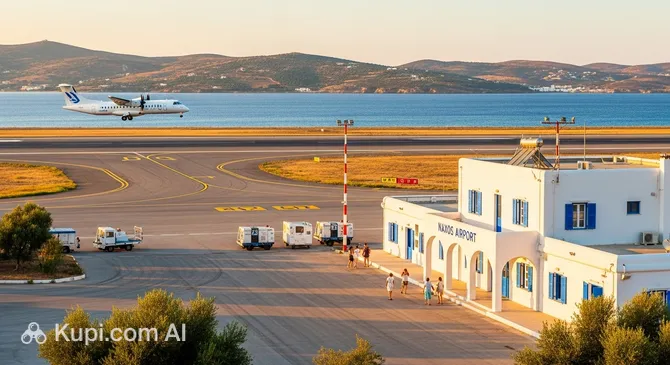
Naxos Airport. Source: Kupi.com Binoculars

Welcome to Naxos Island National Airport "Apollon" — the aerial gateway to the largest and greenest island of the Cyclades archipelago! This cozy air harbor serves as the starting point for thousands of travelers eager to discover the mythical homeland of Dionysus with its endless beaches, fertile valleys, and ancient monuments. Located just a few minutes' drive from the island's capital, Naxos Airport ensures a quick and convenient start to your Greek adventure.

IATA Code JNX
ICAO Code LGNX
City Naxos
Distance to center approx. 3 km
Status National (domestic flights)
Passengers per year approx. 230,000 (in 2023)
Popular Airlines Olympic Air, Sky Express, Aegean Airlines
Schedule "Naxos Airport" online board

The main advantage of Naxos Airport is its compactness and convenient location. It is situated just 3 km from Chora (the island's capital) and in close proximity to popular beaches such as Agios Georgios and Agios Prokopios, allowing tourists to reach their hotels as quickly as possible. The airport primarily serves domestic flights from Athens operated by Olympic Air, Sky Express, and Aegean Airlines, making it a key transit hub for travelers. Currently, the airport is undergoing major modernization, including runway expansion and infrastructure improvements, to accommodate larger aircraft in the future and ensure even greater comfort for the growing number of passengers.

Contact Information

Below are the essential contact details for Naxos Airport (JNX) to help you plan your trip and resolve any potential inquiries.

  • Official Airport Website: You will find the most complete and up-to-date information on flights, services, and regulations on the official website managed by Fraport Greece: www.jnx-airport.gr.
  • Information Desk Phone: For general questions and information, you can call: +30 22850-23969.
  • Airport Address: The airport is located a few kilometers from Naxos town at: Naxos Airport, Naxos 843 00, Greece.
  • Email: The airport does not provide a direct public email address. For written inquiries, it is recommended to use the dedicated contact form on the official website.
  • Social Media: Official news and updates are published on the pages of the airport operator, Fraport Greece, on popular social networks such as Facebook, X (formerly Twitter), and Instagram.
  • Lost & Found Information: If your luggage has been lost or damaged, you must contact your airline's Lost & Found service or their ground handling representative in the arrivals hall directly.
  • Passenger Support Contacts: For most inquiries related to airport services, you can contact the main information desk number.

How to Get to the Airport

Naxos Island Airport (JNX) is located just 3-4 kilometers south of the island's capital, the city of Naxos (also known as Chora), making the journey there quick and convenient. Regardless of your budget and preferences, you will easily find a suitable way to reach the terminal to catch your flight.

Public Transport: Bus
The most economical way to get to the airport is by using the local KTEL buses. Routes connect the airport with Chora and the popular Agios Georgios beach. The trip from the city center takes no more than 10-15 minutes, and the ticket cost is only about 2-3 Euros. It is important to remember that the schedule may change depending on the season (there are significantly more flights in summer), so it is recommended to check it in advance on the carrier's website or at the main bus station in Chora.

Taxi and Transfer
For those who value comfort and time, a taxi is the ideal choice. The trip from the center of Naxos city to the airport will take just 5-10 minutes. The fare is usually around 15-20 Euros. Cars can be found at designated stands in the city or ordered by phone. Additionally, you can book a private transfer in advance — this is particularly convenient if you are traveling with a lot of luggage or as a group, as the price will be fixed.

Car Rental and Parking
If you have rented a car to explore the beautiful landscapes of Greece, driving it to the airport is the most flexible option. Most rental companies allow you to return the car directly at the airport before departure — be sure to confirm this option when booking. There is a small parking lot next to the terminal. In most cases, it is free of charge, however, during the peak tourist season (July-August), the number of available spaces may be limited.

Terminals and Map

Naxos Island Airport (JNX) is a very compact and homely air hub, making navigation extremely simple. Its structure is simplified to the maximum for the convenience of passengers arriving on this picturesque island of the Cyclades archipelago.

Number of Terminals and Layout

Naxos Airport consists of one small passenger terminal that handles all flights without exception — both domestic and seasonal international charters. The terminal building is single-story, and all key zones are within walking distance of each other; it is practically impossible to get lost here. Upon entering, you will immediately see the check-in counters, and nearby — the security checkpoint and boarding gate. Naturally, there are no transfers between terminals.

Departure and Arrival Zones

Processes for departing and arriving passengers are organized in a linear and intuitive manner.

  • Departure Zone: After baggage check-in, passengers pass through a single security control point, which leads directly to a small waiting hall. There are a few boarding exits (gates) here, which are essentially doors leading to the apron, from where passengers walk to the aircraft.
  • Arrival Zone: Arriving passengers enter the baggage claim hall directly from the airfield. There is one luggage belt here, and the exit to the city is located just a few meters away. Car rental counters and taxis are located immediately at the exit.

Processing Time and Recommendations

Thanks to the airport's modest size, flight check-in and security screening usually take minimal time — often no more than 15–20 minutes. However, during the peak tourist season (July-August), the terminal can get quite crowded due to several flights being serviced simultaneously. To avoid rushing, it is recommended to arrive at the airport approximately 1.5–2 hours before departure. During the rest of the year, arriving one hour in advance is sufficient.

Airport History

The history of Naxos Airport (JNX), officially named "Apollon," began relatively recently. It was opened on July 3, 1992, with the main goal of making one of the largest Cycladic islands more accessible to travelers. Prior to this, ferry services were the main link to mainland Greece. Since its inception, the airport has become a catalyst for tourism development, turning Naxos into one of the popular destinations in the Aegean Sea.

Initially, it was a small regional airport with a short runway designed to accommodate only light turboprop aircraft, such as the ATR and Dash 8. For many years, this was the main limiting factor for growth, as the airport could primarily handle domestic flights from Athens. Nevertheless, it performed its function reliably, ensuring a steady influx of tourists.

A key event in the airport's modern history was the launch of a large-scale modernization and expansion project. The main task was the extension of the runway so that it could accommodate larger jet aircraft, such as the Airbus A320 and Boeing 737. This reconstruction is a historic moment for the island, as it opens up prospects for direct international flights from European cities, which will undoubtedly take the tourism industry of Naxos to a new level.

Interestingly, the airport received its official name "Apollon" in honor of the ancient Greek god, whose cult was widespread on the island. Thus, even a modern transport hub is inextricably linked with the rich mythological heritage of Naxos. Today, the airport is not just a point on the map, but a gateway that annually opens the amazing world of Cycladic culture, magnificent beaches, and ancient monuments to thousands of travelers.

Services and Facilities

Naxos Airport (JNX) is small and mainly serves domestic flights, so the range of services here is basic but sufficient for a comfortable wait before departure. Inside the terminal building, there is a small buffet cafe where you can have a snack, drink coffee, or purchase soft drinks. There are no full-service restaurants or a wide selection of Duty Free shops here, but you can find a kiosk with essentials and souvenirs. Complimentary Wi-Fi is available for passengers throughout the terminal. The number of power outlets for charging devices may be limited, so it is recommended to carry a portable power bank.

Financial services at the airport are represented by ATMs where you can withdraw cash. There are no specialized currency exchange points, so it is worth taking care of this in the city beforehand. Basic amenities are provided for passengers with children, including changing tables in the restrooms. Passengers with reduced mobility are provided with all necessary assistance, but you must notify your airline in advance — usually at least 48 hours before departure. If necessary, you can contact airport staff for first aid.

It is important to note that Naxos Airport lacks premium lounges (VIP lounges), and there are no conference rooms or business centers. The terminal is oriented towards the quick and functional service of passengers arriving for their holidays.

There are no hotels within the airport grounds, but it is located very close to the island's capital, Naxos Town (Chora), and popular beaches such as Agios Georgios. Most hotels, apartments, and villas are just a 5-15 minute drive away by taxi or rental car, making it convenient for travelers with early departures or late arrivals.

Where to Eat

Naxos Airport (JNX) is a compact regional terminal, typical of many islands in Greece. Consequently, the choice of dining establishments here is quite limited, and travelers should plan their lunch or dinner in advance, especially if there is a lot of time left before departure.

In the airport's single terminal, there is one small buffet, which serves as the main place to grab a snack. It is located in the public area, so it is accessible to both departing passengers and those waiting, prior to security control.

The menu at the buffet is designed for a quick bite. Here you can order coffee, soft drinks, as well as buy pre-packaged sandwiches, pastries, and light snacks. Sometimes the assortment includes local pastries, such as traditional cheese pie, but one should not expect full hot meals from a restaurant menu. This place is excellent for having a cup of coffee before your flight.

It is important to note that finding options for special diets (vegetarian, vegan, gluten-free) here is practically impossible. If you require a substantial meal or have specific dietary preferences, the best solution would be to eat at one of the numerous cafes and tavernas in the city of Naxos before traveling to the airport. The buffet's operating hours depend directly on the flight schedule, and it is open during airport operating hours.

Travel Tips

Planning a trip through Naxos Island Airport requires taking its specific features into account. Being a small regional airport, preparing for departure here has its own nuances. To ensure your journey begins and ends without unnecessary hassle, make use of our tips.

Arrival Time at the Airport. Despite the compact size of the terminal, it can get quite crowded during the peak tourist season (June to September). For domestic flights within Greece, it is recommended to arrive 1.5–2 hours before departure. If you have an international charter flight, it is better to arrive 2.5–3 hours in advance to calmly complete all formalities.

Check-in and Security Control. To save time, always try to check in for your flight online if your airline provides this option. Check-in counters at the airport may not operate continuously but open specifically for flights. Security checks usually go quickly, but small queues are possible during peak hours. Prepare all liquids and electronic devices in advance to speed up the process.

Seat Selection and Hand Luggage. When flying to or from Naxos, try to get a window seat. Stunning views of the Aegean Sea and neighboring islands will open up to you. Regarding hand luggage, standard international rules apply: liquids in containers larger than 100 ml are prohibited (all must be packed in one transparent bag), as are sharp objects. Power banks are allowed only in hand luggage.

Transfers and Customs Control. Naxos Airport is not a major transit hub, so connecting flights here are rare. If you are planning a self-transfer, allow sufficient time for baggage claim and re-check-in. Upon arrival from non-Schengen countries, you will have to pass passport control. Customs inspection for tourists arriving from EU countries is usually selective.

Saving Time and Money. Book a taxi or transfer from the airport in advance, especially in high season — this can be cheaper than hiring a car on the spot. Traveling light, with only hand luggage, will save you from having to wait for luggage and pay for its carriage. There is a small buffet inside the terminal, but prices may be higher than in the city.

In Case of Flight Delay. In the event of a flight delay or cancellation, contact your airline representative first. Keep an eye on the information on the departure boards. Since the airport is small, facilities for long waits are limited. Know your rights: for flights operated by European carriers, EU Regulation No. 261/2004 applies, which provides for compensation and assistance to passengers (water, food, accommodation) depending on the length of the delay.

Reached the end of the page?

That means the route is fully explored