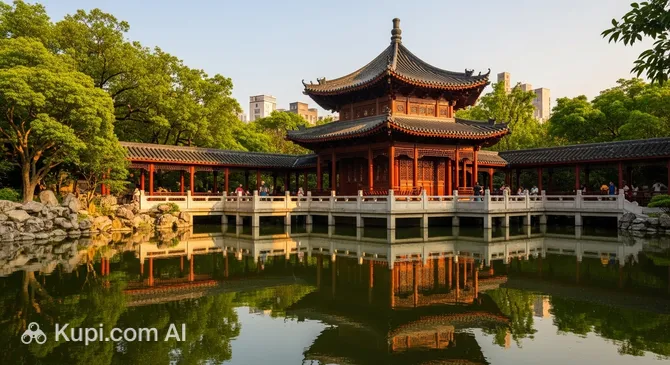
Located on the New Asia College campus of The Chinese University of Hong Kong is one of the city's most inspiring spots — the Pavilion of Harmony. This architectural landmark in Hong Kong is an elegant structure embodying the ancient philosophical idea of the unity of man and nature. The site has become an important symbol of the academic community and a popular destination for those seeking aesthetic pleasure and peace.
Pavilion of Harmony. Illustration.
Source: Kupi.com AI
Traveler photos:
Erected in Hong Kong as a tribute to the college founder, Ch’ien Mu, the pavilion impresses with its minimalist yet profound design. The main feature of the site is a small pond that reflects the sky and surrounding trees, creating an illusion of infinite space and harmony. Officially opened in late 2003, the pavilion is now ranked among the best locations for photography thanks to its contemporary artistic vision.
Situated between student dormitories, the Pavilion of Harmony offers breathtaking views of Tolo Harbour. It is a space where Confucian traditions meet modern architecture, inviting every visitor to reflect on their place in the world amidst the silence and natural beauty of the Sha Tin district.
Contacts
For ease of navigation through the university grounds, you can use the following contact details for the site:
A visit to this site is primarily an opportunity to immerse yourself in an atmosphere of tranquility and contemplation. One of the main reasons for the pavilion's popularity is its incredible aesthetics: here you can take stunning photographs where the architecture literally merges with the horizon and the water's surface. It is a renowned "Instagrammable" spot, attracting lovers of beautiful views from all over the world.
Beyond the visual delight, it is worth taking the time to thoughtfully examine the details. Walk along the pedestrian path to see the metal plaque with calligraphy. The inscriptions contain fragments of Ch’ien Mu's works dedicated to the philosophy of harmony, adding a deep cultural context to your visit. It is an ideal place for those who want to combine a light stroll through the campus with a touch of Eastern wisdom.
Many come here for meditative reflection, gazing at the "clear pond" and the trees embracing the pavilion. Despite its popularity with tourists, the campus grounds often maintain a quiet, academic atmosphere conducive to reading or simply observing nature. A visit to the pavilion often becomes part of a larger tour of the university, offering a pleasant pause in the shade of modern architecture.
Getting There
The most convenient way to reach this secluded spot is by public transport. The fastest and most reliable method is to take the MTR to University Station (East Rail Line). From the station exit, you can take a pleasant 15-minute walk uphill through the campus or wait for the internal university shuttle bus heading to the New Asia College stop.
If you prefer a taxi, the ride from central areas of the city will take approximately 30–45 minutes depending on traffic. You should provide the driver with the specific address in the Sha Tin district: New Asia Circle, Ma Liu Shui. Please keep in mind that parking for private visitor vehicles on campus is very limited, making public transport the preferred option.
Nearest city: Hong Kong
History & Facts
The history of this site is inextricably linked to the prominent thinker Ch’ien Mu, the founder of New Asia College. The pavilion serves as the architectural embodiment of his 1996 philosophical work titled “The Theory of the Unity of Man and Nature”. The project was made possible through a generous donation by Dora Ng Zung-lin and was opened to the public on December 12, 2003.
The structure was designed by Freeman Chan Wai-kei from the CUHK School of Architecture. He sought to create a space that moved away from traditional garden forms toward modern art while preserving deep Confucian meaning. The pavilion's location next to two trees that seem to "embrace" each other symbolizes the inseparable bond between heaven and humanity.
The site's cultural value is further enhanced by its artistic design. A long metal plaque installed along the walkway features exquisite calligraphy. The texts from Ch’ien Mu's works were calligraphed by professors Lee Yun-woon and Vincent Tong Kam-tan, making this location an important point of heritage preservation on the modern campus.
Time Needed
For a leisurely tour of the pavilion itself, reading the calligraphic inscriptions, and taking beautiful photos against the backdrop of Tolo Harbour, most travelers find 30–60 minutes to be sufficient. This allows enough time to fully experience the serene atmosphere of the place.
However, if you plan to take a slow walk through the entire campus of The Chinese University of Hong Kong, which is renowned for its landscape design and architecture, we recommend allocating 1 to 2 hours for your visit. The campus is situated on hills, so the walk may require a bit more time and effort.
Working Hours
The Pavilion of Harmony can be visited at any time, as it is open to the public 24 hours a day, seven days a week. This makes the location accessible for both early morning walks and for contemplating the evening city lights.
Since the site is located on the grounds of an active educational institution, visitors are encouraged to show respect for students and faculty, especially during study hours and in the evening. Before your trip, it is also worth checking the official Chinese University of Hong Kong (CUHK) website to ensure there are no temporary access restrictions to the campus due to internal events.
Open 24 hours
Nearby
Exploring the university's surroundings allows you to discover different facets of the region, from modern theme parks to water sports centers. A walk through the campus can be the perfect start to a busy day.