Support

广济桥

About

Imagine a unique engineering marvel that has for centuries been considered one of the four great ancient bridges that China is proud of. Located near the city of Shantou, in historic Chaozhou, Guangji Bridge is a masterpiece of ancient architecture, combining features of beam, arch, and even floating bridges.

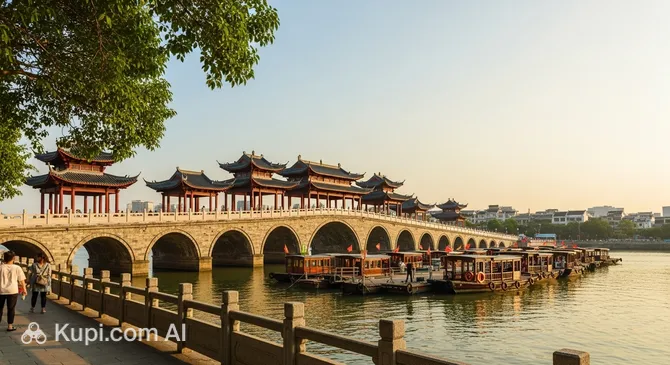
The main feature of this landmark is its central section. It consists of 18 wooden boats connected by chains. During the day, they form a continuous pedestrian path, and at night, they are moved aside to open the way for large vessels. This amazing mechanism not only captures the imagination of tourists but has also helped to effectively manage floods on the Hanjiang River for centuries.

Guangji Bridge
Guangji Bridge. Иллюстрация. Источник: Kupi.com AI

The bridge is approximately 518 meters long. Its architectural ensemble is complemented by 12 majestic pavilions and 18 gazebos, each with its own unique appearance. A walk here is not just a crossing from one bank to another, but a true immersion into the history and culture of Guangdong province.

Contacts

To clarify visiting details for this unique site, it is recommended to contact the Chaozhou Tourist Information Center or use the services of local guides, as direct contact information for the bridge is not publicly available. Currently, the attraction holds a high rating of 4.4 out of 5 based on more than 400 traveler reviews.

How to contactContact
AddressXiangqiao District, Чаочжоу, Китай, 521021

What to Do

Today, Guangji Bridge is primarily a pedestrian zone, offering tourists a chance to enjoy a leisurely promenade over the waters of the Hanjiang River. As you walk along its deck, be sure to peek into each of the pavilions: they are decorated with unique calligraphic inscriptions and poetic couplets that reflect the deep philosophy and aesthetics of ancient China. You can take a close look at the ancient stone piers, many of which have been preserved in their original state.

In ancient times, this bridge was known as the "market on the water." A popular saying went: "one li of bridge length is one li of market." Modern travelers can try to imagine the bustling trade that thrived here hundreds of years ago. The atmosphere of a lively trade route can still be felt in the architectural rhythm of the pavilions.

For photography enthusiasts, this place is a goldmine. Here you can capture amazing shots of the play of light and shadow in the gazebos or take in the breathtaking views of the river. A particularly striking impression is made by the process of opening the floating section, when the boats move aside, transforming the look of the entire structure before the eyes of the amazed public.

Getting There

The legendary Guangji Bridge is located in the Xiangqiao District of Chaozhou, which is in close proximity to Shantou. It majestically spans the Hanjiang River on the eastern edge of the city's historic center. Getting there is easy if you are already in the old town—a walk to the East Gate (Dongmenwai) will lead you directly to the start of the structure.

For those who prefer comfort, the most convenient way is by taxi or using navigation apps like Google Maps or Baidu Maps, where you can simply enter the address in the Xiangqiao District (postal code 521021). Public transport also runs to the historic part of the city, connecting modern neighborhoods with the cultural heart of Guangdong province.

Ближайший город: Shantou

History & Facts

The history of this architectural masterpiece began in 1171, during the Southern Song dynasty. Initiated by the official Zeng Wang, a crossing made of 86 boats was created. Initially, the structure was named Kangji. Over the following decades, the bridge "grew": massive stone piers were built from both banks, but the central part remained floating due to the very strong river current.

Guangji Bridge received its current name in 1435 during the Ming dynasty. Governor Wang Yuan initiated a large-scale reconstruction, during which the piers were reinforced and numerous pavilions were erected. The name itself translates as "bringing benefits to all the people of Guangdong," emphasizing the strategic and social importance of the site for the region.

By 1530, the bridge took on its classic appearance, which was celebrated in folk sayings: "eighteen boats and twenty-four stone islands." Despite the destructive passage of time, a meticulous restoration was carried out between 2003 and 2007. Master craftsmen fully restored its Ming dynasty appearance, preserving this unique combination of engineering thought and aesthetics for future generations.

Time Needed

To fully experience the atmosphere of this place, an average visitor will need about 1.5–2 hours. During this time, you can leisurely cross the entire 518-meter length of the bridge, examine each pavilion in detail, and take memorable photos against the backdrop of the Hanjiang River.

If you are interested in historical architecture or professional photography, it might be worth budgeting a little more time. The evening hours, when the illumination is turned on, or the moments when the floating section is opened, require extra time to catch the bridge in its different states.

Working Hours

Since Guangji Bridge is an important outdoor tourist attraction, it is usually open for visitors during daylight hours. However, given its complex design and the floating section that may be opened to allow ships to pass, pedestrian access hours may vary.

Official operating hours are not strictly regulated in public sources, so before planning a visit, it is highly recommended to check the information on the region's official tourism website or confirm the current schedule with the staff at your hotel in Chaozhou or Shantou.

Nearby

Exploring the surroundings of the Hanjiang River can significantly enrich your trip. After visiting the ancient bridge, it is worth paying attention to the entertainment zones and parks located within easy reach of this location.

NameDistance
Kaiyuan Temple0.4 km

Reached the end of the page?

That means the route is fully explored