Support

Red Fort of Agra

About

Agra Fort is a majestic fortress made of bright red sandstone, rising on the banks of the Yamuna River in the city of Agra, India. Built in the shape of a crescent, this citadel is a true "city within a city," spanning 38 hectares and surrounded by massive walls up to 21 meters high with a deep defensive moat.
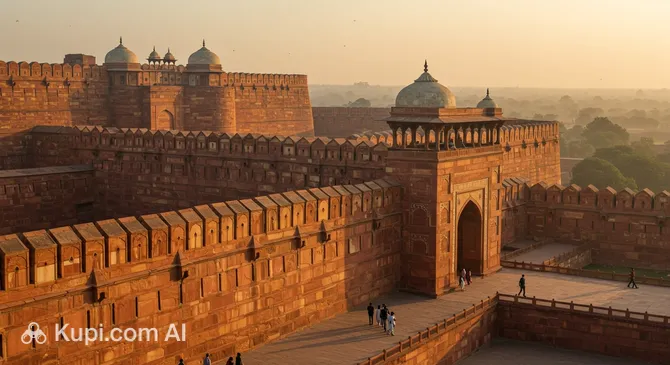
Agra Fort. Illustration.
Source: Kupi.com AI

Traveler photos:

The complex's architecture impresses with a harmonious blend of Islamic and Hindu traditions. Hidden within the fortress walls are luxurious palaces, mosques, and well-kept gardens. Many halls are decorated with exquisite inlay of gold and precious stones, while white marble pavilions create a striking contrast with the rugged outer walls. As a UNESCO World Heritage site, the fort remains one of the most significant symbols of the Mughal era.

Contacts

When planning a visit to the magnificent Agra Fort, be sure to check the latest information regarding access to the grounds. As this historical monument is managed by the Archaeological Survey of India, some operational details may change due to public holidays or restoration work.

It is recommended to check the current schedule and entrance ticket prices on the official website or directly at the entrance to ensure your visit is as comfortable as possible.

How to contactContact
AddressАгра Форт, Ракабгиндж, Агра, Уттар-Прадеш 282003, Индия
Phone+91 562 222 6431
Websitewww.tajmahal.gov.in

What to Do

A visit to Agra Fort turns into a fascinating journey through the centuries. Begin your exploration by passing through the massive Amar Singh Gate, whose winding design once served as a reliable defense against invaders. Once inside, be sure to look into the Jahangir Mahal to admire the fine stone carvings decorating its facades.

Special attention should be paid to the Khas Mahal—a white marble pavilion offering one of the best views of the Taj Mahal in the distance. Strolling through the Diwan-i-Am and inner courtyards, you can appreciate the craftsmanship of ancient jewelers whose semi-precious stone inlays still adorn the walls. The ideal time to visit is sunrise or sunset, when the soft lighting gives the red sandstone a magical glow.

Getting There

Getting to Agra Fort is quite simple, as it is located in the heart of the city of Agra in the state of Uttar Pradesh, India. The most convenient way to travel from Delhi is the Gatimaan Express high-speed train, which will take you to Agra Cantt station in just 1.5–2 hours, after which it’s only a 15-minute taxi or auto-rickshaw ride.

If you are already in the city, you can use Uber or local tuk-tuks. The main entrance for tourists is through the famous Amar Singh Gate. The fortress is only about 2 kilometers from the neighboring Taj Mahal, which can be covered in 20 minutes of leisurely walking or a few minutes by rickshaw.

For those who prefer organized trips, tour buses depart regularly from Delhi and Jaipur. On-site parking for private vehicles is also available; however, during peak hours, it is recommended to use a navigator to avoid traffic jams in the narrow streets of the old city.

Nearest city: Agra

History & Facts

The history of Agra Fort dates back to ancient times: the first mentions of a fortress at this site appear in records from 1080. However, it began to take its modern form in 1565, when Emperor Akbar the Great decided to move the capital to Agra and transform the old dilapidated fortress into an impregnable red sandstone citadel.

Later, in the 17th century, Akbar's grandson—the famous Shah Jahan—supplemented the fortress's austere appearance with elegant white marble palaces. It is said that the emperor spent his final years here, gazing from the window of his honorary prison at the masterpiece he created—the Taj Mahal. The best masters of the time worked on the interior decoration, including the famous architect Ustad Ahmad Lahauri.

Over the centuries of its existence, the complex has survived many rulers, evolving from a purely military facility into a symbol of Mughal imperial power. Today, the preserved portion of the structures, recognized as a UNESCO World Heritage site, allows one to imagine the scale of life at the Mughal court, which once occupied hundreds of buildings within these massive walls.

Time Needed

To explore all accessible corners of Agra Fort without rushing, it is recommended to set aside 2 to 3 hours for your walk. This is enough time to see the main palace complexes, take atmospheric photos, and enjoy panoramic views of the Yamuna River.

If you plan to combine a tour of the fortress with a visit to the Taj Mahal, it is better to allocate a full daylight day for both attractions. Keep in mind that using a guide or an audio guide may increase your stay time but will make your introduction to the fortress's history much deeper and more interesting.

Working Hours

The majestic Agra Fort opens its gates to visitors daily from sunrise to sunset (approximately from 6:00 AM to 6:00 PM). This allows you to see the ancient walls in the rays of the rising sun when the red stone looks most impressive and there are no large crowds of tourists yet.

It is important to note that access to the grounds may be closed or restricted on Fridays. Before your trip, it is recommended to double-check the current schedule on the official website or when buying tickets online, as operating hours may be slightly adjusted depending on the season and public holidays.

Nearby

The surroundings of Agra Fort are literally steeped in history, and continuing your walk beyond its walls will allow you to dive even deeper into the atmosphere of the great empire. Nearby are such architectural gems as the elegant Shish Mahal, known for its unique "glass" decor, and the picturesque Anguri Bagh gardens, where members of the imperial family once strolled.

It is also worth paying attention to the Jahangir Mahal, which demonstrates a wonderful synthesis of architectural styles, and the ancient shrines of the city. Such close proximity to many iconic monuments makes this area an ideal place for a packed full-day cultural program.

NameDistance
Agra Fort0 km
Shish Mahal (Glass Palace)0.2 km
Anguri Bagh0.2 km
Jahangir Palace0.3 km
Amar Singh Gate0.4 km
Chhatrapati Shivaji Maharaj Memorial0.5 km
Shri Mankameshwar Temple0.6 km

Reached the end of the page?

That means the route is fully explored