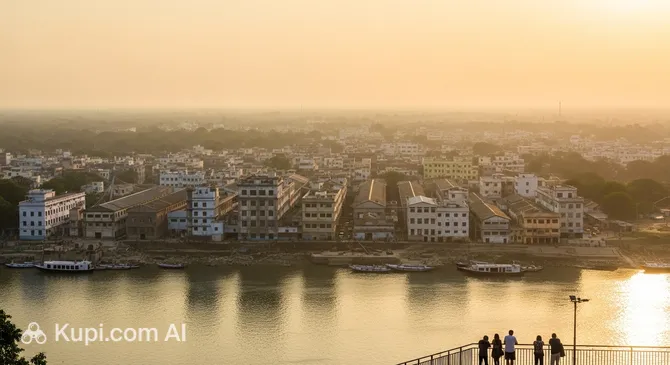
Located on the eastern bank of the Hooghly River, Bhatpara is a colorful industrial suburb in the state of West Bengal. As part of the vast Kolkata metropolitan area in India, the city harmoniously combines a dynamic working pace with deep spiritual traditions. With a population of approximately 386,019, it serves as an important hub for the regional economy and culture.
Bhatpara. Illustration.
Source: Kupi.com AI
Delving into the history of the city, one discovers that its name originates from "Bhatta-Palli," referring to an ancient settlement of Brahmin pandits. Historically, the city flourished as a vital center for Sanskrit learning. The spirit of old traditions still lingers along the banks of the Hooghly, and the municipality, established back in 1899, preserves the memory of Bengal's early industrial era.
The modern face of the city is largely defined by its jute, cotton, and paper mills. Although Bhatpara is not a typical tourist resort, it attracts travelers with its authentic atmosphere, lively markets, and the opportunity to see the real, unvarnished life of industrial India. We recommend visiting this city for those seeking a deep immersion into the daily life and traditions of the Bengali region.
Weather Overview
The climate of Bhatpara is typical for the tropical regions of West Bengal. There is a clear division into three seasons: a hot summer, a humid monsoon, and a mild winter. During the summer months, especially April and May, temperatures can rise to +35...40°C, and the proximity to the Hooghly River creates a high humidity effect, making being outdoors during the day quite tiring.
The monsoon period lasts from June to October and brings heavy rains. The maximum precipitation occurs in July and August (over 300 mm per month). During this time, the weather in the city becomes unpredictable, and downpours may be accompanied by strong gusts of wind. Winter in Bhatpara (November–February) is the most pleasant time to visit: the average temperature is around +19...22°C, and the days are dry and sunny.
If you are planning a trip, we recommend checking the city climate in advance to choose your wardrobe correctly. Also, keep in mind that due to the high concentration of industrial plants, smog may occur on windless days, which people sensitive to air quality should take into account.
Average monthly temperature
Average monthly precipitation
Interesting Facts
The name of the city Bhatpara comes from the Sanskrit term "Bhatta-Palli," where "Bhatta" denotes a community of scholarly Brahmins and "palli" means a settlement.
The city's municipality is one of the oldest in West Bengal: it gained independent status in 1899 after separating from neighboring Naihati.
The city has an extremely high population density, exceeding 11,000 people per square kilometer, which is typical for the industrial suburbs of Kolkata.
Bhatpara long held the status of one of the world's centers for the jute industry, which formed the foundation of the region's economic prosperity during the colonial period.
The literacy rate of the city's population is nearly 85%, which is significantly higher than the national average, highlighting a historical tradition of respect for education.
How to Get There
The transport accessibility of Bhatpara is based on its proximity to Kolkata. The primary way to get here is by rail. The city is served by stations on the Sealdah–Ranaghat line, and the journey from central Kolkata (Sealdah station) takes about 1–1.5 hours. It is also convenient to use the station in neighboring Naihati, which is a major railway junction.
Station
Passenger traffic
Distance
Howrah railway station
21
30 km
Jashore Junction railway station
5
90 km
Durgapur railway station
7
131 km
Rajshahi Railway Station
3
170 km
Dhanbad Junction railway station
8
226 km
For those who prefer air travel, the nearest air hub is Netaji Subhash Chandra Bose International Airport (IATA: CCU). It is located approximately 50 kilometers to the south. A taxi ride from the airport to Bhatpara can take anywhere from 1.5 to 2.5 hours due to heavy traffic on the NH12 highway, so it is wise to plan for extra time.
More detailed information on routes and schedules can be found on the how to get to Bhatpara page. In addition to trains and taxis, numerous buses run between the suburbs, and river crossings over the Hooghly connect the city with the west bank, specifically with Chandannagar.
Main Attractions
The city of Bhatpara is a place where the daily life of the locals becomes the main attraction. You won't find grand palaces here, but there is the vibrant energy of markets and industrial quarters. One of the city's key features is its Hooghly River waterfront. A stroll along the bank allows you to see traditional boats and observe rituals that have remained unchanged for centuries.
The city's cultural heritage is closely linked to historical Sanskrit schools known as tols. While many no longer function on their former scale, the presence of these traditions in the architecture and lifestyle of the old quarters serves as a reminder of the city's status as an "ancient center of learning." Exploring these quiet corners helps provide a better understanding of the region's intellectual past.
Industrial zones, particularly the old jute mills, are also of interest to tourists. These monumental structures from the Victorian era and the early 20th century stand as monuments to India's industrial progress. Additionally, Bhatpara serves as an excellent transit point for those heading to the river ferries that lead to colonial Chandannagar on the opposite bank.
Local Cuisine
The gastronomy of Bhatpara is a classic embodiment of Bengali cuisine, where the gifts of the Hooghly River take center stage. The main dish you must try is macher jhol—a fragrant fish stew in a spicy sauce of mustard oil and spices, served with steaming white rice. Rice and dal (lentil soup) form the basis of the locals' daily diet.
Street food thrives in the city thanks to the large number of workers. At every turn, you can find stalls offering samosas, chaat, and the famous Bengali phuchka—crispy hollow balls with a spicy filling. The most popular drink is cha (tea) with milk and sugar, which in Bengal is often served in small clay cups called "bhar."
For those with a sweet tooth, Bhatpara offers legendary Bengali desserts such as delicate rosogulla and thick mishti doi yogurt. Most dining establishments are simple eateries and family cafes in the markets. Despite the lack of high-end restaurants, the food here is characterized by authentic flavors and affordability, making a gastronomic introduction to the city truly sincere.
Travel Tips
When planning a visit to this dynamic industrial center, check out our tips to help make your trip more comfortable and safe.
Clothing and essentials: Choose light clothing made of natural cotton, as it is almost always hot and humid here. When visiting religious sites or old quarters, it is recommended to cover your shoulders and knees. Be sure to bring comfortable closed shoes for walking through densely built-up areas.
Transport: Use suburban trains for travel between towns, but avoid peak hours (morning and evening) when the carriages are overcrowded. Inside the city, it is most convenient to get around by auto-rickshaws after agreeing on a price, or by ordering a taxi via apps.
Finances: The main currency is the Indian Rupee (INR). Shops and markets only accept cash. ATMs are available in central parts of the city, but international cards may be unreliable, so keep a supply of cash on hand.
Health and safety: Drink only bottled water and avoid drinks with ice from street stalls. After dark, it is best to avoid walking in industrial zones and slum areas.
Communication: The main language is Bengali, though many understand Hindi. English is common in administrative offices and among the youth, but basic phrases or gestures may be needed in market stalls.
Local etiquette: Greet people with a slight bow or the traditional "Namaste." Always ask for permission before photographing locals or the interiors of temples.
What to avoid: Do not engage in long discussions on the street and try not to display expensive gadgets or large amounts of money in crowded places to avoid attracting pickpockets.
Seasonality: During the monsoon season (June–October), roads can flood, paralyzing traffic. Plan your visit for the winter months (November–February) when the weather is most pleasant.
May your introduction to the real India in Bhatpara be rich and memorable!
Entertainment & Nightlife
In the city of Bhatpara, classic Western-style entertainment is practically non-existent, as it is primarily a working-class and residential area. Local activity after sunset is centered around bustling street markets and small cafes. The evening atmosphere is filled with the sounds of urban hustle and the aromas of spices from food stalls, creating the unique character of a densely populated suburb.
For vibrant nightlife, cinemas, and modern bars, travelers usually head to neighboring Naihati or Barrackpore, or more often, directly to Kolkata, which can be reached in about an hour. However, during major religious festivals like Durga Puja, Bhatpara is transformed: the streets are decorated with lights, temporary pavilions (pandals) are built, and festive processions are held.
For daytime relaxation, residents use local public spaces and the riverfront. General safety in the city is at an acceptable level, but for night travel, it is recommended to use taxis (Uber or Ola) and avoid walking alone in poorly lit industrial zones or slum areas.
Parks & Museums
Due to the extremely dense industrial development and its status as a working suburb, Bhatpara does not have extensive park areas. Nevertheless, the banks of the Hooghly River serve as a natural space for walks and outdoor relaxation. Local squares near the municipal administration buildings are the main gathering points for residents in the shade of the trees.
The city does not have its own large museums; however, its rich history of Sanskrit learning is a living monument in itself. Travelers will find it interesting to walk through the old quarters in search of traditional schools—tols—whose architecture reflects the spirit of bygone eras. The city's cultural heritage is manifested more in its street life and religious structures than in museum exhibits.
To visit full-fledged amusement parks or historical galleries, visitors usually head to neighboring areas. Proximity to Naihati allows for visits to memorial sites associated with Bengali literature, while a short trip to Kolkata opens access to world-class museums and extensive botanical gardens. Bhatpara residents often use river transport to reach greener zones on the west bank of the river.
Getting Around
The transport system in Bhatpara is fully integrated into the transport network of the Kolkata metropolitan area. The main artery is the railway: suburban trains on the Sealdah North line are the fastest and most reliable way to get around. Bhatpara and Kankinara stations are always crowded, especially during peak hours when workers are commuting to or from their shifts.
Within the city itself, the primary means of transport are auto-rickshaws and more modern electric rickshaws (e-rickshaws), which skillfully maneuver through narrow alleys. Buses also run, connecting the city with neighboring Naihati and Barrackpore. The cost of public transport is extremely low, but tourists should be prepared for a lack of comfort and significant crowding.
For more convenient trips, it is recommended to use ride-hailing apps like Uber or Ola, which operate reliably in the area. Walking can be difficult due to the high density of buildings and the lack of sidewalks in many places. However, river ferries across the Hooghly remain a popular and scenic alternative for crossing to the other side, offering a way to avoid road congestion.
Accommodation
Hotel infrastructure in Bhatpara is underdeveloped, as the city is primarily oriented toward the industrial sector. Travelers rarely stay here for long, preferring to use the city as a transit point. Most available options are modest guest houses and apartments aimed at specialists visiting local factories for business.
Accommodation prices in local "guesthouses" start from 1,000–3,000 Indian Rupees per night. The main lodging options are concentrated in the municipal area or near the Hooghly riverfront. If you are looking for comfortable international-standard hotels with a full range of services, we recommend booking accommodation in Kolkata or more developed neighboring areas like Barrackpore.
When planning a trip during festival periods, especially Durga Puja, even the few spots in guest houses may be occupied. In such cases, it is worth booking in advance through popular Indian online services. For a short-term visit, it is most convenient to choose accommodation near the railway station to allow for quick travel around the region.
Nearby Cities
The city of Bhatpara is an excellent starting point for exploring the historical suburbs along the Hooghly River. Just a few kilometers away is Naihati, known for its temples and as the birthplace of Bankim Chandra Chattopadhyay, the author of India's national song. Also very close is Shyamnagar, which offers the peaceful atmosphere of the Bengali countryside.
For fans of colonial architecture, Chandannagar, located on the opposite bank of the river, is a must-visit. This former French colony preserves elegant promenades and Catholic cathedrals. It is also worth visiting Hooghly-Chinsurah, where you can see traces of Dutch and Portuguese influence, and Bhadreshwar, famous for its ancient temples.
Exploring these surroundings will allow you to see the diversity of West Bengal's cultural layers: from British industrial heritage to French charm and ancient Indian traditions. Most of these towns are within a 5–15 minute train or ferry ride, making them ideal for day trips.
Shopping & Souvenirs
Shopping in Bhatpara is primarily about visiting the noisy and vibrant local markets that stretch along the main streets and near the railway stations. You won't find massive air-conditioned malls here, but there is an abundance of daily essentials and locally produced goods. Special attention should be paid to textiles and traditional jute products manufactured at local mills.
The main shopping areas are concentrated around the municipal squares and at the Kankinara market. It is an ideal place to purchase fresh spices, tea, or everyday Indian clothing at very affordable prices. If you are interested in cultural heritage, look for stalls with books in Sanskrit or Bengali—they serve as a reminder of the city's status as a center of enlightenment.
As souvenirs from Bhatpara, it is worth bringing back Bengali sweets in sealed packaging or items made from coconut fiber and jute. Shops generally operate from morning until late evening with a lunch break, and most points only accept cash in Rupees. To visit large malls with international brands, it is best to take a quick trip to Kolkata.