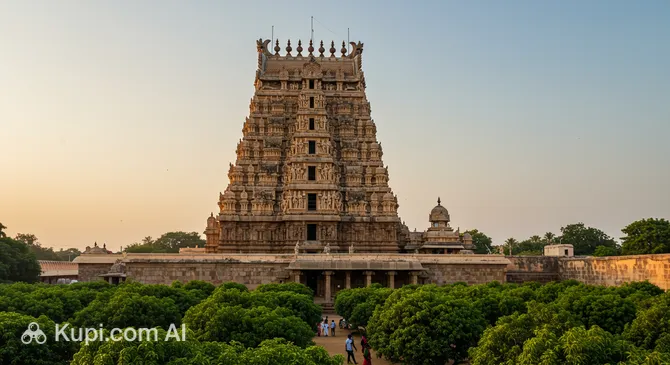
The Ekambaranathar Temple, also known as Ekambareswarar, is one of the most significant landmarks in Kanchipuram and a major Shaivite shrine in all of South India. This grand complex dedicated to Lord Shiva is the largest in the city, covering an area of about ten hectares. It attracts pilgrims and tourists with its majestic architecture and unique spiritual atmosphere.
The temple's hallmark is its impressive white gopuram towers, the tallest of which rises nearly 60 meters. The architectural ensemble is unique: it contains no right angles, and the towers are not parallel to each other, giving the complex a distinctive and picturesque look. Among other structures, the majestic hall with a thousand pillars stands out.
Ekambaranathar Temple. Illustration.
Source: Kupi.com AI
Traveller photos:
Inside the temple, devotees worship Shiva in the form of the Earth Lingam (Prithvi Lingam)—one of the five main lingams symbolizing the natural elements. Another gem of this site is the ancient sacred mango tree, which tradition holds is over 3,500 years old. Legend says the tree has four branches representing the four Vedas, with each bearing fruit of a different taste. This tree is considered sacred and is an integral part of the temple's history.
Contacts
To plan your visit, check worship schedules, or obtain other information, it is recommended to contact the temple administration directly. Below are the primary contact details.
A visit to the Ekambaranathar Temple is an immersion into the spiritual and architectural treasury of South India. Guests can begin their visit by admiring the majestic gopurams and then stroll through the spacious inner courtyard. Here, you'll find the famous thousand-pillar hall (Aayiram Kaal Mandapam), where every pillar is decorated with unique carvings, and the sacred temple pond. Walking through the grounds allows you to fully appreciate the scale and beauty of Dravidian architecture.
One of the main goals for pilgrims and tourists is to visit the sacred mango tree, believed to be over 3,500 years old. According to legend, its four branches symbolize the four Vedas, and the fruit on each has a different taste. It is believed that this ancient tree can grant wishes and health. In the heart of the temple, visitors can pay their respects at the main shrine of the Earth Lingam (Prithvi Lingam), one of the five sacred lingams representing the elements.
The Ekambaranathar Temple is not just an architectural monument but a living spiritual center. Visitors can witness daily rituals and pujas (worship ceremonies) held several times a day. Particularly vivid impressions can be gained during temple festivals, which are filled with music and ancient rites. Additionally, there is a separate shrine dedicated to Goddess Kamakshi on the complex grounds, offering a deeper look into the rich religious traditions of Kanchipuram.
Getting There
The Ekambaranathar Temple is conveniently located in the very heart of Kanchipuram, making it easily accessible for pilgrims and tourists alike. The city itself is situated approximately 70 kilometers southwest of Chennai (formerly known as Madras), a major transportation hub in South India. Travelers can reach Kanchipuram from Chennai in several ways: by train, regional bus, rental car, or taxi. The journey typically takes between one and a half to two and a half hours, depending on the chosen mode of transport and traffic conditions.
Once you arrive at Kanchipuram’s train station or bus terminal, reaching the temple is simple. The most convenient and popular way to get around the city is by local transport, such as an auto-rickshaw or taxi. The ride to the Ekambaranathar Temple takes just a few minutes, as it is located in the central part of the city. Since the city is well-oriented towards welcoming guests and pilgrims, most drivers know the way to this major shrine perfectly.
Nearest city: Kanchipuram
History & Facts
The history of the Ekambaranathar Temple spans many centuries and reflects the succession of powerful South Indian dynasties. Its construction began during the Pallava dynasty, while the grand complex reached its final form only in the 17th century. This lengthy construction period explains the remarkable variety of architectural styles and the characteristic asymmetry of its structures. Over the centuries, many rulers contributed to the expansion and decoration of the shrine, including notable figures such as Kulothunga III and Maharaja Krishnadevaraya.
The name and spiritual essence of the temple are inextricably linked to a beautiful legend. Tradition has it that Goddess Kamakshi, an incarnation of Parvati, wishing to receive Shiva's blessing, fashioned a lingam directly from the earth beneath a sacred mango tree. It was here, in the shade of this tree, that Shiva appeared to her and accepted her devotion. This story explains why the temple is dedicated to Shiva in the form of the Earth Lingam and why the ancient mango tree on its grounds is revered as one of the main holy sites.
Beyond its architectural and mythological value, the temple holds deep philosophical significance for all of India. Its history is closely intertwined with the name of the great sage and reformer Adi Shankaracharya. It is believed that he revived the traditions of Mother Goddess worship in Kanchipuram and established a special mystical diagram—the Sri Chakra—within the temple. This yantra is still used in rituals today, highlighting the temple's status as one of the country's most important spiritual centers.
Time Needed
To fully appreciate the Ekambaranathar Temple, its architecture, and its shrines at a leisurely pace, it is recommended to set aside at least 2–3 hours. This will allow you to explore the vast complex without rushing, carefully examine the details of the majestic gopurams (towers), and see the unique carvings in the famous thousand-pillar hall. The temple covers a significant area, and a quick walk won't give you a full sense of its scale and beauty.
When planning your visit, keep in mind that some time will be spent visiting key spots within the complex. Be sure to leave enough time to see the ancient sacred mango tree, which legend says is several thousand years old, and to visit the main sanctuary with the Earth Lingam. If you wish to not just see the architecture but also soak in the spiritual atmosphere, try to catch one of the daily ceremonies (pujas), which may also extend your stay. While an hour might suffice for a quick look, a longer visit is better for a deeper immersion.
Working Hours
The Ekambaranathar Temple is open to visitors daily, but it is important to note that there is a break in the middle of the day. Usually, the temple doors are open from 6:00 AM until 12:30 PM, after which it closes. It reopens at 4:00 PM and remains open until 8:00–8:30 PM. These hours may change during major festivals, so it is recommended to check the current schedule on the official website or at local information centers before your visit.
Generally, no special booking or ticket purchase is required for a standard visit—entry is free for everyone. The temple is active year-round; however, for a deeper immersion into its spiritual life, you might plan your visit during one of the daily pujas (ceremonies) or major annual festivals, such as Panguni Brahmotsavam, which takes place in March or April.
6:00 – 12:30, 4:00 – 20:30
Nearby
Visiting the Ekambaranathar Temple is just the beginning of your journey through the incredible Kanchipuram, often called the "City of a Thousand Temples." Exploring its surroundings allows you to dive deeper into the rich history and spiritual atmosphere of South India. Many significant shrines and points of interest are within walking distance, making them a perfect addition to your trip.
To help you plan your itinerary, we have compiled a list of attractions located near the Ekambaranathar Temple. All of them are close enough to reach on foot or by a short trip via local transport.