Support

Kanyakumari Amman Temple

About

Kanyakumari Amman Temple, also known as the Kumari Amman Temple, is an ancient Hindu temple located at the southernmost tip of the Indian peninsula in the city of Kanyakumari. This is a landmark location where the waters of three seas meet: the Arabian Sea, the Bay of Bengal, and the Indian Ocean. The temple is dedicated to the goddess Devi Kumari (Kanya Amman), who is worshipped as an incarnation of the goddess Parvati and is a symbol of purity and strength.
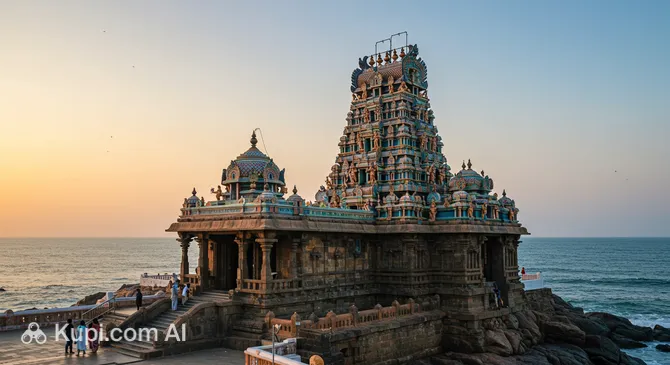
Kanyakumari Amman Temple. Illustration.
Source: Kupi.com AI

Traveler photos:

The temple is built in the traditional Tamil architectural style and occupies a special position at the very tip of Cape Kanyakumari. Inside, visitors are greeted by coolness and dim light. The columns are decorated with intricate stone statues of women whose joined palms serve as unique lamps. In the depths of the sanctuary lies a beautiful image of the goddess, who, according to belief, grants hope to all who come to her feet.

One of the temple's main features is that it is built around a section of rock on which a human footprint is clearly visible. Legend has it that this is the footprint of the Virgin Kumari herself, who stood here waiting for her beloved. Kanyakumari Amman Temple is an important pilgrimage center for Hindus and attracts many tourists from around the world who wish to experience its holiness and enjoy the unique atmosphere of this sacred place.

Contacts

For the most up-to-date information regarding Kanyakumari Amman Temple's opening hours, potential tours, or special events, it is recommended to visit the official website (if available) or contact local tourist information centers in Kanyakumari. Detailed information can often be found on India's tourism portals.

How to contactContact
Address3HH2+P9H, Temple Rd, Kanniyakumari, Tamil Nadu 629702, India

What to Do

A visit to Kanyakumari Amman Temple offers guests a unique opportunity to experience ancient Hindu traditions. Believers and tourists can participate in rituals and ceremonies, pay homage to the goddess Devi Kumari, and, according to belief, receive her blessing. Inside the temple, you can explore its architectural features: notice the intricately crafted columns with stone statues of women serving as lamps and, of course, the beautiful image of the goddess located deep within the sanctuary.

One of the temple's main shrines and attractions is the footprint on the rock, which, according to legend, was left by the goddess Devi Kumari herself. The temple's unique location on the cape where three seas meet—the Bay of Bengal, the Arabian Sea, and the Indian Ocean—makes it a very special place. Many pilgrims and tourists aim to watch the sunrise here, seeing the sun rise from behind the temple, which is considered an especially auspicious moment. Walking along the beach near the temple, you can find multicolored pebbles—according to legend, these are grains of rice scattered by the goddess that turned into stone.

Beyond the temple itself, it is worth paying attention to nearby sites. Close by, on a neighboring islet, stands the impressive 40-meter statue of the Tamil poet-saint Thiruvalluvar. The monument was inaugurated on January 1, 2000, and its height—133 feet—symbolically corresponds to the number of chapters in his famous literary work, the "Thirukkural." Visiting the statue is a wonderful addition to a tour of the temple complex.

Getting There

Kanyakumari Amman Temple is majestically located in the city of Kanyakumari, at the southernmost tip of the Indian peninsula. This sacred site can be reached in several ways, making it accessible to pilgrims and tourists from all corners of the country and the world.

For travelers preferring air travel, the nearest international airport is in Trivandrum (Thiruvananthapuram), approximately 90 kilometers from Kanyakumari. From the airport, you can comfortably reach the city by taxi or by using regular bus services. This journey itself can be a delightful introduction to the picturesque landscapes of southern India.

The city of Kanyakumari also has excellent rail connections. Trains arrive here from major Indian metropolises such as Mumbai, Delhi, Chennai, and Bangalore, making rail travel a convenient option for many. Additionally, there is a well-developed network of bus routes linking Kanyakumari with nearby cities in the states of Tamil Nadu and Kerala. Regular buses offer both budget-friendly and more comfortable travel options.

Upon arrival at the Kanyakumari railway station or bus terminal, reaching the Kanyakumari Amman Temple itself is quite simple. The temple is located in the central part of the city, right on the tip of the cape, so it can be reached on foot while enjoying the sea breeze, or you can use the services of local rickshaws for a quick and colorful ride.

Nearest city: Kanyakumari

History & Facts

Kanyakumari Amman Temple, located at the southernmost point of India in the city of Kanyakumari, is steeped in ancient legends and rich history. Its origins are inextricably linked with the legend of the goddess Devi Kumari. According to one of the most famous legends, the beautiful goddess waited here in her wedding attire for her betrothed, Lord Shiva. However, the demon Vanasura, enchanted by her beauty, tried to take her as his wife by force. Devi Kumari fought and defeated the demon. Out of grief and disappointment that Shiva never appeared, she scattered the wedding feast; according to legend, the rice that fell on the sand turned into the multicolored pebbles that can still be found on the coast today.

There is another version of the legend explaining why the goddess remained a virgin (Kanya). According to this tradition, Lord Shiva himself set out from this place to marry Kanyakumari Amman. However, along the way, he heard a rooster's crow, which was taken as an unfavorable omen, and Shiva returned. Thus, Goddess Kumari remained an eternally young maiden waiting for her beloved, and she is worshipped in this form, giving her name to both the city and the temple.

The temple itself, dedicated to the goddess, was erected, according to various sources, in the 8th century, though some sources point to the 12th-13th centuries when the rulers of the Pandya dynasty built the structure around an existing statue of the goddess. Built in the traditional Tamil architectural style, the temple has been a major pilgrimage center for Hindus for many centuries. Its unique location on the cape, where the waters of the Arabian Sea, the Bay of Bengal, and the Indian Ocean merge, gives this place a special sacred significance, attracting believers and tourists from all over the world who wish to experience the ancient shrine.

Time Needed

To fully enjoy a visit to the Kanyakumari Amman Temple, the average visitor is recommended to set aside 1 to 2 hours. This time is generally sufficient to explore the temple itself, study its unique architectural features, and, if desired, participate in ongoing rituals. Additionally, during this time, you can appreciate the temple's special location at the picturesque junction of three seas, which is an impressive sight in its own right.

Many travelers strive to visit the temple at dawn to catch the sunrise, which looks particularly mesmerizing from here and is considered an auspicious moment. If you plan to witness this natural wonder, it is worth arriving at the site about 30-40 minutes before sunrise. Keep in mind that this will add to the total time of your visit.

Also, bear in mind that if your plans include visiting other nearby attractions, such as the famous Thiruvalluvar Statue, additional time will be required. Therefore, when planning your day in Kanyakumari, allow for a sufficient time buffer to explore all the sites of interest without rushing.

Working Hours

Kanyakumari Amman Temple, like many Hindu temples, is typically open to visitors during specific hours in the morning and evening, with a break in the middle of the day. The exact schedule may vary depending on the day of the week, the season, and the performance of special rituals or festivals. Generally, temples open early in the morning, around 4:00-5:00 AM, and close for a midday break from approximately 12:00 PM to 4:00 PM, after which they reopen until the evening, around 8:00-9:00 PM.

It is strongly recommended to check the current operating hours immediately before your visit on the temple's official website (if available), at local tourist information centers, or at your hotel in Kanyakumari. Usually, no prior booking is required to enter the main parts of the temple; however, during major festivals or for participation in special pujas (religious ceremonies), specific rules or restrictions may apply. The temple is generally open for visitors year-round.

4:30 – 12:30, 4:00 – 20:30

Nearby

A visit to Kanyakumari Amman Temple is undoubtedly a highlight of any trip to Kanyakumari. However, to fully experience the spirit of this amazing place and enrich your impressions, we recommend exploring other nearby attractions. Getting to know the surroundings will allow you to dive deeper into the culture and history of India, see more, and make your trip even more fulfilling.

Near the Kanyakumari Amman Temple, you will find several interesting sites that deserve your attention. Below is a list of some of them, along with their distances.

NameDistance
Kanyakumari Sunrise Viewpoint0.1 km
Triveni Sangam0.1 km
Mahatma Gandhi Memorial0.1 km
Southernmost Point of Mainland India0.2 km
Aqua World0.3 km
The Curry0.4 km
Thiruvalluvar Statue0.4 km

Have you reached the end of the page?

So the route has been studied inside and out