Support

Srimanthi Bai Memorial Government Museum

About

Imagine an elegant mansion whose silhouette resembles a majestic ship. This is the Shreemanthi Bai Memorial Government Museum — a unique cultural space located in the Bejai district of Mangalore. As the city's only museum, it offers guests an incredible journey through the ages, combining the history of ancient civilizations with the personal treasures of its founder.
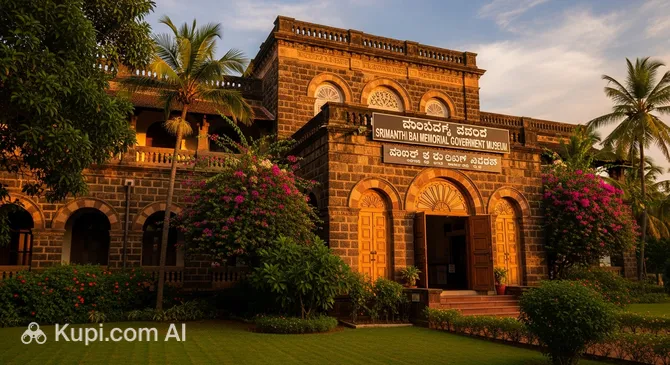
Srimanthi Bai Memorial Government Museum
Srimanthi Bai Memorial Government Museum. Иллюстрация. Источник: Kupi.com AI

The museum building itself is an architectural monument: it was built in 1935 as the private residence of Colonel V.R. Mirajkar, based on a design inspired by Milanese style. In 1955, the owner donated his home and a rich collection of antiques to the state government to commemorate his mother. Since then, this treasure trove in India has become home to rare archaeological and geological artifacts.

Today, the museum is divided into thematic zones: the ground floor is dedicated to ancient eras and the history of the Tulunadu region, while the first floor houses fascinating items brought by the Colonel from Europe, Africa, and Asia. Visitors are greeted not by a strict academic environment, but by the cozy atmosphere of a private home, where every exhibit feels like a part of a living family history.

Contacts

For those planning a visit to this cultural corner of the city, below is the essential contact information. The museum is managed by the Directorate of Archaeology and Museums of Karnataka.

How to contactContact
AddressVRPX+QFV, Бежай, Мангалуру, Карнатака 575004, Индия
Websitearchaeology.karnataka.gov.in

What to Do

A walk through the museum's halls turns into a real exploration of cultural heritage. On the ground floor, be sure to notice the collection of Tulunadu artifacts: mysterious Bootharathane idols, ritual masks, and antique metalware are on display here. Archaeology enthusiasts will be impressed by Paleolithic and Neolithic tools, as well as accurate replicas of finds from the famous settlements of Mohenjo-Daro and Harappa.

Upon heading to the first floor, you will find yourself in a world of amazing rarities from around the globe. Colonel Mirajkar's personal collections are gathered here: from the finest Chinese porcelain and ivory products to antique musical instruments and curious lighters from various parts of Europe. Both children and adults will surely enjoy the special section featuring dolls for traditional Yakshagana performances and detailed models of boats and planes.

Don't forget to step out into the museum's courtyard. In the open air among the greenery, you'll find stern hero stones (sati-stones), ancient inscriptions in Tulu and Kannada languages, and impressive 14th–16th century cannons brought from Jamalabad Fort. This spot is perfect for taking a pause and reflecting on the fleeting nature of time, surrounded by silent witnesses of history.

Getting There

Finding the museum is easy: it is located in the quiet district of Bejai, slightly away from the main thoroughfares. If you are in the city center, a ride by taxi or autorickshaw will take only 10–15 minutes. For those who prefer public transport, city buses to the Bejai stop are suitable, from which you will need to walk for about 5–10 minutes, following the signs.

Travelers arriving from other regions should note that the distance from Mangalore Airport is approximately 15 kilometers (about a 30-minute drive), and from the central railway station, it is about 5 kilometers. Thanks to its convenient location, a visit to the museum can easily be combined with a walk around the neighborhood and visits to nearby temples.

Ближайший город: Mangalore

History & Facts

The history of this place is inextricably linked with the personality of Colonel V.R. Mirajkar, a distinguished surgeon and local native who served in the British Indian Army. During his service in Lahore, he was so impressed by the local architecture that he decided to build an exact replica of a bungalow he had seen in his native Bejai. Erected in 1935 based on a Milanese design, this house became not just a residence, but a repository for a vast collection of antiques that the colonel had gathered during 40 years of world travel.

In 1955, Colonel Mirajkar made a noble gesture by donating his estate and all its accumulated treasures to the government of Karnataka. His only condition was that the museum be named after his mother — Shreemanthi Bai. The official opening took place on May 4, 1960, and since then, the building has served as an important educational center connecting different eras and cultures.

Interestingly, the colonel himself was known not only for his passion for collecting but also for his exceptional kindness: he treated poor patients free of charge, for which he was honored with high awards. Today, the museum preserves an atmosphere of personal legacy, where every exhibit — from British East India Company coins to 2nd-century stone idols — reflects the creator's deep respect for the history of ancient civilizations.

Time Needed

For a leisurely stroll through all three floors of the mansion and to view the outdoor exhibits in the garden, 1–2 hours is sufficient for most visitors. This time is quite enough to appreciate both Colonel Mirajkar's personal collection and the region's archaeological finds.

If you are an art lover, a history student, or simply enjoy studying ancient manuscripts and photographs in detail, we recommend allowing about 2.5 hours for your visit. The museum features a quiet and intimate atmosphere, which invites thoughtful contemplation without unnecessary haste.

Working Hours

The museum is hospitably open to visitors daily. The standard operating schedule is from 10:00 to 17:30. The museum welcomes guests throughout the week, including weekends.

Despite the stable schedule, it is recommended to check the official website of the Karnataka Department of Archaeology before your visit, as opening hours may vary slightly on holidays. The best time to visit is in the morning when the halls are particularly quiet and cool.

10:00–17:30

Nearby

Exploring the area around the museum allows you to dive deeper into the city's atmosphere and find interesting locations for relaxation. The surroundings of Bejai offer both educational sites and family entertainment, including aquariums and water parks.

NameDistance
Kadri Manjunatha Temple0.8 km
Mixx - The Lounge Bar1.3 km
K9 Restro1.4 km
Froth On Top1.5 km
Big Bollywood Adda1.5 km
St. Aloysius Chapel1.5 km
Aloyseum1.5 km

Reached the end of the page?

That means the route is fully explored