Support

Shravanabelagola

About

Shravanabelagola is an incredibly atmospheric town located in southern India, in the state of Karnataka. It is situated approximately 120 kilometers west of vibrant Bangalore, nestled comfortably between two picturesque hills – Chandragiri and Vindhyagiri. From the peaks of these hills, breathtaking views of the green surroundings and snow-white temple domes unfold, while the town itself is permeated with tranquility and a special spiritual aura.
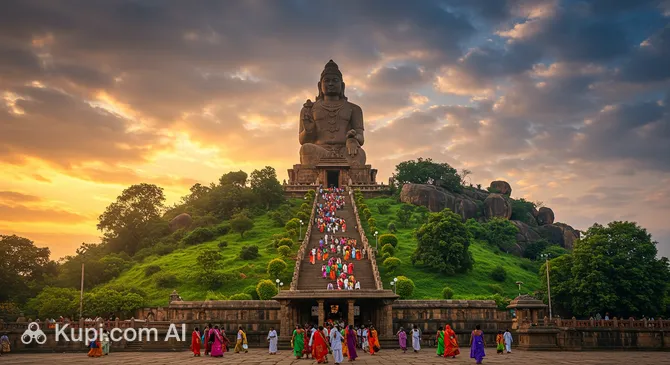
Shravanabelagola. Illustration.
Source: Kupi.com AI

Despite the fact that the population of Shravanabelagola is just over 10,000 people, making it more of a large village, its cultural and religious significance is immense. The town is one of the main centers of Jainism, an ancient Indian religion, and every year it attracts thousands of pilgrims and tourists from all over the world who wish to touch history and feel the energy of this unique place. Shravanabelagola is famous for its peaceful atmosphere: there is no city bustle here, only leisurely walks, contemplation of ancient temples, and the quiet ringing of bells.

The main magnets for visitors are the famous 18-meter monolithic statue of Bahubali (Gommateshwara), one of the tallest in the world, carved from a single block of granite. It is also worth climbing the ancient steps to the numerous temples located on the summits of Chandragiri and Vindhyagiri hills to gain a deeper understanding of the rich Jain culture and enjoy panoramic views. Don't miss the opportunity to try authentic South Indian cuisine and appreciate the hospitality of the locals.

Shravanabelagola is the perfect place for those seeking inspiration, striving for spiritual renewal, or simply wishing to enjoy authentic India away from noisy tourist routes. A visit to this town will give you unforgettable impressions and allow you to touch ancient wisdom.

You can find more interesting facts on the history of Shravanabelagola page.

Weather Overview

The weather in Shravanabelagola is characterized by high temperatures throughout the year. Expect a hot summer with peak temperatures in April (average maximum temperature around 33.0°C) and warm winters, where the average temperature in January is about 21.5°C. The main rainy season falls between May and October, with the highest rainfall and number of rainy days observed in July (average of 8 mm of precipitation and 26 rainy days). The driest months are January, February, and March, when precipitation is practically absent. For a more detailed forecast and monthly weather information, you can visit the Shravanabelagola's climate page.

Average monthly temperature

Average monthly precipitation

Interesting Facts

In addition to its world-famous shrines, Shravanabelagola holds many fascinating secrets and surprising details that make this ancient town even more attractive to curious travelers.

  • Shravanabelagola is home to the world's largest monolithic statue – the colossal 18-meter-high figure of Bahubali (Gommateshwara). This masterpiece was carved from a single rock in the 10th century, testifying to the incredible skill of ancient stone carvers.

  • Every 12 years, the town becomes the center of the grand Mahamastakabhisheka festival. During this unique ritual, the statue of Bahubali is ceremoniously bathed with milk, sandalwood paste, saffron, and floral infusions, attracting tens of thousands of pilgrims from all over the world.

  • Legend has it that Bahubali, to whom the famous statue is dedicated, was the son of Rishabha, the first Tirthankara (enlightened teacher). After winning a battle for the throne, he renounced worldly goods and spent years in meditation, becoming a symbol of non-violence and self-abnegation.

  • On the hills of Vindhyagiri and Chandragiri surrounding the town, dozens of ancient temples, bas-reliefs, and inscriptions in Sanskrit and the ancient Kannada language have been preserved. Many of these artifacts date back to the 10th–12th centuries and are priceless monuments of South Indian temple architecture and writing.

How to Get There

When planning a trip to the famous Gommateshwara statue, it is important to think through your route in advance. Shravanabelagola does not have its own airport, so most tourists arrive via neighboring major cities. You can find out more about how to get to Shravanabelagola and choose the most convenient option.

The main air gateway for travelers is Kempegowda International Airport (IATA: BLR), located in the metropolis of Bengaluru. This is the largest hub in the region, receiving flights from all over the world. The airport is approximately 139 km from Shravanabelagola. A taxi or intercity bus trip from here will take about 3.5–4 hours, depending on traffic. Thanks to the high passenger flow, Kempegowda International Airport offers an excellent selection of transportation services for transfers.

An alternative option could be Mangalore Airport (IATA: IXE), located in the coastal city of Mangalore at a distance of about 173 km. The journey from here to the destination will take a bit longer — approximately 4.5–5 hours by car. Mangalore Airport serves both domestic and some international flights, making it a convenient entry point for those traveling along the west coast.

For convenience, here is summary information on the main airports:

AirportPassenger trafficDistance
Kempegowda International Airport41.9 mln139 km
Kannur International Airport1.3 mln145 km
Shivamogga Airport161 000146 km
Mangalore Airport2.3 mln173 km
Calicut International Airport3.7 mln198 km

In addition to air travel, the town can be reached by land transport. Shravanabelagola has its own railway station, which connects the town with Bengaluru, Hassan, and Mysore. Bus connections are also well-developed: state and private buses regularly run from major cities in Karnataka, making the trip affordable and accessible.

Main Attractions

Shravanabelagola, located in the state of Karnataka, is one of the most important centers of Jainism in India and attracts pilgrims and tourists with its ancient temples and monumental structures. The town is steeped in history and spirituality, offering a unique experience of immersion into ancient culture.

The crowning jewel of Shravanabelagola is the colossal statue of Gommateshwara (Bahubali), situated atop Vindhyagiri Hill. This 17-meter monolithic statue, carved from a single block of granite in the 10th century, is considered one of the tallest free-standing statues in the world. It depicts the Jain saint Bahubali in a state of deep meditation. Every 12 years, the grand Mahamastakabhisheka festival takes place here, during which the statue is bathed in milk, turmeric, saffron, and other sacred substances, attracting millions of believers and curious travelers.

The climb up Vindhyagiri Hill to the base of the Gommateshwara statue is an impressive experience in itself. Visitors must navigate approximately 600 steps carved into the rock, from where breathtaking panoramic views of the surrounding countryside and the neighboring Chandragiri Hill unfold. In addition to the main statue, the hill is home to several smaller Jain shrines and temples.

Opposite Vindhyagiri rises Chandragiri Hill, which also holds immense historical and religious significance. According to tradition, it was here that Chandragupta Maurya, the founder of the Maurya Empire, spent the final years of his life practicing asceticism. Numerous ancient Jain temples (Basadis) are located on Chandragiri, dating from various periods starting as early as the 3rd century BCE. Notable among them are the Chavundaraya Basadi, Kattale Basadi, and Chandragupta Basadi. The hill is dotted with ancient inscriptions that are of great interest to historians.

Among other significant landmarks, Bhandari Basadi is worth mentioning – it is the largest Jain temple in Shravanabelagola, built in the 12th century. It is known for its impressive architecture and size. Also deserving of attention is the Akkana Basadi, built in the 12th century, featuring beautiful carved pillars and a shrine dedicated to the 23rd Tirthankara, Parshvanatha.

Local Cuisine

The cuisine of Shravanabelagola is a true reflection of the Jain philosophy that permeates every aspect of the town's life. Here, an exclusively vegetarian menu awaits you, where dishes are prepared without onion or garlic, with deep respect for all living beings. This is not just food, but an introduction to an ancient culture where every ingredient is chosen with special care.

Be sure to try the famous South Indian dishes, which are prepared here with exceptional skill. "Masala dosa" – a thin, crispy pancake with a spicy potato filling, "idli" – soft steamed rice cakes, and "uttapam" – a thick pancake with added vegetables, will be true discoveries. These dishes are traditionally served with aromatic chutneys and a thick lentil soup called "dal," as well as "sabzi" – various vegetable curries that reveal the richness of local spices.

Among beverages, the traditional Indian "masala chai" with milk and warming spices is particularly popular here. You can also always refresh yourself with freshly squeezed juices from local fruits. Don't miss the chance to try local sweets, often made with milk, coconut, and nuts – they make for a pleasant conclusion to any meal.

The gastronomic scene of Shravanabelagola is concentrated around small family cafes and lively street stalls, where you can experience the authentic atmosphere of the town. It is especially colorful during religious holidays when culinary fairs are held, offering dishes based on ancient recipes. Locals and pilgrims often choose these very places for their meals, enjoying freshly prepared food and the hospitality of the owners.

Every meal in Shravanabelagola is not just about satisfying hunger, but an immersion into a unique culture where food carries deep meaning and respect for nature. This is an experience that will pleasantly surprise even seasoned gourmets with its authentic taste and warm atmosphere.

Travel Tips

Welcome to Shravanabelagola! To ensure your journey to this significant center of Jainism in India goes smoothly and leaves only the best impressions, we have prepared some practical tips.

  1. Clothing and Essentials:

    The climate in Shravanabelagola is predominantly warm, so choose light, breathable cotton clothing. For visiting numerous temples and shrines, including the climb to the Gommateshwara statue, modest clothing is mandatory, covering shoulders and knees. You will have to remove your shoes before entering temples. Don't forget comfortable walking shoes (the climb to the main statue involves about 600 steps, which are navigated barefoot!), sunscreen, a hat, sunglasses, and repellent. A universal adapter for electronics might also be useful.

  2. Transportation in Shravanabelagola:

    Shravanabelagola is a small town, and its main attractions, especially the temple complexes, are best explored on foot. To travel longer distances or if you are arriving from other cities like Hassan, Bangalore, or Mysore, you can use local buses or hire an auto-rickshaw. Be sure to agree on the price of the rickshaw ride in advance. Renting a car within the town itself is unlikely to be necessary.

  3. Finances – All About Money:

    The local currency is the Indian Rupee (INR). It is recommended to exchange money in larger cities before traveling to Shravanabelagola or withdraw cash from ATMs there, as exchange facilities and the number of ATMs in the town itself may be limited. Credit and debit cards are not accepted everywhere, mostly in larger hotels. Always have sufficient cash with you. Tipping is not strictly mandatory but is always welcomed for good service (usually a small amount).

  4. Health and Safety Concerns:

    There are pharmacies in town with a basic range of medications. For more serious medical assistance, the nearest large city with developed infrastructure is Hassan. Be sure to have travel insurance. Shravanabelagola is considered a fairly safe pilgrimage site, but standard precautions against petty theft, especially in crowded places, won't hurt. Drink only bottled or purified water.

  5. Communicating with Locals:

    The official language of Karnataka state is Kannada. Some locals may understand Hindi. English is common among tourism sector workers but not universal. Learning a few simple phrases in Kannada, such as "Namaskara" (Hello) and "Dhanyavadagalu" (Thank you), will help you build a rapport with the locals. It's better to purchase a SIM card with internet access in a large city. Wi-Fi is available in some hotels, but do not count on its widespread availability.

  6. Local Etiquette and Traditions:

    Show respect for local customs and religious traditions. Greet people with a polite "Namaskara." In temples and holy places, behave quietly and follow all rules (e.g., removing shoes, not taking photos where prohibited). Jainism emphasizes the principle of Ahimsa (non-violence), so be mindful of the environment and living beings. Dress modestly, especially when visiting religious sites. Avoid public displays of affection.

  7. What to Avoid:

    Categorically avoid disrespectful behavior in religious places: do not wear revealing clothing, do not make noise, and do not touch shrines without permission. Also, avoid photographing people without their consent. Do not litter and be mindful of water use – these are important resources.

  8. Special Tip – Climbing to Gommateshwara:

    The climb to the monumental statue of Gommateshwara on Vindhyagiri Hill is a key experience in Shravanabelagola. It involves navigating over 600 stone steps barefoot. Start the ascent early in the morning to avoid the scorching sun and hot stones. Bring water with you. For those who cannot make the climb on their own, porter services with palanquins (doli) are available.

We hope these tips help you plan an unforgettable and spiritually rich journey to the ancient town of Shravanabelagola. Have a pleasant trip!

Entertainment & Nightlife

The town of Shravanabelagola, located in India, is one of the most important centers of Jainism and attracts pilgrims and tourists with its rich history and spiritual atmosphere. If you are planning a trip and are interested in entertainment, especially nightlife, it is important to understand the specific nature of this unique place.

In Shravanabelagola, you will not find the loud nightclubs, trendy bars, or bustling streets typical of large cities where nightlife thrives until morning. This town is primarily a place for spiritual practices, meditation, and connecting with ancient shrines. Evening life here is quiet and serene. As the sun sets, the town is enveloped in an atmosphere of silence, conducive to reflection and rest. Most visitors prefer to spend their evenings taking leisurely walks or revisiting the temples during the cooler hours when there are fewer tourists.

Regarding establishments, Shravanabelagola has small local restaurants and eateries where you can dine on traditional South Indian, predominantly vegetarian, cuisine. However, these places usually close relatively early and are not designed for nighttime entertainment. Unfortunately, there is no information available in the data regarding specific bars or nightclubs, which aligns with the predominantly spiritual and cultural character of leisure in this town. There are no specialized quarters or streets known for their nightlife activity here.

From a safety perspective, Shravanabelagola is generally considered a safe town, especially in the areas adjacent to the main temple complexes. Nevertheless, as with any journey, it is recommended to observe reasonable precautions, especially if you decide to walk late in the evening along less-lit streets. For transportation after dark, you can use the services of local auto-rickshaws, but it is better to agree on the fare in advance.

Daytime entertainment in Shravanabelagola is entirely focused on its rich religious and historical heritage. The main points of interest are the majestic statue of Gommateshwara (Bahubali) on Vindhyagiri Hill and the numerous ancient Jain temples, known as Basadis, on Chandragiri Hill. Exploring these unique monuments and studying their architecture and history takes up most of the visitors' time. There are no classic theaters, large modern art museums, or amusement parks in Shravanabelagola, as the town's focus is directed toward entirely different values.

Thus, if you are looking for a vibrant nightlife, Shravanabelagola will likely not meet your expectations. However, if your goal is immersion in ancient culture, spiritual searching, and contemplation of unique shrines in an atmosphere of peace, then the evenings here will grant you tranquility and unforgettable impressions.

Parks & Museums

Shravanabelagola, a sacred center of Jainism, offers visitors a unique blend of spiritual tranquility amidst picturesque natural landscapes and a rich cultural heritage embodied in its ancient monuments. Although there are no traditional urban parks or museums in the conventional sense, the very essence of the town and its surroundings provides many opportunities for contemplation and learning.

Green Zones and Natural Attractions:

The main natural landmarks of Shravanabelagola are two hills that serve not only as sites for shrines but also as natural viewpoints and zones for peaceful walks:

  • Vindhyagiri Hill: The larger of the two hills is famous for the colossal statue of Gommateshwara. The ascent up the hill, consisting of hundreds of steps carved into the rock, is rewarded not only by an encounter with this marvel of ancient sculpture but also by breathtaking panoramic views of the surrounding countryside. The hill itself, with its rocky outcrops and sparse vegetation, represents a rugged but impressive natural area.
  • Chandragiri Hill: Smaller in size but no less significant, Chandragiri is dotted with numerous ancient Jain temples (Basadis). A walk on this hill allows you to immerse yourself in an atmosphere of antiquity and tranquility, enjoying the views and studying the historical buildings in a more secluded setting.

Cultural Heritage and "Living Museums":

In Shravanabelagola, the role of museums is played by the ancient temples and structures themselves, each of which is a repository of history, art, and architecture:

  • Temple Complexes (Basadis): The numerous Basadis on Vindhyagiri and Chandragiri hills, such as the Chavundaraya Basadi, Chandragupta Basadi, and Kattale Basadi, are true treasure troves. Inside, you can see exquisite stone carvings, ancient inscriptions, and sculptures telling the rich history of Jainism in this region. Each temple is a separate page of history open for study.
  • Gommateshwara Statue (Bahubali): This monumental statue is an outstanding cultural heritage site in its own right, striking in its scale and craftsmanship. It attracts pilgrims and tourists from all over the world.
  • Jain Math: The local Jain monastery also plays an important role in preserving and promoting Jain culture, philosophy, and art. Although it is a functioning religious institution, it is often open to visitors interested in Jain heritage.

Authentic Experiences and Tips:

For a deeper immersion into the atmosphere of Shravanabelagola, try to visit the temples during rituals (pujas) to see living traditions. Do not rush; explore the lesser-known shrines and rock inscriptions – they can tell many interesting stories. Climbing the hills barefoot, as pilgrims do, can be a special experience, although it requires some preparation.

Getting Around

Getting around Shravanabelagola is fairly simple, given its compact size as a major pilgrimage center. The primary modes of transport for visitors are auto-rickshaws and walking, especially for accessing the main temple complexes.

While there may not be an extensive urban bus network like in major metropolises, local buses can be an option for reaching Shravanabelagola from neighboring towns or for a very limited number of routes within the town itself. Fares on these buses are usually paid in cash directly to the conductor or driver. It is best to inquire locally about routes and schedules, as they may be unofficial.

Auto-rickshaws are ubiquitous here and serve as the main type of individual transport. They are ideal for short distances, trips to your accommodation, or to the base of the two main hills – Vindhyagiri and Chandragiri. It is crucial to agree on the fare with the driver before starting the trip, as meters are not always used and bargaining is a common practice. Auto-rickshaws are generally available throughout the day, especially near popular sites.

A unique aspect of transport in Shravanabelagola, especially for the ascent to the famous Gommateshwara statue atop Vindhyagiri Hill, is the availability of "doli" (palanquins carried by porters). This service is available for visitors who might find it difficult to navigate the steep climb up several hundred steps. Of course, many pilgrims and tourists prefer to make the climb on foot. Similar considerations apply to reaching the temples on Chandragiri Hill.

For longer trips or if you prefer a private vehicle, taxis can sometimes be arranged, often through your hotel or local travel agents, although they are less common for getting around within the town compared to auto-rickshaws. Given the nature of Shravanabelagola, exploring the temple complexes and the immediate surroundings is often best done on foot, which allows you to fully immerse yourself in the atmosphere of this sacred place.

Accommodation

In Shravanabelagola, a well-known pilgrimage center, tourists will find accommodation options primarily geared toward pilgrims and travelers seeking an authentic experience. The range of housing includes mostly budget guesthouses, simple hotels, and Dharamshalas (specialized guest houses for pilgrims). There are few luxury resorts here; the emphasis is on functionality and affordability.

For convenience in visiting the main attractions, such as the famous Gommateshwara statue, it is recommended to choose accommodation in close proximity to the Vindhyagiri and Chandragiri hills. Most accommodation options are concentrated in this part of town, providing easy access to the temple complexes. Some travelers may also find homestay options, which allow for a deeper immersion into the local atmosphere.

While Shravanabelagola is not known for a large number of famous chain hotels, you can find several decent local hotels and numerous guesthouses offering both basic and more comfortable conditions. The main emphasis is on cleanliness and simplicity, which aligns with the spirit of this holy place.

It is crucial to book your accommodation in advance, especially if your trip coincides with major Jain festivals (such as the Mahamastakabhisheka, which takes place every 12 years and attracts a huge number of pilgrims) or the peak tourist season. During such times, finding available rooms upon arrival can be virtually impossible.

The price range for accommodation in Shravanabelagola mostly varies from very budget-friendly to moderate. You can book accommodation through popular international and Indian online booking platforms or, in some cases, by contacting the hotel or guesthouse directly. For Dharamshalas, there may be specific terms for accommodation and booking, which are best inquired about in advance.

Nearby Cities

For those who want to explore the surroundings, Shravanabelagola serves as an excellent starting point for day trips to several interesting nearby locations:

CityPopulationDistance
Channarayapatna40 40011 km
Krishnarajpet29 80522 km
Hole Narsipur35 67127 km
Hemavati10 67030 km
Nagamangala21 18830 km

Among these destinations, the following are particularly interesting: Hassan, which is a convenient base for visiting the famous Belur and Halebidu temples that showcase the magnificent architecture of the Hoysala era. Krishnarajasagara attracts with its impressive KRS (Krishna Raja Sagara) dam and the picturesque Brindavan Gardens, famous for their musical fountains. A trip to Mandya, nicknamed the "Sugar City," will provide an insight into the region's agricultural heart and sugar production.

These nearby destinations allow for a more complete understanding of the diverse culture, history, and landscapes of the Karnataka region.

Shopping & Souvenirs

Shopping in Shravanabelagola has its own specific character, determined by the town's status as an important center for Jain pilgrimage. Here you will not find large shopping malls or streets with designer boutiques; however, you can purchase unique souvenirs and items related to the rich history and culture of this place. The main range of goods is oriented toward pilgrims and tourists interested in Jainism and local traditions.

The main shopping spots are concentrated primarily at the foot of Vindhyagiri and Chandragiri hills, where the main temple complexes are located, as well as along the streets leading to them. These are typically small shops and stalls offering religious paraphernalia, souvenirs, books, and essential items.

In Shravanabelagola, there are no large modern shopping centers. Purchases here are of a more traditional nature, allowing you to immerse yourself in the local atmosphere and find authentic products.

There are no specialized large markets similar to those found in major Indian cities in Shravanabelagola. However, you may discover small local bazaars selling fresh fruits, vegetables, and flowers for religious offerings. There are also rows of souvenir and ritual goods that become particularly lively during Jain festivals and holidays.

As souvenirs from Shravanabelagola, tourists most often bring back miniature figurines of Gommateshwara Bahubali – the town's main shrine. Also popular are books on Jainism, images of saints, ritual items, incense, aromatic oils, and powders (kumkum, sandalwood paste). Occasionally, you can find works by local artisans, such as small carvings in wood or stone, as well as traditional Indian fabrics and simple jewelry.

Shops and stalls in Shravanabelagola usually operate during the daytime, roughly from 9-10 AM to 7-8 PM. Some of them, especially those located closer to the temples, may open earlier for the convenience of pilgrims. The primary method of payment in most small shops and markets is cash in Indian Rupees. Although some larger souvenir shops may accept bank cards, it is recommended to always carry enough cash with you. Mobile payment systems (UPI) are also gaining popularity in India and may be available at some points.

The possibility of Tax-Free shopping for tourists on goods purchased in small towns like Shravanabelagola is generally limited or non-existent for standard souvenirs and small purchases. If you plan to make a large purchase in a specialized store, it is worth clarifying this with the seller, but in general, you should not count on the widespread availability of this system here.

Reached the end of the page?

That means the route is fully explored