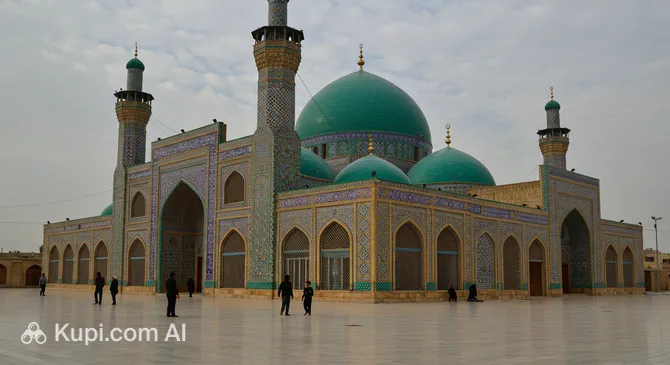
The majestic Umm al-Qura Mosque is one of the most unusual and recognizable architectural structures that modern Baghdad has to offer a traveler. Located in the heart of Iraq, this religious complex is striking in its scale and unique design, where Islamic traditions intertwine with the monumental style of the late 20th century.
Umm al-Qura Mosque. Illustration.
Source: Kupi.com AI
Traveler photos:
The main feature of the complex lies in its symbolism. White limestone and azure mosaics create a solemn appearance, while the mosque's eight minarets have a specific shape inspired by modern weaponry, making the site unique on a global scale. The name "Umm al-Qura" translates as "Mother of All Cities," emphasizing the status and significance of this place.
The area around the building is beautifully landscaped: there is a large pool whose outlines mirror the map of the Arab world. This place is not just a house of prayer, but a true architectural manifesto that draws attention with its geometry and attention to the smallest details of decorative design.
Contacts
To easily find this grand complex in the metropolis, it is worth saving the exact coordinates of the site in advance. The mosque is active, so it is easily found on city maps and in travel guides. Below is the official address information for your convenience.
Once on the grounds of the complex, be sure to take the time for a detailed inspection of the minarets. Four outer towers 43 meters high and four inner ones create a unique silhouette that looks especially impressive in the sunlight. This is an excellent location for photographs that capture the spirit of modern Middle Eastern architecture and its striving for monumentality.
A walk along the artificial lake with 28 fountains will allow you to appreciate the scale of engineering thought and the symbolism embedded in every element of the landscape. Visitors can study the mosaic patterns, calligraphy, and golden initials that adorn the walls of the building. The location is ideal for quiet relaxation and studying the cultural code of the region away from the busy shopping districts.
History buffs and lovers of rare artifacts will be interested to learn about the "Blood Quran" kept here, whose pages were created in a special way. Even if you limit yourself to an external tour, the scale of the complex itself and its well-kept gardens with decorative water features will leave a strong impression.
Getting There
The easiest way to reach the complex, located in the western part of the city, is by taxi. A trip from the city center usually takes 10 to 20 minutes, depending on traffic. Local drivers know the site well, so simply saying the name of the mosque is usually enough.
For those who prefer to navigate themselves, navigation apps accurately map the route to the address 639, Baghdad Governorate. If you are using a private car or rental vehicle, parking is available on the complex grounds. Public buses also run in this direction, but a taxi remains the most comfortable option for international guests.
Nearest city: Baghdad
History & Facts
Construction of this large-scale site began in 1998 and was fully completed by 2001. Approximately 7.5 million dollars was spent on the construction of the complex. Interestingly, the mosque originally bore the name "Umm al-Ma'arik", which translates as "Mother of All Battles," and only much later received its current name.
Every architectural detail is filled with numerical symbolism. For example, the 43-meter height of the four main minarets and the number of fountains in the pool (28) refer to significant dates and events in the life of the country's former leadership. Even the shape of the corner towers, which resemble ballistic missiles in their silhouette, was chosen as part of the monumental design of that era.
Despite its relatively young history, the Umm al-Qura Mosque quickly became an important spiritual center for the city's Sunni community. In the early 2000s, it was considered the largest place of worship in Baghdad, embodying the power and aesthetic ambitions of late 20th-century architecture in white stone.
Time Needed
When planning your visit, you should set aside approximately 1–2 hours to see the mosque. This is quite enough time to take a leisurely stroll through the vast grounds, study the unusual architectural features of the facades, and take memorable photos by the fountains.
If you plan to explore the interiors in detail or linger to contemplate the atmosphere, add another 30–40 minutes. Also, take travel time into account, as the site covers a significant area and requires some time to move between different parts of the complex.
Working Hours
The access schedule for the mosque has its own specifics: according to available data, it is open to visitors primarily on Fridays from 09:00 to 01:00. On other days of the week, the site may be closed to mass visits by tourists.
As this is an active religious institution, visitors are advised to check current information before traveling. Remember the need to maintain silence and follow the dress code, especially during prayer times.
Day
Working hours
Monday
Закрыто
Tuesday
Закрыто
Wednesday
Закрыто
Thursday
Закрыто
Friday
09:00–01:00
Saturday
Закрыто
Sunday
Закрыто
Nearby
After visiting the mosque, you can continue exploring the city by visiting interesting places nearby. The surrounding area offers several leisure and entertainment zones, which will particularly appeal to those traveling with family or wishing to see Baghdad's modern parks.
Exploring nearby attractions will help you change the scenery and feel the rhythm of life in the Iraqi metropolis more deeply. Below are the most notable sites within a radius of several kilometers: