Support

Dublin Castle

About

Dublin Castle is one of the key historical and architectural landmarks of Dublin, located in the heart of the capital of Ireland. For over 800 years, it served as the seat of British power and a royal residence; today, it is an important government complex and a popular tourist destination. The castle occupies a strategic position on a hill at the confluence of the River Liffey and the River Poddle, where an ancient Viking settlement that gave the city its name once stood.
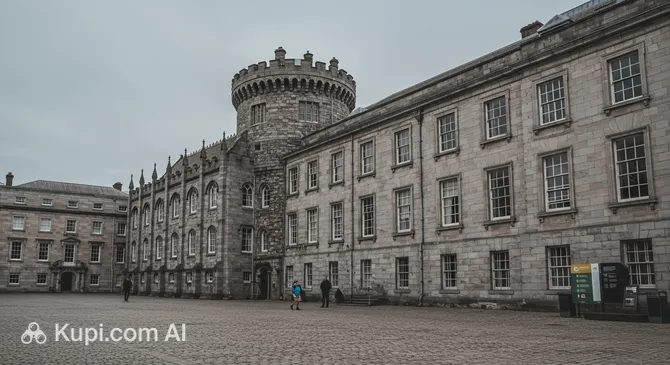
Dublin Castle. Illustration.
Source: Kupi.com AI

Traveler photos:

The architectural appearance of the castle is a fascinating blend of styles, reflecting its long and rich history. Originally built in the 13th century as a Norman fortress, it was almost completely rebuilt in the 18th century following a major fire. Only the mighty Record Tower has survived from the medieval building to the present day, while the other buildings surrounding the courtyards are primarily Georgian in style. This contrast allows visitors to literally trace the transition of eras in Irish architecture.

Today, Dublin Castle continues to play an important role in the life of the country. Its luxurious State Apartments host presidential inaugurations and official receptions. Visitors can explore not only the ceremonial halls but also the Chapel Royal with its magnificent stained glass and carvings, as well as the underground section featuring the remains of medieval fortifications and Viking-era walls. A visit to the castle is a unique opportunity to experience a living symbol of Irish history and statehood.

Contacts

To plan your visit to Dublin Castle, specifically to check current opening hours or tour booking conditions, it is recommended to use only verified sources. Since exact contact details may change, the most reliable and up-to-date information can be found on the official tourism portals of Dublin or Ireland. Additionally, local tour guides can often provide valuable insights and practical advice.

How to contactContact
AddressDame St, Dublin 2, Co. Dublin, Ireland
Phone number+353 46 942 2213
Websitedublincastle.ie

What to Do

A visit to Dublin Castle offers guests a unique opportunity to immerse themselves in the centuries-old history of Ireland. You can wander through its many halls, corridors, and courtyards, soaking in the atmosphere of the Middle Ages and later periods. Special attention should be paid to the luxurious State Apartments, where important state receptions are still held today, allowing you to feel a living connection across time. Don't miss the chance to see the surviving fragments of the ancient fortress walls and towers, which stand as silent witnesses to the castle's past.

For those who want to learn more than what meets the eye, guided tours are highly recommended. Experienced storytellers will share fascinating historical facts and legends associated with this iconic site, revealing the secrets of royal life and government administration from past centuries. This is an excellent way to gain a deeper understanding of the castle's significance for the capital and the entire country. You can also use a special mobile app with an audio guide for self-guided exploration.

Dublin Castle is not just a static historical monument but a living cultural space. Its grounds regularly host temporary exhibitions, chamber music concerts, and other cultural events. Before your visit, it's worth checking the schedule so you don't miss an interesting event that will make your visit even more fulfilling and memorable. With such a variety of activities, the castle attracts visitors of all ages and interests.

Getting There

Dublin Castle boasts a prime location in the heart of the capital, making it easily accessible for tourists. If you are staying in central Dublin, the best way to get there is a pleasant walk. This not only saves time but also allows you to soak in the atmosphere of the city's historic streets. Most hotels and other key attractions are within walking distance of the castle.

For those who prefer public transport, the journey is also straightforward. Numerous city bus routes pass near the castle, with the nearest stops on Dame Street and Lord Edward Street just a couple of minutes' walk away. Additionally, you can use the modern Luas tram system. The nearest stops for both lines, Green (St Stephen's Green) and Red (Jervis), are about a 10-15 minute walk from the castle entrance.

A taxi ride is a convenient alternative, especially if you value comfort or are traveling with light luggage. However, you might want to reconsider driving a rental car. As in any historic center, parking near Dublin Castle is extremely limited, so using public transport or a taxi is a more practical solution. It is also worth noting that special facilities are provided for visitors with disabilities to ensure comfortable access to the complex.

Nearest city: Dublin

History & Facts

The history of Dublin Castle is inextricably linked with the history of the city itself. Its construction began in 1204 by order of King John of England, shortly after the Norman invasion of Ireland. The site was not chosen by chance—the castle was built on high ground where a Viking fortress had previously stood, at the confluence of the River Liffey and the River Poddle. By 1230, the main work was completed, and the complex was a typical Norman citadel with thick walls, round corner towers, and a large central courtyard.

Originally, the castle served as a vital outpost of British power in Ireland and was a symbol of its rule for 700 years. Its location was strategically planned: the walls joined the city's defensive perimeter, and a natural water barrier—the River Poddle—was used to fill the moat, making the fortress even more impregnable. Over the centuries, the castle was rebuilt and expanded several times, gradually transforming from a purely military facility into an administrative and ceremonial center housing the courts and parliament.

This centuries-long transformation left its unique mark on the castle's architecture. After a major fire in the 17th century, most of the medieval structures were lost, leading to large-scale reconstruction in the 18th century. Today, only the mighty Record Tower remains from the original fortress, serving as a vivid reminder of its Norman past. The rest of the buildings, primarily constructed in the Georgian style, create a striking architectural contrast. Thus, a walk through the castle grounds allows you to literally travel through time, observing the changing eras of Irish history.

Time Needed

When planning a visit to Dublin Castle, you should allow between 1.5 and 3 hours. This time will be sufficient to fully explore the main highlights of the complex. If your time is limited, an hour and a half to two hours is enough to see the luxurious State Apartments, where presidential inaugurations still take place today, and walk through the courtyards to appreciate the unique blend of Georgian architecture and the surviving medieval Record Tower.

For a deeper and more leisurely immersion into the castle's history, it is better to set aside about 3 hours or even more. This will allow you not only to study the ceremonial halls in detail but also to visit the Chapel Royal with its magnificent stained glass windows, and descend into the dungeons, where remnants of Viking-era fortifications are on display. Additionally, consider time for visiting temporary exhibitions and events regularly held on the grounds. If you choose to join a guided tour, this may also increase the total duration of your visit but will provide plenty of fascinating details and stories.

Working Hours

Dublin Castle is open to visitors year-round, seven days a week, typically from 9:45 AM to 5:45 PM, with the last entry at 5:15 PM. However, it is important to remember that the castle is an active government complex, so access may be limited during official events. It is highly recommended to check the current schedule on the official website before your visit to avoid any inconvenience related to potential changes in opening hours.

Tickets for self-guided tours or guided tours can be purchased online in advance, which is especially convenient during the peak tourist season. A limited number of tickets are also available at the ticket office on the day of the visit. For groups of more than 10 people, advance booking is required. Guided tours allow for a deeper dive into the castle's history and provide access to parts of the complex that are not open for self-guided visits.

9:45 – 17:15

Nearby

A visit to Dublin Castle is just the starting point for exploring the rich history and culture of Dublin. Thanks to its central location, many other iconic sites are within a few minutes' walk, helping you form a more complete picture of the capital of Ireland. A stroll around the castle area will reveal world-famous cathedrals and museums, as well as cozy pubs that have become an integral part of city life.

Exploring nearby attractions will enrich your experience and allow you to immerse yourself in the atmosphere of the old city at your own pace, where every corner holds its own story. Below is a list of interesting places located in the immediate vicinity of the castle.

NameDistance
Smock Alley Theatre0.3 km
The Temple Bar Pub0.4 km
Marsh’s Library0.5 km
Whelan's0.7 km
Bow St. Distillery0.9 km
National Museum of Ireland – Archaeology0.9 km
Trinity College Dublin0.9 km

Have you reached the end of the page?

So the route has been studied inside and out